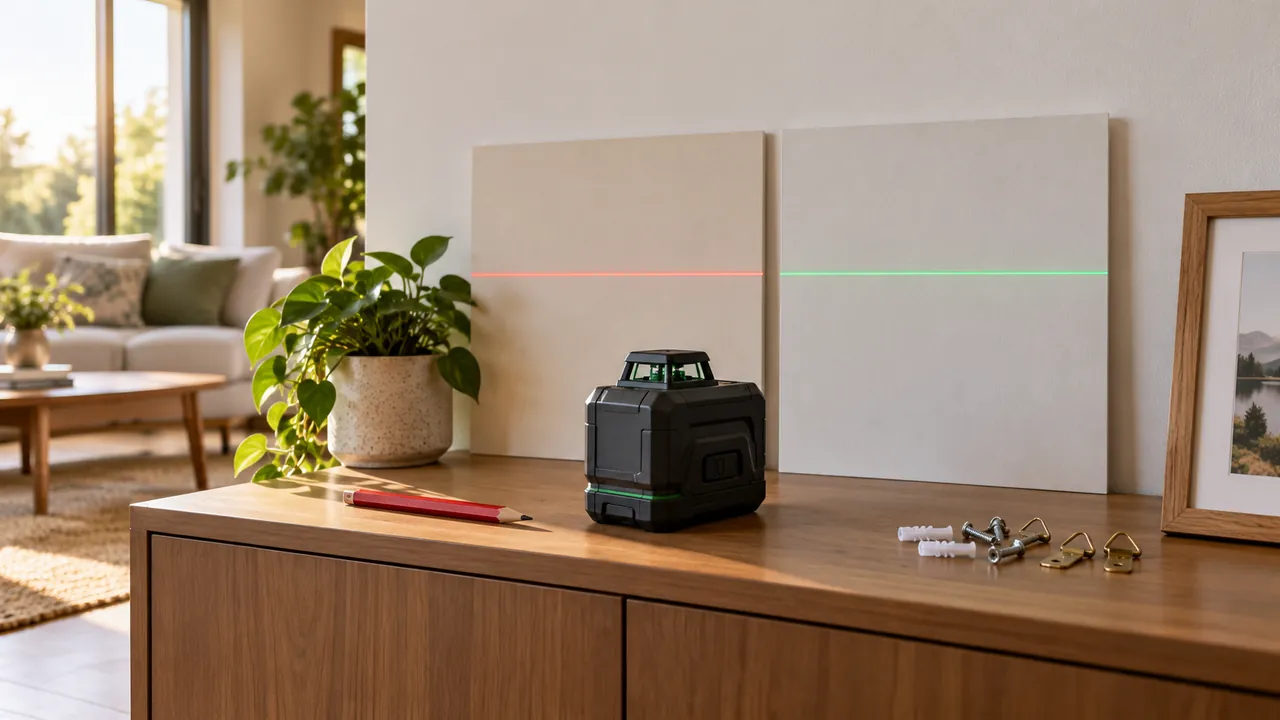
A laser line can be perfectly level and still be frustrating to find on a bright wall. That is the useful starting point for the DEWALT DW088K vs DW088CG decision. Both give you a horizontal and vertical reference, but the red DW088K suits straightforward indoor marking, while the green DW088CG makes more sense when visibility across the room is the sticking point.
The practical verdict: favor the DW088CG for brighter interiors or longer sightlines. The DW088K remains a sensible match for shorter, controlled-light jobs. Neither becomes a full-room 360-degree layout tool, and the green model does not automatically give you a tighter level reference.
Two familiar cross-line lasers, two visibility priorities
DEWALT DW088K: a simple indoor reference

For a shelf above a workbench or a small gallery wall, the DW088K covers the essential job: establish a line you can mark against without repeatedly balancing a bubble level. Its red beam, AA power, and integrated magnetic bracket keep the setup familiar. It is especially appealing if you work within one section of a room and can control the light reaching the wall.
To buy this product, click here.
DEWALT DW088CG: the green option for harder-to-see layouts

The DW088CG keeps the cross-line approach but changes the beam color and rated reach. That is useful when a cabinet run stretches toward a window or your reference needs to remain readable across a larger interior. Buy it for that visibility advantage, rather than expecting a different class of accuracy or a line that wraps around every wall.
To buy this product, click here.
DEWALT DW088K vs DW088CG: The Differences That Matter
| Decision factor | DW088K | DW088CG | What it changes |
|---|---|---|---|
| Beam color | Red | Green | Readability on the working surface |
| Visible working range, manual rating | 50 ft | 100 ft | How far you can plan a visible reference |
| Level accuracy | ±1/8 in. at 30 ft | ±1/8 in. at 30 ft | No tighter quoted tolerance for green |
| Projection | Horizontal and vertical cross lines | Horizontal and vertical cross lines | Neither is a 360° room layout |
| Power | 3 AA alkaline batteries | 3 AA alkaline batteries | Carry matching fresh spares |
| Specified optional detector | DW0892 | DW0892G | Accessory selection is model-specific |
| Protection rating | IP54 | IP54 | Neither rating means waterproof immersion |
The standout distinction is how readily you can use the reference at the working surface. The shared DEWALT instruction manual lists the same level accuracy for these models. Its separate range and detector entries explain why the DW088CG can be easier to place in a demanding room without making it a more precise instrument by default.
Visibility matters most at the mark, not beside the laser
Picture a row of upper cabinets on a wall that gets strong afternoon light. You can see the reference near the tool, yet the far end fades just where you need to mark the last fixing. The useful question is whether you can locate the center of that line consistently at every mark. A green reference can be the more comfortable option in this situation, particularly when moving the laser closer would interrupt the layout.
Now move to a shaded hallway with a few picture hooks. There is much less distance to cover, and you can work from nearby marks. The DW088K has a clear role here. Choosing it does not mean accepting crooked shelves; it means selecting the simpler visibility arrangement for conditions that do not ask more of it.
Surface finish also changes the experience. A glossy tile can produce a reflection that looks like a second line, while a strongly patterned wall can make any reference harder to read. Before treating either model as the answer to a difficult surface, check the projection from the actual marking position. Repositioning the tool or shading the target may help more than changing color.
Equal accuracy still leaves room for a better layout
For both models, the published level tolerance is ±1/8 inch at 30 feet. That is an instrument specification, not a promise that every hole will land within that distance of your intended position. A thick pencil mark, a rocking support, or a bracket that shifts while you tighten a fastener adds its own error to the process.
For cabinet installation, establish the datum first and measure the required offset from it. Do not assume the visible beam must sit exactly on the cabinet top or the screw-hole height. Keeping the reference away from obstructions often makes it easier to preserve. A quick check against a previously marked point after moving the setup can also catch a changed position before it travels down the whole run.
This is where the DW088CG can offer a practical benefit without changing the tolerance figure. An easier-to-locate line can help you mark more consistently. It cannot correct a poor datum or compensate for movement after you have begun. Our guide to using a laser level on a wall explains how to separate the level reference from the hardware positions you actually need.
A detector extends the system, but it must match the laser
Both lasers can work with the appropriate optional detector. The manual pairs the red model with DW0892 and the green model with DW0892G. Check that exact compatibility rather than buying any accessory described as a DEWALT receiver. Beam color and the receiver’s supported signal matter more than a similar-looking case.
For an occasional outdoor reference, a detector changes how you find the beam: you read the receiver at the target instead of relying on a visible stripe. It does not turn a cross-line tool into a rotary construction laser. If the job is repeated elevation checking over an open site, think through the receiver, rod, support, and setup pattern before deciding that either of these compact lasers is the right system.
Also keep the two range figures separate. The manual gives visible working ranges of 50 feet for DW088K and 100 feet for DW088CG, with different extended detector ranges. Those figures describe specified operating arrangements, not guaranteed visibility in direct sun. An outdoor purchase should be based on a compatible receiver and the task, rather than the largest distance printed in a listing.
AA power and mounting: small details that decide how smoothly work goes
Both models use three AA alkaline batteries. That makes carrying a fresh matched set straightforward, especially for a tool that spends time between projects. Replace the set together, and remove batteries for long storage according to the instructions. Neither model should be chosen on the assumption that it shares a rechargeable DEWALT power-tool battery platform.
The integrated magnetic bracket is handy around suitable steel, but it does not remove the need for a stable support at the right height. A bracket attached to a moving door frame will move the reference with it. When there is no dependable magnetic surface near the mark, a compatible tripod is the more useful addition. The support should solve the room’s geometry, rather than forcing you to project through a cabinet, radiator, or other obstruction.
Neither cross-line pattern provides a continuous horizontal reference behind the tool. For marks on several walls, repositioning is part of the workflow, which means protecting and recovering the same datum. If that is how you work most days, a different layout pattern may be more important than the red-versus-green decision. The broader DEWALT laser-level selection guide helps place these two alongside tools for other layout requirements.
Which one fits the work in front of you?
| Your situation | Better fit | Reason or limit |
|---|---|---|
| Picture hooks on a shaded interior wall | DW088K | Short, easy-to-read references suit its role |
| Longer sightline across a bright interior | DW088CG | Green visibility is the meaningful advantage |
| Cabinet work with a controlled datum | Either | Visibility and setup decide; quoted accuracy is equal |
| Work requiring an optional receiver | Model plus its specified detector | Check the exact signal and color compatibility |
| Continuous reference around several walls | Neither is the ideal pattern | Consider a 360° layout tool |
| Frequent elevation transfer over open ground | Assess a rotary system | The full receiver-and-rod workflow matters |
Notice that neither option wins every row. The strongest reason to move toward the green model is a real visibility constraint. When the constraint is full-room coverage or site-wide elevation transfer, choosing another beam color does not address the underlying problem.
Questions worth settling before you order
Is DW088CG more accurate because it is green?
No. The shared manual gives the same level-accuracy rating. The useful distinction is the visibility and working-range arrangement, not a tighter quoted tolerance.
Can DW088K and DW088CG use the same detector?
Do not assume so. Use the detector specified for the exact model and beam color. Confirm the model number on both the laser and accessory before assembling an outdoor setup.
Will either laser project around an entire room?
They are cross-line lasers, not three-plane 360-degree tools. If several walls need a continuous reference from one position, reconsider the projection pattern before deciding between them.
The better choice depends on the wall you need to mark
DW088CG is the stronger fit when a fading reference is the problem. In a bright room or across a longer cabinet run, the green beam and its rated reach give you a clearer reason to select it. Keep the remaining setup equally deliberate: a firm bracket, a consistent datum, and the correct detector if the task requires one. That combination matters more than treating green light as a shortcut to accuracy.
To buy this product, click here.
DW088K fits shorter indoor jobs where the red reference stays easy to read. For shelves, pictures, and localized marking in controlled light, its appeal is uncomplicated operation with familiar batteries. It covers that role without pretending to be an all-room layout system. If your actual projects stay in that lane, the red model remains a purposeful choice.
To buy this product, click here.
