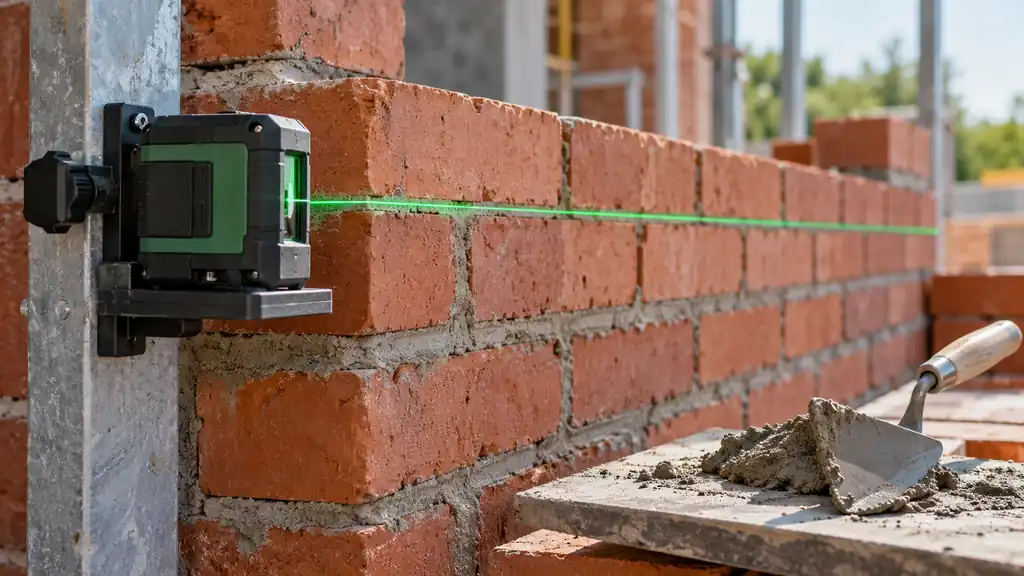
A course line, a planned opening, and a base elevation are related marks, but they are not the same reference. Masonry work can need outdoor receiver readings in one stage and clear local lines in another. Choosing the laser starts with identifying which of those jobs it must perform. The best laser level for masonry should suit the course, plumb, or elevation reference you are transferring, with a setup that stays readable and stable.
Rotary systems suit elevation transfer across a bright site. Plane and cross-line instruments can help with visible references on appropriate surfaces, subject to lighting and compatibility. The actual masonry system and project determine course dimensions, structural details, and accepted tolerances.
These nine options cover those different measuring roles. Choose around the target surfaces, distance, support, and intended reading method. A useful setup makes the planned reference repeatable without asking the instrument to decide the construction details.
Quick Answer
- Best Overall: Bosch GRL900-20HVK Kit. Horizontal and vertical rotary operation.
- Best Focused Outdoor Elevation Tool: Topcon RL-H5A Receiver Kit. Horizontal rotary reference.
- Best Numeric Receiver Feedback: Spectra Precision LL300N with HL450. Horizontal rotary reference.
Comparison Table
| Product | Best fit | Reference layout | Power and positioning |
|---|---|---|---|
| Bosch GRL900-20HVK Kit | Best Overall | Horizontal and vertical rotary operation | Selected alkaline-battery kit; LR10 receiver, BT160 tripod and grade rod |
| Topcon RL-H5A Receiver Kit | Best Focused Outdoor Elevation Tool | Horizontal rotary reference | Specified D-cell or rechargeable configuration; Receiver holder; tripod separate |
| Spectra Precision LL300N with HL450 | Best Numeric Receiver Feedback | Horizontal rotary reference | Four D-cell batteries; HL450 receiver and clamp; tripod separate |
| DEWALT DW089LG | Best Connected Green Interior References | Three green 360° planes | DEWALT 12V MAX battery platform; Magnetic bracket and ceiling bracket |
| Bosch GLL3-330CG | Best Controlled Multi-Plane Positioning | Three green 360° planes | Bosch 12V Max or AA adapter; BM1 positioning device |
| DEWALT DW089K | Best Fine Local Right-Angle Lines | Three red lines for 90° layout | Four AA batteries; Magnetic pivot bracket; ceiling mount |
| Bosch GLL3-300 | Best AA-Powered Three-Plane Alternative | Three red 360° planes | Four AA batteries; BM1 positioning device |
| Klein Tools 93PLL | Best Rechargeable Klein Plane Setup | Three green 360° planes | Integrated rechargeable battery; Magnetic bracket; hard case |
| Huepar B03CG Pro | Best Removable-Battery Plane Alternative | Three green 360° planes | Removable rechargeable battery; Magnetic pivoting base |
1. Bosch GRL900-20HVK Kit (Best Overall)

Outdoor height transfer and other defined rotary tasks can justify a complete field system. The GRL900-20HVK supplies the receiver, tripod, and rod with its transmitter. That makes it a useful starting arrangement for a masonry project involving more than one measuring role.
The selected kit includes an LR10 receiver, tripod, grade rod, remote, wall mount, and case. Horizontal and vertical operation supports elevation transfer and interior alignment. Electronic leveling and a disturbance monitor help identify a changed setup; the linked package lists D-cell power for the transmitter. The horizontal datum can relate planned base or course-control marks to a benchmark. The actual course progression still comes from the masonry layout, not from the instrument’s self-leveling function. Keep the component offsets clear and recheck the benchmark after a disturbance before accepting another group of readings.
Pros
- Horizontal and vertical operation.
- Electronic leveling.
- Disturbance monitor.
- Receiver, tripod, and rod included.
- Remote and wall mount supplied.
Cons
- Larger package than a compact wall laser.
- Do not assume numeric slope entry.
The GRL900-20HVK is well matched to masonry work involving receiver-based height transfer as well as other defined rotary layout tasks. Its complete field accessories are especially useful to a buyer starting without a matched reading arrangement. A focused horizontal tool can be sufficient if the other roles will never be used. For the mixed project, the Bosch gives the purchase a coherent purpose, with the planned course or base offsets linking each measurement to the construction layout instead of to the beam’s convenient position.
To buy this product, click here.
2. Topcon RL-H5A Receiver Kit (Best Focused Outdoor Elevation Tool)

A recurring horizontal elevation task can favor a focused instrument over a broader collection of modes. The RL-H5A supplies a rotary reference and receiver for that work. It is useful when several planned base or course-control stations need to remain tied to one datum.
Topcon specifies an 800-meter working diameter and ±10 arc-second horizontal accuracy for the RL-H5A. Electronic horizontal self-leveling and IP66 protection suit outdoor elevation work with a receiver. The selected listing identifies an LS-80L receiver and holder; verify the exact battery and support-equipment bundle. A course-control mark can relate to the horizontal plane through a measured offset. It does not need to be placed wherever the instrument happens to project. Record the intended relationship and keep the rod method consistent. The selected package supplies the receiver but leaves the tripod and rod to be arranged.
Pros
- Horizontal rotary reference for elevation checks.
- Receiver and holder identified in the selected kit.
- Electronic self-leveling.
- Documented IP66 protection.
- Manual slope capability described by the manufacturer.
Cons
- Not a three-plane interior wall-layout tool.
- Tripod, rod, and exact battery bundle need separate confirmation.
The RL-H5A is the focused choice when outdoor elevation transfer is the recurring masonry task. Its receiver package supports repeated readings from one horizontal datum, while a separate tripod and rod can be chosen around the actual site. A visible local line or an opening-related right angle may call for another tool in this selection. For the height-transfer role, the Topcon is appealing because the reference method stays clear: preserve the benchmark and apply the planned component offsets consistently at every station.
To buy this product, click here.
3. Spectra Precision LL300N with HL450 (Best Numeric Receiver Feedback)

A numerical receiver offset can help organize repeated readings at defined construction stations. The LL300N with HL450 provides that feedback alongside a protected rotary instrument. Its purpose is measured height comparison, with the intended component identified separately in the station records.
The LL300N combines automatic horizontal leveling with a protective rotor housing and IP66 enclosure. The selected alkaline package includes an HL450 receiver and clamp but does not include a tripod. Its single-axis slope workflow requires the optional RC601 remote, with leveling retained on the other axis. The receiver’s number is not the absolute elevation of the masonry component. Connect it to the rod reading and the intended offset. A clear record matters when several courses or sections use different planned heights. The optional slope workflow is a separate method requiring the specified remote, not a function supplied by the receiver display.
Pros
- Automatic horizontal leveling.
- IP66 enclosure.
- Protective rotor housing.
- HL450 receiver included.
- Optional single-axis slope workflow.
Cons
- Tripod and rod are separate in this package.
- RC601 remote is separate.
The LL300N with HL450 suits someone who wants numeric offset information during repeated base or course-control checks. The reading becomes useful through the defined station and rod method, rather than by representing an absolute construction height on its own. Complete packages are worth comparing when field supports are also missing. With those supports available, the Spectra makes a convincing focused system for a deliberate sequence of measurements, keeping the later stages connected to the original reference as the wall grows.
To buy this product, click here.
4. DEWALT DW089LG (Best Connected Green Interior References)

Connected interior surfaces give complete green planes a useful masonry-related role. The DW089LG can relate a shared height and vertical directions from one position. That is a different task from reading outdoor elevations on a rod, so the actual targets and lighting should decide the comparison.
The DW089LG projects three 360° green planes and uses the specified 12V MAX battery platform. The documented kit includes a battery, charger, extended ceiling bracket, target card, and carrying case. Full-time pulse operation supports a compatible detector, supplied separately, while the housing carries an IP65 rating. Choose the method around the actual light and target material. Green projection does not guarantee sunlight visibility, and a rough or interrupted surface can hide the intended line. The selected mounting and battery package helps assemble the instrument, while the baseline and construction dimensions remain independently established.
Pros
- Three full green reference planes.
- Uses the specified removable 12V MAX battery.
- Battery and charger included in the listed kit.
- Extended ceiling bracket and case supplied.
- Documented detector mode and IP65 housing.
Cons
- Detector and full-height tripod are separate.
- Battery compatibility is limited to the documented platform.
The DW089LG has a useful masonry-related role where connected visible references fit the actual surfaces and lighting. Its planes can relate several marks without repeatedly aiming a short cross, but exposed field elevations may be more naturally handled by a rotary receiver system. A buyer who needs the multi-surface line geometry has a clearer reason to choose the DEWALT. The selected rechargeable package supports that arrangement, while the separate compatible detector decision remains tied to conditions in which the visible projection is insufficient.
To buy this product, click here.
5. Bosch GLL3-330CG (Best Controlled Multi-Plane Positioning)

A small reference-height correction can matter as much as the number of projected directions. The GLL3-330CG pairs its planes with BM1 positioning and connected controls. It suits a layout where the instrument stays on an established datum while related surfaces are marked.
Three green planes can be controlled through Bosch’s connected operating system. The listed package supports its Bosch 12V Max battery or four AA batteries with the required adapter. The specified LR8 receiver extends the operating range to 330 feet in diameter, not radius, and is separate from the base kit. The LR8 is a separate supported detector route, and its quoted extended coverage uses a diameter convention. Consider the building’s actual sightlines before choosing the instrument position. A plane cannot carry through a wall or stored materials simply because its nominal range is long.
Pros
- Three-plane green layout.
- Connected operating controls.
- Documented 12V and AA-adapter power options.
- BM1 positioning device included.
- Supported LR8 receiver operation.
Cons
- LR8 receiver is separate.
- Connected functions add setup beyond basic wall alignment.
The GLL3-330CG is most appealing for a connected line layout that also benefits from careful mounting adjustment. The BM1 can help put the reference at the chosen datum, and the controls can keep useful planes active from another position. Those features do not make the beam pass through a wall or stored blocks. For a buyer who has planned the surfaces and detector path, the Bosch offers a coordinated line-system approach, with preserved marks allowing the layout to survive the next move or obstruction.
To buy this product, click here.
6. DEWALT DW089K (Best Fine Local Right-Angle Lines)

A defined opening or local right angle can reward controlled aiming. The DW089K supplies three local lines and a micro-adjustment knob for that task. Its usefulness is the small orientation correction, rather than the complete coverage of a three-plane instrument.
Three red line references support 90-degree layout rather than three continuous planes. A micro-adjustment knob helps position the intersecting references; DEWALT specifies ±1/8 inch at 30 feet for level applications. The kit includes a ceiling mount, box, and four AA batteries; receiver operation uses the separately supplied compatible DW0892. The tool does not replace the masonry system’s dimensional checks or create a complete three-plane arrangement. Map where each local line must land and check visibility at the working surface. Its AA supply makes preparation straightforward, while a stable magnetic or alternative support keeps the aiming adjustment meaningful.
Pros
- Three lines support 90-degree layout.
- Micro-adjustment control.
- Magnetic pivot bracket.
- Four-AA supply.
- Documented DW0892 detector compatibility.
Cons
- Detector is supplied separately.
- Not a three-plane 360° system.
The DW089K deserves consideration when the important masonry-related task is a local right-angle reference that needs a small orientation correction. Its micro-control addresses that problem directly without pretending to provide complete planes or field rod readings. The rotary kits are stronger comparisons for exposed height transfer. For a buyer repeatedly working beside a defined opening or local baseline, the DEWALT offers a purposeful line arrangement, with the actual construction dimensions checked independently before the optical reference becomes a permanent mark.
To buy this product, click here.
7. Bosch GLL3-300 (Best AA-Powered Three-Plane Alternative)

Complete planes do not require rechargeable platform power to be useful. The GLL3-300 supplies red connected references with AA operation and the BM1. It is relevant where the beam remains readable at the actual surfaces and controlled positioning fits the marking method.
The GLL3-300 projects three red planes and uses four AA batteries. Its package includes the BM1 positioning device, target, pouch, and hard case. Bosch documents receiver-assisted operation with the appropriate LR8 and a 300-foot diameter range; this is different from the green connected GLL3-330CG. Check the line on the actual target rather than choosing solely by beam color. For supported detector work, the LR8 is separate. The baseline should be preserved before the instrument moves, and the course or opening dimensions must remain tied to the project rather than inferred from the visible intersections.
Pros
- Three full reference planes.
- Standard AA battery supply.
- BM1 positioning device.
- Target and hard case included.
- Documented LR8 receiver support.
Cons
- Compatible receiver must be supplied separately.
- Red visible lines do not guarantee outdoor daylight readability.
The GLL3-300 suits connected layout in suitable light, with AA power and the BM1 offering practical differences from rechargeable plane kits. Its red reference must be readable at the relevant surfaces, and the optional LR8 serves the supported detection role separately. A local task may need less geometry. For a buyer who will use the complete planes across the working area, the Bosch provides a coherent arrangement, with the plan’s component offsets controlling the marks rather than whichever intersection happens to be easiest to see.
To buy this product, click here.
8. Klein Tools 93PLL (Best Rechargeable Klein Plane Setup)

A rechargeable Klein setup can keep related visible references connected across an interior. The 93PLL provides complete planes for those marks. Its role is useful where line coverage suits the task and a stable mounting position leaves the required target surfaces accessible.
The X, Y, and Z planes can project independently or together. Intersecting vertical planes provide plumb reference locations rather than separate point emitters. The current product page lists a rechargeable power arrangement, magnetic bracket, USB charging cable, and hard case. The magnetic mount needs a secure suitable support, with another arrangement needed beside timber or masonry surfaces alone. Keep the tool outside the path of moving material and preserve control marks before the beam becomes obscured. The plane count does not establish the accepted construction tolerance or make an existing surface square.
Pros
- Three continuous green planes.
- Independent or combined plane operation.
- Plumb reference at vertical-plane intersections.
- Integrated magnetic mount.
- Charging cable and hard case supplied.
Cons
- No conventional AA-battery fallback.
- Plane intersections are different from dedicated point emitters.
The 93PLL is a useful comparison for someone who wants connected visible lines in a rechargeable Klein setup. Its full planes can serve several related surfaces from one position, provided the mount and beam path suit the work. It should not be chosen as an assumed outdoor detector system or because masonry alone supplies magnetic support. For the defined interior line task, the Klein’s appeal is the coherent plane geometry, with a separate stable support and preserved references allowing that coverage to remain useful through the layout.
To buy this product, click here.
9. Huepar B03CG Pro (Best Removable-Battery Plane Alternative)

A removable battery can support a longer session of planned multi-surface line layout. The B03CG Pro combines that routine with selectable green planes. It is useful when connected height and vertical references are needed together, with unused directions switched off to keep the working guide clear.
One horizontal and two vertical planes can be selected in different combinations. The listed package contains a removable 5,200mAh battery, USB-C charging equipment, magnetic base, target, and hard case. Receiver operation requires an appropriate Huepar receiver, which is separate from this kit. The magnetic base and a compatible separate receiver serve different support and reading roles. Neither should be assumed to solve every exterior condition. Establish the intended datum, check the actual target path, and reconnect the reference after moving the instrument rather than treating automatic leveling as memory of the previous position.
Pros
- Three full planes cover adjoining surfaces.
- Selectable beam combinations avoid unnecessary lines.
- Removable rechargeable battery supports repeated indoor projects.
- Magnetic base provides positioning on suitable steel.
- Hard case and charging equipment are included.
Cons
- Full-height positioning tripod is not included.
- Outdoor receiver must be supplied separately.
The B03CG Pro is attractive when a connected line layout and removable rechargeable supply fit the buyer’s working routine. Its three planes provide more scope than a short local cross, with unused directions selectable off. A purely outdoor elevation job points more naturally toward the receiver-based rotary systems here. For visible or correctly detected line references at planned surfaces, the Huepar has a clear role, with the physical support and original datum established before its extra geometry is treated as a benefit.
To buy this product, click here.
Choosing the Best Laser Level for Masonry
Identify the Masonry Measuring Task
Base elevation, course control, opening layout, and vertical reference transfer need different geometry. Choose the instrument according to the actual mark rather than treating every masonry job as one laser application. The method for transferring the site reference to masonry checks is useful when courses or openings must relate to an established site elevation.
Choose Visible Lines or Receiver Readings
Indoor surfaces may allow a clear line reference. Bright exposed areas often favor a compatible rotary receiver system. Beam color alone does not establish useful outdoor readability. The distinction involved in choosing between local lines and a rotary reference helps match the system to the particular masonry marking task.
Apply Course and Component Offsets
A common datum does not automatically coincide with every course edge or finished top. Transfer the correct dimensions from the project and keep each control mark labeled.
Preserve Clear Sightlines
The growing wall, stored blocks, and working platforms can interrupt projection. Establish reference marks early and reconnect a moved setup deliberately.
Keep Design and Tolerance Decisions Separate
The laser transfers chosen references. It does not specify structural details, material relationships, or acceptable construction variation. Use the relevant system and project information for those decisions.
FAQ
Is a Rotary Laser Useful for Masonry?
Yes, especially for receiver-based elevation transfer in bright conditions. The exact task and reading method should determine the choice.
Do Green Planes Replace an Outdoor Receiver?
Not automatically. Visibility depends on conditions, while detector support must be documented for the exact transmitter.
Can the Laser Set Every Course Dimension?
No. It provides a datum. Course progression and component offsets come from the masonry layout.
Is the DW089K a Complete Three-Plane Tool?
No. It provides three local lines, which serve a different coverage role from full planes.
What If Construction Blocks the Beam?
Use preserved control marks to reconnect another setup. Verify the datum rather than assuming the previous reference height remains.
Final Verdict
The GRL900-20HVK is our overall choice for complete field equipment and several defined rotary roles. The Topcon RL-H5A is more focused when outdoor height transfer is the recurring task, while the LL300N adds useful numerical offset information. These receiver-based systems should be compared with the intended station readings in mind, rather than ranked against visible wall lines as though they do the same job.
Connected plane and local-line tools serve the surfaces on which those references are readable and useful. Choose them for actual course-control, opening, or related layout marks, with the appropriate detection arrangement where required. Preserve control points before construction blocks the beam and apply the project’s component offsets consistently. That keeps the optical reference connected to the masonry layout instead of allowing its convenient position to determine the construction dimensions.
