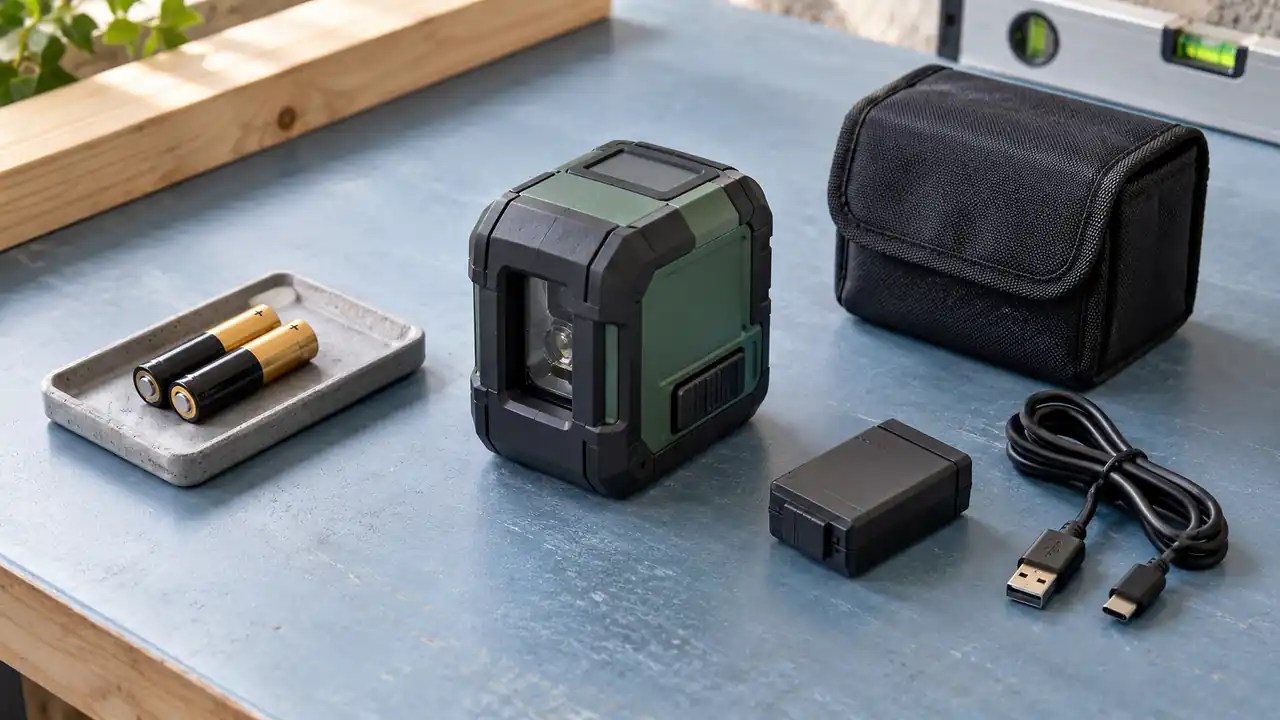
One extra letter can make two tool listings look like different performance classes. In the Bosch GLL50-20G vs GLL50-20GL comparison, the more useful distinction is what powers the laser when you open the pouch. The GLL50-20G package comes with AA batteries; the GLL50-20GL package includes a rechargeable lithium-ion battery and charging cord.
Start with your charging routine. The 20G is a straightforward match if you want AA power immediately or already own the specified compatible rechargeable battery. The 20GL is the more complete starting package for someone who wants rechargeable operation from day one. The L suffix is not a sound reason to expect more accurate lines or a more capable projection pattern.
Pick the package that matches how you keep tools ready
GLL50-20G: AA batteries included

The 20G makes sense for an occasional room project, a kit stored away between jobs, or an owner who already has the right Bosch rechargeable battery. You can start with the included AAs and keep another set in the tool bag. Its power flexibility also leaves a route to the specified lithium-ion battery without changing the basic job the laser does.
To buy this product, click here.
GLL50-20GL: rechargeable configuration included
The 20GL brings the compatible rechargeable battery into the package. That is appealing when the laser comes out repeatedly for shelves, cabinets, or interior reference work and you prefer adding it to a regular charging routine. AA compatibility still matters as a backup option, so the rechargeable package does not force every future job to depend on finding an outlet.
To buy this product, click here.
Bosch GLL50-20G vs GLL50-20GL at a Glance
| Factor | GLL50-20G | GLL50-20GL | Buying implication |
|---|---|---|---|
| Included power | 2 AA batteries | 3.7V 1.0 Ah Li-ion battery | Choose the setup you want immediately |
| Alternative supported power | Specified Bosch Li-ion battery | 2 AA batteries | Both support the other power approach |
| Published visible range | Up to 65 ft | Up to 65 ft | No rated reach upgrade from L |
| Published level accuracy | ±1/4 in. at 30 ft | ±1/4 in. at 30 ft | Match the tolerance to the project |
| Projection pattern | Green horizontal and vertical lines | Green horizontal and vertical lines | Neither becomes a 360° laser |
| Protection and mounting | IP55; 1/4-20 thread | IP55; 1/4-20 thread | Support requirements remain similar |
The Bosch GLL50-20G page and GLL50-20GL page list the same key optical ratings and power flexibility. The package difference is the important part of the comparison, rather than an invented contest over line precision.
Rechargeable or AA is a workflow decision
Imagine the laser lives in a closet until you hang a new set of shelves. With AA operation, a fresh pair can get the tool ready without waiting for a depleted rechargeable pack. That is a practical benefit if you are not in the habit of checking a battery before the weekend begins. Store batteries appropriately between uses rather than leaving a forgotten set inside indefinitely.
For repeated room work, the appeal changes. You finish a layout, put the rechargeable pack on your normal charging routine, and start the next job with a known preparation step. The 20GL packages that arrangement together. The benefit is readiness that matches your habits, not a claim that rechargeable power makes the projected line more level.
Already have a compatible pack? That shifts the choice again. The 20G can use the specified Bosch 3.7V lithium-ion battery even though it is not included. Check the actual battery model before treating it as interchangeable with another Bosch tool. Shared branding does not mean a 12V or 18V power-tool pack will fit this compact laser.
Neither configuration eliminates preparation. AA users need a matched fresh pair; rechargeable users need a charged pack and the correct charging equipment. Decide which small habit you are more likely to maintain. A theoretically convenient setup is of little use if it repeatedly reaches the wall with a flat battery.
Read the charging arrangement correctly
A USB-C cord in the GL package does not mean you can plug a cable into any part of the laser or recharge disposable AA cells. The charging connection belongs to the supported lithium-ion battery arrangement. Use the designated equipment and follow that battery’s charging instructions, especially if you intend to power the setup while charging.
This distinction becomes useful in a half-finished room. A cable may keep the supported rechargeable arrangement available, but it also introduces something to snag. Route it away from foot traffic and avoid pulling the instrument off its reference. A carefully positioned cable is an operating choice; it is not a substitute for a secure mount.
One more small check prevents an irritating surprise: a USB-C charging cord is not the same item as a wall adapter. Verify the package contents and have the required compatible supply ready. Package planning is where these two versions differ most, so it deserves a little more attention than the nearly identical names suggest.
The layout limitations do not disappear with the L suffix
Both are green cross-line lasers. They give you level and plumb references in front of the tool, rather than a continuous horizontal plane around a whole room. For one shelving wall, that can be exactly the coverage you need. For references running behind the laser or across several adjoining walls, repositioning remains part of the work.
Consider a kitchen with an L-shaped cabinet run. The question is not simply whether the battery lasts until lunch. You also need a method of preserving the datum as the working position changes. If the whole reason for buying a new laser is to avoid those moves, neither package suffix solves it. A 360-degree instrument may be the more relevant comparison.
The published accuracy also deserves context. Bosch lists ±1/4 inch at 30 feet for both green versions on its US pages. Before picking any compact laser for fine cabinetry or another tolerance-sensitive task, compare that rating with the required result at the actual distance. Do not let rechargeable convenience distract from whether the instrument meets the job’s needs.
Retail copy sometimes mixes model-family details, so confirm the full name on the selected listing. In particular, GLL50-20, GLL50-20G, and GLL50-20GL are not interchangeable search terms. A missing G can change which model you are reading about. The battery package is only one part of correct identification.
Look at the contents before deciding you need an upgrade
| Item | GLL50-20G package | GLL50-20GL package |
|---|---|---|
| Laser | GLL50-20G | GLL50-20GL |
| AA batteries | Included pair | Sold separately |
| Bosch rechargeable battery | Sold separately | Included 3.7V 1.0 Ah battery |
| USB-C charging cord | Not listed in this package | Included |
| Integrated magnetic mount | Included | Included |
| Soft pouch | Included | Included |
The two packages overlap on the parts that hold and protect the laser. Before ordering extra hardware, identify what the integrated mount can actually attach to in your room. A magnetic surface must be suitable and stable, while a tripod needs the right thread and useful height. A mount that is technically compatible but cannot reach your datum is still the wrong support for the task.
The rechargeable version does not create a detector-ready outdoor construction system merely by adding a lithium-ion battery. Neither should be selected for bright-sun grading on that basis. If outdoor detection is essential, verify explicit receiver compatibility for the instrument you intend to buy instead of assuming it from the green beam or brand.
Which configuration should you bring home?
| Situation | More suitable starting point | Why |
|---|---|---|
| Occasional indoor projects; fresh AAs kept ready | GLL50-20G | A familiar battery routine may be easiest |
| Frequent room layout with regular recharging | GLL50-20GL | The rechargeable configuration is included |
| Already own the specified compatible battery | GLL50-20G may fit | Check existing charging equipment first |
| Need tighter tolerance or full-room coverage | Reassess both | Battery packaging cannot change optical capability |
If neither package fits the task, revisit the instrument category before revisiting the battery. Our guide to choosing a laser level helps separate projection pattern, accuracy, mounting, and power. For other instruments within the brand, see the Bosch laser-level buying guide.
Two questions that often cause unnecessary confusion
Is the GLL50-20GL more accurate than the GLL50-20G?
The current Bosch US pages give matching key optical ratings. The GL package should be judged by its included rechargeable setup, not by an assumed precision upgrade.
Can the GLL50-20G become rechargeable later?
It supports the specified Bosch 3.7V lithium-ion battery. Check the exact supported battery and charging arrangement before ordering, rather than trying to adapt an unrelated Bosch pack.
A useful choice without an imaginary performance winner
GLL50-20GL is the tidy choice if you want to begin with the rechargeable arrangement. It makes the most sense when you will use the laser regularly and charging is already part of your tool routine. You still need to confirm that a cross-line pattern and the published tolerance meet the project, but you do not need to assemble the basic rechargeable configuration separately.
To buy this product, click here.
GLL50-20G is purposeful for AA-first use or an existing compatible battery setup. It provides the same published optical capability without making the included rechargeable battery the deciding feature. If you already know how you will keep it powered, there is little reason to let the extra L turn a clear package decision into a fictional upgrade.
To buy this product, click here.
