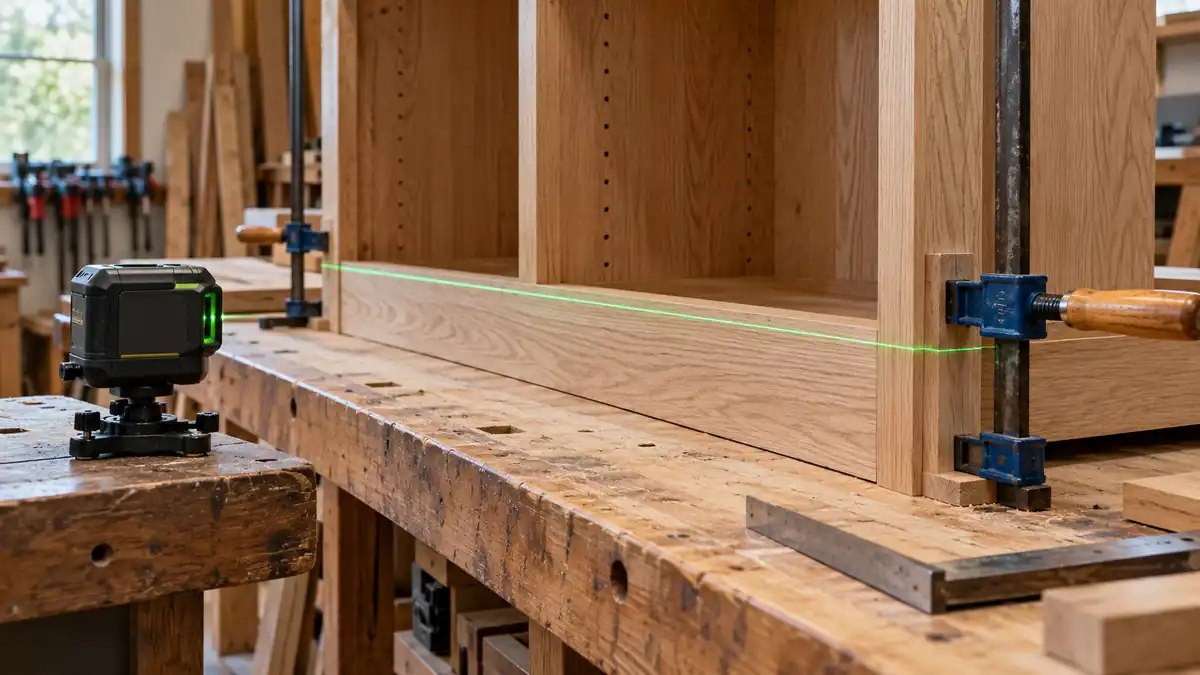
A long bench, a wall of shop cabinets, or a built-in installation asks different questions from a small joint at the bench. A laser becomes useful when the woodworking project needs references carried across space. It is not a replacement for the direct-contact tools used to fit a joint or set a machine. The best laser level for woodworking is the one whose reference and stated tolerance fit the installation, not a replacement for checking the wood itself.
For this selection, the focus is large-layout and installation work: common cabinet heights, related wall references, workshop positioning, and discrete square or plumb points. The useful tool depends on which of those marks the project actually needs.
These nine options range from focused crosses to complete planes and specialist point or surface-layout tools. Choose around the scale of the work and the available support. A readable reference at the relevant surfaces matters more than adding optical modes to a task they cannot improve.
Quick Answer
- Best Overall: DEWALT DW088CG. Green horizontal and vertical cross lines.
- Best Compact Power-Flexible Cross: Bosch GLL50-20G. Green horizontal and vertical lines.
- Best Red Cross for Indoor Layout: Bosch GLL55. Red horizontal and vertical cross lines.
Comparison Table
| Product | Best fit | Reference layout | Power and positioning |
|---|---|---|---|
| DEWALT DW088CG | Best Overall | Green horizontal and vertical cross lines | Three AA batteries; Integrated magnetic bracket |
| Bosch GLL50-20G | Best Compact Power-Flexible Cross | Green horizontal and vertical lines | AA or specified Bosch Li-ion pack; Integrated magnetic mount |
| Bosch GLL55 | Best Red Cross for Indoor Layout | Red horizontal and vertical cross lines | AA battery supply; Magnetic L-mount |
| Huepar B03CG Pro | Best Connected Green Layout | Three green 360° planes | Removable rechargeable battery; Magnetic pivoting base |
| Bosch GLL3-300 | Best AA-Powered Three-Plane Setup | Three red 360° planes | Four AA batteries; BM1 positioning device |
| DEWALT DW089K | Best Fine Local Right-Angle Positioning | Three red lines for 90° layout | Four AA batteries; Magnetic pivot bracket; ceiling mount |
| Bosch GPL100-50G | Best Discrete Point Layout | Five green points | Two AA batteries; Integrated magnetic rotating mount; 1/4-20 |
| Bosch GTL3 | Best Workshop Floor Layout Specialist | 0°, 90°, and optional 45° surface layout | AA batteries; Steel positioning plate |
| SKIL LL932201 | Best Included Horizontal-Plane Kit | Red 360° horizontal plus vertical line | Integrated rechargeable battery; Included adjustable tripod |
1. DEWALT DW088CG (Best Overall)

Cabinet installation asks a laser to carry references through the room rather than measure a small joint. The DW088CG provides a local green cross for that installation role. Its AA supply and magnetic bracket suit a focused tool used alongside direct measuring and marking equipment.
The DW088CG provides a green cross-line configuration with a magnetic mounting bracket. DEWALT’s operating instructions list ±1/8 inch at 30 feet for the line reference. Detector-assisted use requires the compatible green-line detector; it is not included in the basic laser kit. Its role is carrying a reference across the installation, not measuring a small joint gap or calibrating a machine fence. Position the bracket where the workpiece and your hands do not block the line. The actual dimensions still come from the drawing and direct measurement, while the cross helps relate them to the room.
Pros
- Green wall-layout references.
- Documented line accuracy at a stated distance.
- AA battery power.
- Integrated magnetic bracket.
- Supports specified green-line detector operation.
Cons
- Compatible detector is separate.
- No continuous horizontal plane around the room.
The DW088CG makes sense for woodworking that becomes installation: shop cabinets, a wall rack, or a built-in section needing a local room reference. It can complement direct measuring tools without pretending to take over their bench work. The plane models become more useful when several surfaces need connected marks. For a buyer whose installation tasks mostly fit within a readable cross, the DEWALT keeps the optical setup focused, leaving joint fit, dimensions, and machine settings to the tools intended for those checks.
To buy this product, click here.
2. Bosch GLL50-20G (Best Compact Power-Flexible Cross)

A shop rack or short built-in can need a local cross without requiring full-room projection. The GLL50-20G supplies compact green references with AA and specified optional rechargeable power. That arrangement can fit around existing equipment while dimensions are transferred to nearby installation marks.
The Smart Pendulum System self-levels, indicates excessive tilt, and locks for transport. The package includes two AA batteries and a soft pouch; the compatible Bosch 3.7V rechargeable pack is separate. The compact cross-line configuration prioritizes a wall reference over continuous room coverage. The benefit is a stable visual datum while dimensions are transferred to the work. It does not establish that a board is flat or a machine is correctly adjusted. Check the line on the actual surface and keep the support outside the path of moving stock so the reference survives the marking sequence.
Pros
- Horizontal and vertical green reference lines.
- Included AA batteries avoid an initial charger requirement.
- Supports Bosch’s specified rechargeable pack.
- Integrated magnetic positioning mount.
- Pendulum lock and out-of-level warning.
Cons
- No continuous 360° horizontal plane.
- Manufacturer and retailer accuracy figures differ; check the exact unit.
The GLL50-20G suits a workshop where a compact reference tool is used alongside squares, rules, and templates rather than instead of them. AA operation is useful for an occasional installation session, with the specified rechargeable option available for another routine. A larger built-in around several walls may justify the B03CG Pro. For nearby layout among existing equipment, the Bosch’s smaller arrangement is appealing when the support can keep the relevant line clear of moving stock and the work itself.
To buy this product, click here.
3. Bosch GLL55 (Best Red Cross for Indoor Layout)

A red cross remains a useful comparison when it is clearly readable in the workshop. The GLL55 supplies local references with AA power and an L-shaped mount. It suits wall-related layout in controlled indoor light without adding complete planes across a room full of equipment.
The GLL55 provides separately selectable horizontal, vertical, and combined cross-line modes. VisiMax manages line visibility under standard working conditions. The pendulum self-levels, warns when out of range, and locks when switched off for transport. Controlled lighting and a clear surface path matter more than the color comparison alone. Place the instrument where boards, clamps, and the workbench do not interrupt the useful part of the reference. For another surface beyond the local projection, preserve a control mark before changing the instrument’s position.
Pros
- Independent or combined reference lines.
- Pendulum self-leveling system.
- Out-of-level indication.
- Transport lock.
- Magnetic L-mount for suitable metal.
Cons
- Red projection is not a sunlight-visibility solution.
- No full horizontal plane for several walls.
The GLL55 remains relevant where the red reference is clear on the actual workshop or installation surface. That can leave mount placement and a readable local cross as more useful buying criteria than beam color alone. Connected cabinets around a corner give the full-plane tools another purpose. For local wall-related woodworking marks, the Bosch’s AA-powered arrangement provides a straightforward complement to direct measuring equipment, with control marks preserved before any change of position.
To buy this product, click here.
4. Huepar B03CG Pro (Best Connected Green Layout)

Cabinets continuing onto another wall give complete planes a more concrete purpose. The B03CG Pro can relate their common height and vertical directions from one stable setup. Its removable supply supports a broader installation routine than a small tool used only for occasional local marks.
One horizontal and two vertical planes can be selected in different combinations. The listed package contains a removable 5,200mAh battery, USB-C charging equipment, magnetic base, target, and hard case. Receiver operation requires an appropriate Huepar receiver, which is separate from this kit. Keep the optical geometry tied to the drawing. A clearly visible intersection does not verify that an existing room corner is square or that a cabinet dimension is correct. The removable battery and magnetic base support the operating routine, while a stable stand may still be needed among timber surfaces with no suitable steel.
Pros
- Three full planes cover adjoining surfaces.
- Selectable beam combinations avoid unnecessary lines.
- Removable rechargeable battery supports repeated indoor projects.
- Magnetic base provides positioning on suitable steel.
- Hard case and charging equipment are included.
Cons
- Full-height positioning tripod is not included.
- Outdoor receiver must be supplied separately.
The B03CG Pro is well matched to a larger installation whose dimensions must be related across the room. Its three planes can keep a common height and two vertical directions available without repeatedly turning a short cross. That is more capability than a small bench joint needs. For a buyer building cabinets or fixtures that must fit the surrounding space, the Huepar’s connected geometry has a concrete role, while the drawing and direct contact checks continue to govern the actual pieces.
To buy this product, click here.
5. Bosch GLL3-300 (Best AA-Powered Three-Plane Setup)

A larger installation can justify complete planes while retaining replaceable-cell preparation. The GLL3-300 combines that red geometry with the BM1 positioning device. Its fine height adjustment can be useful at a cabinet or bench datum where the final beam correction matters.
The GLL3-300 projects three red planes and uses four AA batteries. Its package includes the BM1 positioning device, target, pouch, and hard case. Bosch documents receiver-assisted operation with the appropriate LR8 and a 300-foot diameter range; this is different from the green connected GLL3-330CG. Compare visibility where the marks will actually be made. Complete planes are useful only where the path remains clear around machines and stored stock. The mount’s small adjustment is a positioning benefit, not proof that the surrounding surface or workpiece meets the project’s flatness or squareness requirements.
Pros
- Three full reference planes.
- Standard AA battery supply.
- BM1 positioning device.
- Target and hard case included.
- Documented LR8 receiver support.
Cons
- Compatible receiver must be supplied separately.
- Red visible lines do not guarantee outdoor daylight readability.
The GLL3-300 is most attractive to a buyer who wants connected installation references and replaceable-cell power together. Its BM1 also makes the final height correction part of the system rather than a separate mounting problem. The red projection must suit the working conditions, and a local cross may already cover a smaller job. For multi-surface work with a clear beam path, this Bosch offers a purposeful alternative to rechargeable plane kits, without turning a visual reference into a claim about workpiece flatness.
To buy this product, click here.
6. DEWALT DW089K (Best Fine Local Right-Angle Positioning)

A local installation baseline sometimes needs a controlled turn more than broader coverage. The DW089K’s micro-adjustment addresses that orientation task through three local lines. That makes it relevant beside a built-in or workshop fixture where the intended marks fit within the projection.
Three red line references support 90-degree layout rather than three continuous planes. A micro-adjustment knob helps position the intersecting references; DEWALT specifies ±1/8 inch at 30 feet for level applications. The kit includes a ceiling mount, box, and four AA batteries; receiver operation uses the separately supplied compatible DW0892. The three local lines differ from three complete planes, so map where each reference must land. The tool helps transfer a chosen geometry over space; it does not replace a square against a small workpiece. Use the optical reference and direct measurement together where the installation demands both.
Pros
- Three lines support 90-degree layout.
- Micro-adjustment control.
- Magnetic pivot bracket.
- Four-AA supply.
- Documented DW0892 detector compatibility.
Cons
- Detector is supplied separately.
- Not a three-plane 360° system.
The DW089K deserves attention when a local installation baseline needs a small, controlled orientation change. Its micro-adjustment addresses that task directly, which is different from carrying one height around the whole workshop. A full-plane model is more relevant for the latter. For cabinetry or a fixture layout with a defined local right angle, the DEWALT gives the optical reference a specific purpose, while a square and other contact tools remain the appropriate companions at the workpiece.
To buy this product, click here.
7. Bosch GPL100-50G (Best Discrete Point Layout)

Discrete locations deserve a different reference from a long cabinet-height line. The GPL100-50G supplies five green points for plumb and square relationships in a larger installation. Its compact arrangement keeps those marks focused without surrounding the working surfaces with continuous lines.
The GPL100-50G produces five discrete green points, including up-and-down plumb and right-angle layout references. Bosch specifies a different tolerance for the bottom point, so one accuracy figure should not be applied to every dot. The integrated magnetic mount, locking pendulum, and hard case support positioning and transport. Use the point-specific tolerance at the actual transfer distance. The bottom point has a separate specification, and initial orientation still matters for the side references. This is large-layout geometry, not a shortcut for checking the angle of a small joint directly on the bench.
Pros
- Five discrete green reference points.
- Right-angle point layout.
- Integrated magnetic mount.
- AA power.
- Locking pendulum and hard case.
Cons
- Bottom-point tolerance differs from the other specified references.
- No projected wall lines.
The GPL100-50G fits woodworking installations that genuinely need discrete locations transferred through space. Five points can keep that layout clearer than a grid of wall lines, particularly when plumb and square directions both matter. It is not the natural choice for following a long cabinet-height line. For the point task, the Bosch’s integrated mount and AA routine create a compact arrangement, with the correct tolerance applied to the point controlling each transfer rather than assumed across the whole instrument.
To buy this product, click here.
8. Bosch GTL3 (Best Workshop Floor Layout Specialist)

Workshop footprints bring angular floor references into the woodworking discussion. The GTL3 projects surface-layout directions that can help orient a planned bench or cabinet position to a baseline. Its purpose is plan orientation on the floor, rather than transferring a level height around the walls.
The GTL3 creates square and diagonal references for wall or floor covering layout. An offset pivot point assists positioning, while raised beams can clear small surface obstructions. Magnets secure it to the included steel positioning plate or suitable ferrous surfaces; it is not a substitute for a self-leveling elevation plane. The raised beams can help clear small nearby surface interruptions, but the tool does not establish a horizontal elevation datum or prove that the floor is flat. Choose it when plan orientation on the floor is the problem. A cross or plane laser is the more relevant comparison for upright installation heights.
Pros
- Purpose-built square floor-layout references.
- Additional 45° guide for diagonal patterns.
- Offset pivot point supports centering.
- Raised beams help clear small obstructions.
- Steel positioning plate supplied.
Cons
- Does not provide automatic room-height leveling.
- Surface layout still needs deliberate positioning and a sound reference.
The GTL3 is the specialist for a planned workshop footprint, not a universal woodworking measuring tool. Its angular surface references can help orient a bench or cabinet position before the space is occupied. The self-leveling line and plane models here serve a different height-transfer task. For someone laying out a larger area on the floor, the Bosch has a useful defined role, but it should be bought alongside an appropriate measurement plan rather than expected to set machine fences or evaluate small joinery.
To buy this product, click here.
9. SKIL LL932201 (Best Included Horizontal-Plane Kit)
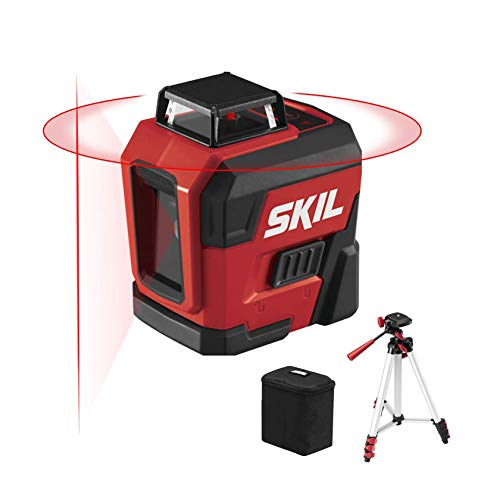
A first shop-installation project may be missing a stable support as well as the laser. The SKIL LL932201 combines a horizontal plane, vertical line, and compact tripod. That package can serve a shared height when the supplied stand reaches a useful position.
The laser projects one continuous horizontal plane and a vertical reference line. The included tripod reaches approximately 3½ feet; charging is by micro-USB. SKIL specifies ±3/16 inch at 30 feet and provides a locking mode for intentional angled lines. The supplied stand’s working height should be compared with the bench or cabinet datum. A low reference and an upper cabinet mark can require different support arrangements. The rechargeable integrated supply also needs preparation, and its micro-USB charging should not be confused with the USB-C arrangements on other tools.
Pros
- Continuous horizontal reference around the room.
- Vertical line adds a second reference direction.
- Adjustable tripod included.
- Integrated rechargeable battery.
- Manual mode supports intentionally angled layouts.
Cons
- Included tripod has limited maximum height.
- Micro-USB charging requires the matching cable.
The SKIL package is most appealing when an installation needs a common horizontal reference and the supplied stand actually reaches a useful position. That combines the optical function and support into one practical starting arrangement. If the stand will need replacing immediately, compare the GLL3-300 on an appropriate separate support instead. For a suitable low or stable elevated reference, the SKIL can make sense as a focused workshop-installation kit, with direct workpiece checks remaining separate.
To buy this product, click here.
Choosing the Best Laser Level for Woodworking
Define the Scale of Woodworking
Lasers are useful for room and workshop installation references. Fine joints, machine calibration, and local workpiece checks usually require appropriate direct-contact measuring tools. Choose the tool for the actual scale of the mark. For built-ins, relating woodwork to an established interior datum is a room-layout task that remains separate from checking the assembly itself.
Choose Height, Direction, or Point Transfer
A horizontal plane carries common elevations, a cross provides local directions, and dots transfer discrete locations. The GTL3 serves surface orientation. These are different roles rather than a single ladder of quality. Understanding the practical roles of line and point references helps avoid selecting a forward point when the job actually needs an overhead relationship.
Plan Around Moving Stock
Long boards, sheet goods, and clamps can block or strike a support. Put the instrument where the useful path stays clear and preserve marks before the setup must move.
Check the Final Adjustment
Fine height or rotation control can be valuable beside a precise installation datum. Compare the supplied mount with the correction you need rather than treating the bracket as an afterthought.
Keep Dimensions Independent
The laser carries a reference established from the drawing. It does not determine cabinet sizes or verify a board’s straightness. Retain the direct dimensional and contact checks appropriate to the work.
FAQ
Can a Laser Replace a Woodworking Square?
Not for every task. It can carry large-layout references, while a square and other contact tools remain useful directly against the workpiece.
Is a Plane Laser Useful for Built-Ins?
It can help connect common heights and vertical directions across surfaces. The actual dimensions and fixing arrangement still come from the plan.
Can the GTL3 Set Cabinet Height?
Its role is angular surface layout. Use a suitable self-leveling line or plane instrument for a horizontal height datum.
Will Green Projection Measure More Accurately?
Color primarily affects visibility under relevant conditions. Compare the actual accuracy specification and reference geometry separately.
Can I Calibrate a Machine from These Recommendations?
Do not infer that use. Follow the machine’s specified calibration procedure with suitable measuring equipment.
Final Verdict
The DW088CG leads for focused woodworking installation references, where a nearby cross complements the direct measuring tools already in use. The B03CG Pro and GLL3-300 are more relevant when a built-in or shop installation needs connected marks across surfaces. The DW089K offers another specific advantage when a local baseline needs fine orientation rather than broader coverage.
The GPL100-50G and GTL3 belong to defined point-transfer and floor-layout roles. Neither should be treated as a universal substitute for a square, a contact measurement, or a machine’s calibration procedure. Start with the scale of the work: carrying a cabinet reference through the room is different from fitting a joint at the bench. The right laser earns its place by making that larger reference easier to establish and reuse.
