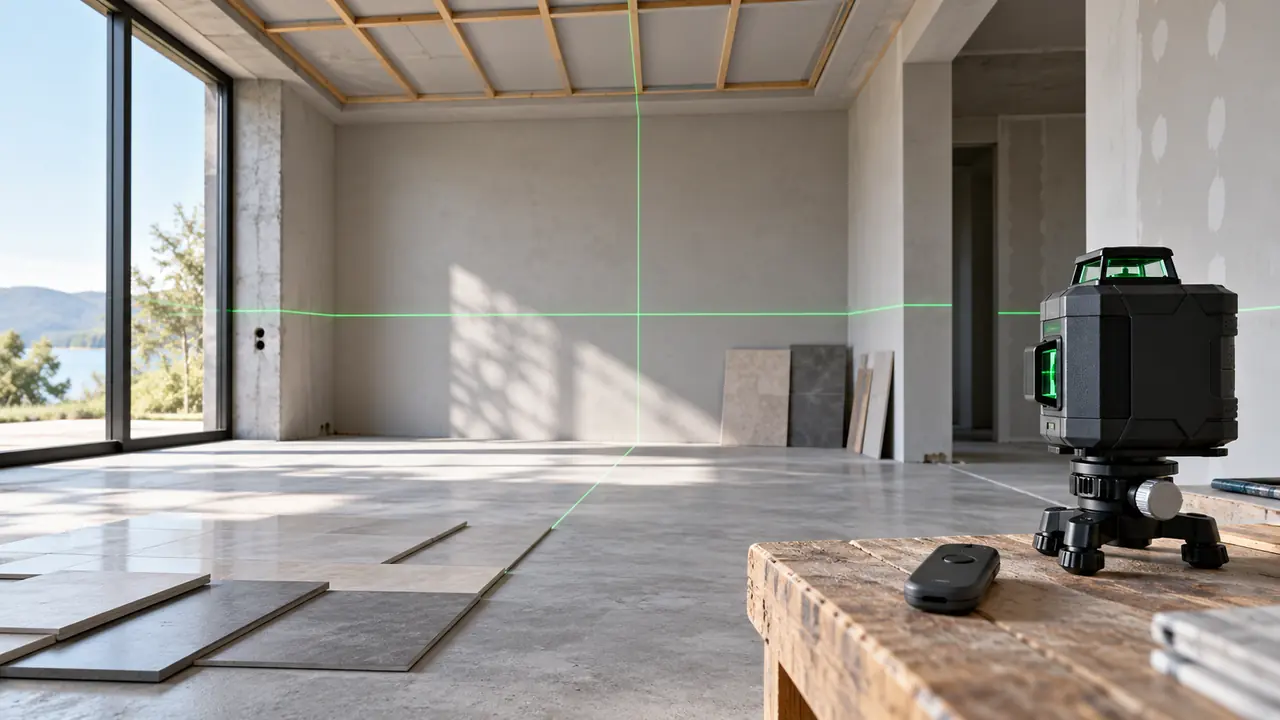
Switching off an unwanted laser line from across the room is useful. Rotating the reference without walking back to the instrument solves a different problem. That distinction sits at the heart of Huepar S04CG vs W04CG: both offer four-plane green layout, but the W04CG adds an electric rotating base to the control workflow.
For frequent solo alignment from the far end of a room, the W04CG has the more compelling control feature. The S04CG is a strong alternative when you mainly need to select planes remotely and want its rechargeable, AA-backup, and direct-input power options. Four planes are common ground here, so the decision should turn on how you position and power the tool.
S04CG: four-plane references with flexible power

The S04CG provides two horizontal and two vertical 360-degree planes, an LCD, and remote line control. It fits a renovation where you move between a cabinet datum, a floor reference, and wall alignment without needing every plane illuminated all the time. The power flexibility is particularly useful when a long layout session outlasts your charging plans.
It is the more convincing choice when the instrument can stay physically oriented once you have set it up. You can change the active reference remotely, but a new direction still requires an appropriate physical adjustment. That is an important boundary to understand before assuming that Bluetooth takes over the entire setup.
To buy this product, click here.
W04CG: the extra control is physical rotation

The W04CG also supplies four-plane green layout and an LCD, but its electric base gives the remote workflow a different purpose. If you are checking where a vertical reference lands at the opposite end of the room, remote rotation lets you alter that direction while remaining near the target. For a solo operator, that can remove repeated trips between the instrument and the mark.
The appeal is strongest where aiming is the recurring interruption. It is less decisive if you set a horizontal datum once and leave the tool untouched. A rotating base is a useful mechanism, but it is not a reason to add complexity to a project that never needs that adjustment.
To buy this product, click here.
Huepar S04CG vs W04CG: Controls and Power Compared
| Decision factor | S04CG | W04CG | What it means |
|---|---|---|---|
| Plane layout | 2 horizontal + 2 vertical 360° planes | 2 horizontal + 2 vertical 360° planes | Both cover four-plane room layout |
| Remote plane selection | Supported | Supported | Switch references without returning to the tool |
| Electric rotating base | Not the S04CG control feature | Three-speed electric base | W04CG adds remote directional adjustment |
| LCD | Included | Included | Check operating status at the instrument |
| Power approach | Li-ion, specified AA holder, direct input | Model-specific rechargeable pack | Plan backups for the actual model |
| Height changes | Require suitable physical support | Require suitable physical support | Rotation does not raise the datum |
| Manual angled references | Supported locked-pendulum mode | Supported locked-pendulum mode | Do not treat an angled reference as automatically level |
Huepar describes the W04CG electric base and controls separately from its line-selection functions. Keeping those two functions separate prevents the most misleading comparison: treating every remote-controlled laser as if it can physically re-aim itself.
Remote line selection and remote aiming are different jobs
Suppose the tool is beside a doorway and you are laying out the other end of a partition. A remote can let you switch to the vertical plane you need. But if that plane misses the far mark, changing which plane is active does not move it onto the mark. That still requires reorientation of the laser.
The W04CG’s electric rotating base is relevant at that second step. It gives you a way to change the direction from the target end rather than returning to the tool for every adjustment. You should still make the final approach carefully and check the relevant reference points. Motorized movement is a positioning convenience, not proof that the alignment is correct.
For a cabinet-height datum, the value is different. Rotating the instrument around a vertical axis does not raise the horizontal plane to a different elevation. You still need a bracket, pole, tripod, or lifting arrangement that puts the reference at the required height. If height setting is your biggest frustration, buying an electric rotating base alone misses the problem.
This is also why remote control should not be described as automatic tracking. The operator still chooses the target and decides when the line is correctly positioned. Nothing about this comparison justifies assuming either laser will follow a receiver or find a layout mark independently.
Four planes help only when you use their positions intelligently
Both models provide a top and lower horizontal reference plus two vertical planes. That offers more ways to place a reference around floor and ceiling work than a conventional three-plane arrangement. It does not make walls flatter, square a room automatically, or remove the need to check the reference against the layout.
During floor work, the low horizontal plane can help establish a nearby height reference. Raised thresholds, tile stacks, and the edge of a doorway may block that plane, however. Raising the tool or using the appropriate lifting base changes where the reference passes. You need to think about obstacles as carefully as the number of lines.
For a ceiling layout, a high horizontal reference may be useful while the vertical planes help carry positions across the room. Do not expect the line to remain visible through cabinets, framing, or stored materials. A 360-degree projection describes the geometry of the plane, not an ability to pass through obstructions.
A stable installation also matters more as you add references. One small shift can move several useful lines at once. Our guide to mounting a laser level securely covers how to place the support so that the references remain usable throughout the job.
The S04CG power options are a real counterweight
The S04CG power configuration includes a removable lithium-ion battery, an AA-holder arrangement, and supported direct-input use. That provides several ways to recover from an interrupted charging routine. Use the correct holder and follow the charging instructions; disposable AA cells are not rechargeable substitutes.
Imagine a weekend renovation with the laser shared between two rooms. A rechargeable pack handles the planned work, while a fresh set of the specified AAs provides another option if the pack is not ready. Direct-input use can also help where a suitable supply is safely within reach. None of those options removes the need to keep cables away from the mount and walking route.
The W04CG uses a different rechargeable pack configuration. A matching capacity number does not make the packs interchangeable. Check voltage, connector, pack identity, and the manufacturer’s approved replacement before ordering a spare. The charger that belongs to one model should not be assumed suitable for the other.
Quoted runtime can be tempting as a tie-breaker, but the active planes and brightness setting matter. Your battery demand during one-plane cabinet marking will not mirror a four-plane layout. Rather than declaring a universal endurance winner, decide whether a spare pack, AA backup, or a safe direct-input arrangement better fits how you work.
Read the LCD as a status tool
A display helps you check the selected modes and battery state without guessing from a few indicators. That is especially welcome when the instrument is positioned somewhere awkward and you want to confirm the setup before making marks. It does not turn the laser into a certified digital inclinometer or an automatically calibrated grade instrument.
Manual mode deserves the same distinction. A locked pendulum can provide an intentionally angled reference, but that reference is no longer automatically level or plumb. For a stair-related layout, establish the intended angle from the project dimensions. Do not mistake the presence of a steady-looking angled line for a verified slope setting.
Which working pattern favors each model?
| Working pattern | Stronger fit | Why |
|---|---|---|
| Frequent solo aiming from the far end | W04CG | Electric rotation changes direction remotely |
| Fixed datum with remote plane switching | S04CG | Core four-plane and line controls already address the task |
| Need a specified AA backup option | S04CG | Its power arrangement provides that route |
| Frequent changes in horizontal reference height | Support selection comes first | Neither rotating base substitutes for elevation adjustment |
| Floor and ceiling room references | Either, with suitable placement | Plane geometry is shared |
| Automatic receiver tracking or numerical grade entry | Reassess both | Those functions are not established by remote control |
The useful winner can change between jobs. A long-distance vertical aiming task favors the electric base; a fixed horizontal datum with uncertain charging favors flexible power. Neither conclusion requires pretending the other instrument is inaccurate or incapable.
Check the version and accessories before building the system
S04CG, S04CG-L, and a bundle carrying an extra package suffix should not be treated as identical feature lists. Read the full model label and package contents. The same rule applies to W04CG packages with added receivers, poles, or tripods: an accessory bundle is not automatically a different laser body.
A receiver must be explicitly compatible with the selected model and operating mode. Green light alone does not establish compatibility, and remote-control range is not the same thing as receiver detection range. If your main requirement is repeated outdoor elevation work, a rotary system may be the more appropriate starting point.
For a wider look at the brand’s layout choices, our Huepar laser-level guide compares instruments for different tasks. Stay with these two when four-plane room layout is genuinely the requirement.
Choose the operation you will use repeatedly
The W04CG makes its strongest case when you need to adjust direction from the far mark. Its electric rotating base has a clear purpose in solo alignment. Put it on a stable support, check the final position, and use the remote feature to reduce the repeated walk back to the instrument. If that interruption is part of most layouts, the additional mechanism has a job to do.
To buy this product, click here.
The S04CG is a purposeful alternative for fixed references and flexible power planning. It still gives you the four-plane geometry, LCD, and remote plane selection that make room layout convenient. If you rarely need to re-aim from a distance, its available power arrangements may be more useful than motorized rotation. The better fit is the one that solves your recurring interruption, rather than the one with the longest feature list.
To buy this product, click here.
