
A short shelf project can turn into a surprisingly long search for a tool. You need a reference on the wall, a way to hold it still, and enough control to mark the holes. Start with those essentials and the choice between a compact cross-line model and a manual wall tool becomes much easier to understand. When looking for the best laser level under 100, start by separating automatic leveling from manually aligned decorating tools.
This selection concentrates on manageable household setups, from automatic red and green cross lines to surface-mounted decorating tools. The differences are real: a magnetic bracket needs metal, a pin makes a hole, and a manually aligned vial does not compensate for a tilted support. None of those details disappears when the project is small.
These nine picks cover ordinary indoor marking tasks, from a quick shelf reference to a more detailed picture arrangement. Confirm the selected model and included equipment before ordering, especially when you need a particular bracket or stand.
Quick Answer
- Best Overall: RockSeed LV1 Red Cross-Line Laser. Red horizontal and vertical cross lines. Power: Two AA batteries.
- Best for Brightness Adjustment: Motovera LL-T2. Green horizontal and vertical cross lines. Power: AA battery supply.
- Best for a Compact Green Setup: Huepar M-9011G. Green horizontal and vertical cross lines. Power: AA battery supply.
Compare the Nine Picks
| Laser level | Best fit | Reference layout | Power and positioning |
|---|---|---|---|
| RockSeed LV1 Red Cross-Line Laser | Best Overall | Red horizontal and vertical cross lines | Two AA batteries; Tripod thread; bracket separate |
| Motovera LL-T2 | Best for Brightness Adjustment | Green horizontal and vertical cross lines | AA battery supply; Adjustable magnetic bracket |
| Huepar M-9011G | Best for a Compact Green Setup | Green horizontal and vertical cross lines | AA battery supply; Magnetic pivoting base |
| Bosch GLL50-20G | Best for Alternative Power Options | Green horizontal and vertical lines | AA or specified Bosch Li-ion pack; Integrated magnetic mount |
| PREXISO PLV2 Multi Surface Laser | Best for Mounting Choices on Walls | Perpendicular surface references; manual vials | Two AA batteries; Pin or adhesive wall base |
| BLACK+DECKER BDL220S | Best for Intentional Angled Lines | Single surface line; manual alignment | Two AA batteries; Rotating wall attachment |
| Johnson Level 9250 Laser Mouse | Best for an Adhesive Single-Line Reference | Single red line; manual alignment | Two AA batteries; Reusable adhesive strip |
| Bosch GLL1P | Best for Pocket Storage | Single line or point; manual alignment | Battery-powered pocket tool; Multipurpose mounting accessory |
| AikTryee Multipurpose Laser Level Kit | Best for Combined Basic Marking Functions | Selectable surface lines; manual vials | Battery-powered combination tool; Included small triangle bracket |
1. RockSeed LV1 Red Cross-Line Laser (Best Overall)

The LV1 is a straightforward starting point when the job needs a self-leveling red cross rather than a collection of room-wide planes. It provides the two directions useful for ordinary shelves and picture layouts. The main practical question is how you will support it, because the bracket is not part of the basic package.
The listed red cross-line model has automatic leveling and a locked manual mode. Its stated self-leveling range is approximately four degrees, with flashing lines outside the operating range. The package lists a carrying pouch and AA batteries, while the magnetic bracket is sold separately.
Pros
- Automatic and manual operating modes.
- Horizontal and vertical red references.
- Out-of-level warning.
- Tripod mounting thread.
- Pouch and batteries supplied.
Cons
- Magnetic bracket is separate.
- No continuous room-wide horizontal plane.
Choose it for contained indoor layout and arrange a compatible support. The manual mode adds deliberate angled references, not calibrated grade control.
To buy this product, click here.
2. Motovera LL-T2 (Best for Brightness Adjustment)

The LL-T2’s four brightness settings give you a control to use when the same wall looks different beside a window or under evening lighting. The green cross and adjustable magnetic bracket are more relevant to small indoor layouts than rotary wording in the listing.
The LL-T2 uses green cross lines with four selectable brightness settings. The listing describes a magnetic fine-adjustment bracket and a 1/4-20 tripod interface. Self-leveling and locked manual modes serve different layouts; its rotating mount does not make it a rotary grading laser.
Pros
- Green horizontal and vertical references.
- Four brightness settings.
- Self-leveling and manual modes.
- Magnetic positioning bracket.
- Standard tripod interface.
Cons
- Not a rotary elevation laser despite some listing terminology.
- Bundle contents should be checked for the selected variant.
Check the selected bundle rather than assuming all versions include the same stand. Its function here is a compact cross-line reference for the room in front of you.
To buy this product, click here.
3. Huepar M-9011G (Best for a Compact Green Setup)

A horizontal and vertical green cross is often enough to organize a shelf or wallpaper reference. The M-9011G stays focused on that smaller working area rather than adding full-room planes. Its pivoting base is useful where the mounting surface and position cooperate.
This compact Huepar model projects horizontal and vertical green lines rather than full-room planes. The published product information describes self-leveling and locked manual operation with a magnetic pivoting base. It is an indoor-focused cross-line option; do not assume that another Huepar model’s receiver capability applies.
Pros
- Green horizontal and vertical references.
- Compact cross-line arrangement.
- Self-leveling operation.
- Manual mode for intentional angles.
- Magnetic pivoting positioning base.
Cons
- No continuous 360° horizontal plane.
- Receiver compatibility must not be assumed.
Choose the compact Huepar for indoor line alignment. Confirm that the linked variant is the M-9011G and do not borrow receiver claims from another series.
To buy this product, click here.
4. Bosch GLL50-20G (Best for Alternative Power Options)

The GLL50-20G offers the choice between included AA cells and the specified Bosch rechargeable pack. That gives an occasional household user one route and a frequent user another. Its compact green cross and transport-locking pendulum keep the basic layout configuration clear.
The Smart Pendulum System self-levels, indicates excessive tilt, and locks for transport. The package includes two AA batteries and a soft pouch; the compatible Bosch 3.7V rechargeable pack is separate. The compact cross-line configuration prioritizes a wall reference over continuous room coverage.
Pros
- Horizontal and vertical green reference lines.
- Included AA batteries avoid an initial charger requirement.
- Supports Bosch’s specified rechargeable pack.
- Integrated magnetic positioning mount.
- Pendulum lock and out-of-level warning.
Cons
- No continuous 360° horizontal plane.
- Manufacturer and retailer accuracy figures differ; check the exact unit.
Use it for wall references and check the exact unit’s accuracy specification. The optional power choice does not mean the rechargeable pack is supplied.
To buy this product, click here.
5. PREXISO PLV2 Multi Surface Laser (Best for Mounting Choices on Walls)
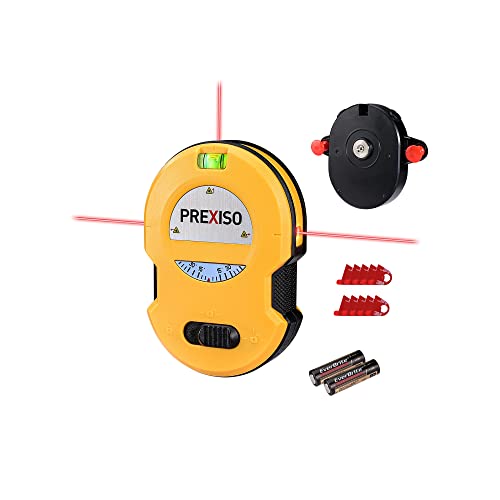
The PLV2’s pin and adhesive options give a wall-based setup a different starting point from a tripod-mounted laser. Its perpendicular surface references and illuminated vials suit deliberate short layouts. The right choice depends on the wall finish as much as on the beam.
The PLV2 uses surface-projected perpendicular references and bubble-vial alignment. Its illuminated angle dial provides a reference for deliberately angled layouts. The mounting base offers pin and adhesive-strip options; surface suitability still needs checking.
Pros
- Perpendicular surface-layout references.
- Illuminated vials aid manual alignment.
- Angle dial for deliberate direction changes.
- Pin and adhesive mounting options.
- Compact wall-mounted arrangement.
Cons
- Does not automatically compensate for tilt.
- Adhesive and pin mounting have surface-specific limits.
Choose it when surface mounting solves your actual setup problem. Treat it as manual alignment and test the attachment method before trusting it beside a finished display.
To buy this product, click here.
6. BLACK+DECKER BDL220S (Best for Intentional Angled Lines)

The BDL220S is useful when the arrangement is meant to slope, such as a staircase display. Its rotating wall attachment and angle-reference ring support that task. The backlit vials also show you how the level or plumb reference is established.
Backlit horizontal and vertical vials provide the alignment reference. The operating manual instructs the user to rotate the device to center the bubble, despite self-leveling language in some listings. The wall attachment uses a drywall pin, and its rotation does not create a 360° projected plane.
Pros
- Rotating attachment permits angled wall references.
- Angle-reference ring assists deliberate layouts.
- Backlit vials aid manual setup.
- Wall attachment and AA batteries included.
- Wall-mounted working position keeps the tool near the marks.
Cons
- Manual bubble alignment is required.
- Drywall-pin mounting makes a hole.
Choose it for wall decorating, with the pin-mount consequence in mind. Its rotating attachment is different from continuous 360° laser projection.
To buy this product, click here.
7. Johnson Level 9250 Laser Mouse (Best for an Adhesive Single-Line Reference)

A Laser Mouse can sit close to the marks where a floor stand would obstruct the work. Its reusable adhesive strip is the defining feature. For a small decorative arrangement, that convenience is worth evaluating alongside the manual alignment and published tolerance.
The reusable SuperStick strip positions the tool against a suitable surface. Horizontal and vertical bubble vials establish the manually aligned reference. Johnson lists ±1/2 inch at 20 feet, a limitation that matters more than its stated 30-foot interior reach.
Pros
- Reusable adhesive provides an alternative to a pin.
- Horizontal and vertical alignment vials.
- Compact body suits close wall work.
- AA batteries included.
- Protective pouch supplied.
Cons
- Requires manual vial alignment.
- Published tolerance is unsuitable for demanding precision work.
Keep this choice to appropriate light decorating. Its tolerance is not a reason to substitute it for a precision layout instrument on a long installation.
To buy this product, click here.
8. Bosch GLL1P (Best for Pocket Storage)

The GLL1P combines a line, point, and bubble vials in a small format. That can suit occasional reference marks where a large case and multiple planes would sit unused. You still need to position and align the instrument carefully.
This pocket-size tool combines a projected line, a point function, and bubble vials. The mounting accessory provides positioning options including a compatible 1/4-20 tripod connection. Its forward-point function is not a dedicated plumb-up or plumb-down reference.
Pros
- Pocket-size format for small layouts.
- Line and point functions in one tool.
- Built-in vials for manual reference checks.
- Mounting accessory included.
- Compatible tripod connection.
Cons
- No automatic self-leveling compensation.
- No simultaneous cross or full-room plane.
Choose it for short, contained marking tasks. A forward point is not a dedicated plumb-up beam, and its line does not become a cross simply because the body is compact.
To buy this product, click here.
9. AikTryee Multipurpose Laser Level Kit (Best for Combined Basic Marking Functions)
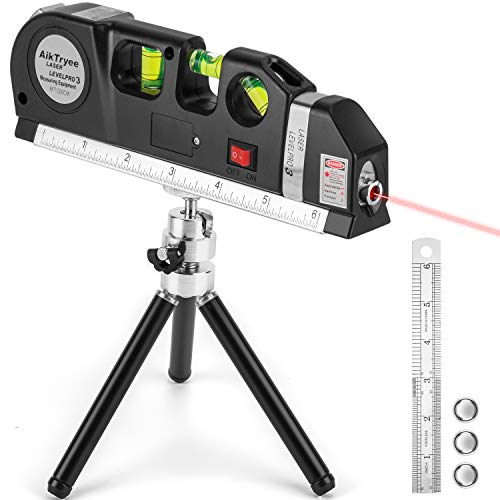
The AikTryee kit combines surface-line choices, bubble references, and a short tape measure. Its small triangle bracket gives the combination tool a support option close to the work. That arrangement can suit simple decorating when you understand that alignment remains manual.
The tool combines selectable horizontal, vertical, and cross-line modes with bubble vials and an eight-foot tape. The listed variant includes a small triangle bracket and a 1/4-inch mounting hole. It should be treated as a manually aligned combination tool, not a documented pendulum self-leveling laser.
Pros
- Selectable surface-line modes.
- Built-in tape for short measurements.
- Horizontal, vertical, and 45° bubble references.
- Small supporting bracket included.
- Combines several basic marking functions.
Cons
- Manual alignment rather than verified automatic compensation.
- Small bracket is not a full-height positioning stand.
Choose the combination for its particular functions, not an assumed automatic-leveling mechanism. The little bracket has a very different role from a full-height tripod.
To buy this product, click here.
Choosing the Best Laser Level Under 100
Buy the Reference You Need
For a shelf, identify whether one horizontal line is enough. A picture grid may benefit from a cross. A small wallpaper job can need a vertical reference. Starting with the task prevents a long feature list from deciding the purchase before you know how the tool will be used.
Plan the Mount Before the Instrument Arrives
A bare tripod thread is useful only if you have a compatible support. Magnetic mounting needs suitable steel; a drywall pin and adhesive base have different surface limits. Include the working height and available space in the plan rather than assuming every package is ready for every room. Spend a moment checking the mounting connection before you start; a small laser is no easier to use if its supported position does not suit the job.
Recognize the Manual Models
Bubble-vial tools require deliberate alignment. Their role can be sensible for short decorating references, but they should not be described as pendulum instruments. Read the operating instructions, especially when a retailer’s self-leveling wording conflicts with the actual setup method. The guide to working with a basic household laser explains why manual alignment and an automatic leveling mode create different operating routines.
Keep Bundle Variants Straight
A listing may offer the same laser with different supports or accessories. Match the linked ASIN and selected configuration to what is described. A photograph of a tripod or magnetic bracket is not enough to establish that it belongs in the package.
Check Meaningful Accuracy Information
Use a stated tolerance together with its reference distance. A range number is not an accuracy number. For close alignment, follow the model’s checking procedure and use a stable support. Do not assume a small instrument is either precise or imprecise solely from its appearance.
Leave Specialist Work to Suitable Equipment
These compact indoor choices do not collectively replace a rotary receiver system, a floor-flatness assessment, or safe wall-fixing selection. For outdoor elevation or demanding installation work, identify the actual equipment requirements before extending a household reference tool beyond its documented role.
Frequently Asked Questions
Is Automatic Leveling Essential for Small Jobs?
It can make repeated references easier, but a manually aligned tool can suit short decorating tasks. The important distinction is knowing which operating method you are buying and checking the reference accordingly.
Why Is a Magnetic Bracket Listed Separately?
Some packages contain only the laser, batteries, and pouch. A mounting thread does not imply an included bracket. Check the selected variant and plan a stable support before starting.
Can a Small Laser Handle Cabinet Installation?
Some cross-line models provide useful references for short runs. Suitability still depends on the required accuracy, mounting, coverage, and installation method. A manual surface tool should not be treated as interchangeable with a continuous-plane layout system.
Are the Included Batteries Rechargeable?
Not necessarily. Standard AA cells and a rechargeable battery pack are different configurations. Use only the battery and charging arrangements supported by the exact tool.
Does a Green Line Solve Outdoor Visibility?
No. Ambient light and distance still matter. A receiver-supported tool may be needed outside, and receiver compatibility must be documented rather than assumed from the color.
What Should I Check When the Listing Changes?
Confirm the exact model, included support, power supply, and current seller configuration. Do not assume that a previously viewed bundle remains unchanged or that every option on a shared listing has the same contents.
Final Verdict
The RockSeed LV1 is our overall selection in this group for a straightforward self-leveling red cross. Motovera adds green lines and brightness adjustment, while the compact Huepar provides another focused indoor configuration. The wall-mounted and pocket tools serve narrower but useful setup needs.
Choose by operating method, mounting, and the references you will actually use. Check the current retailer configuration before ordering and verify the reference before marking the wall. A modest tool can be useful when its limitations match the task rather than being overlooked.
