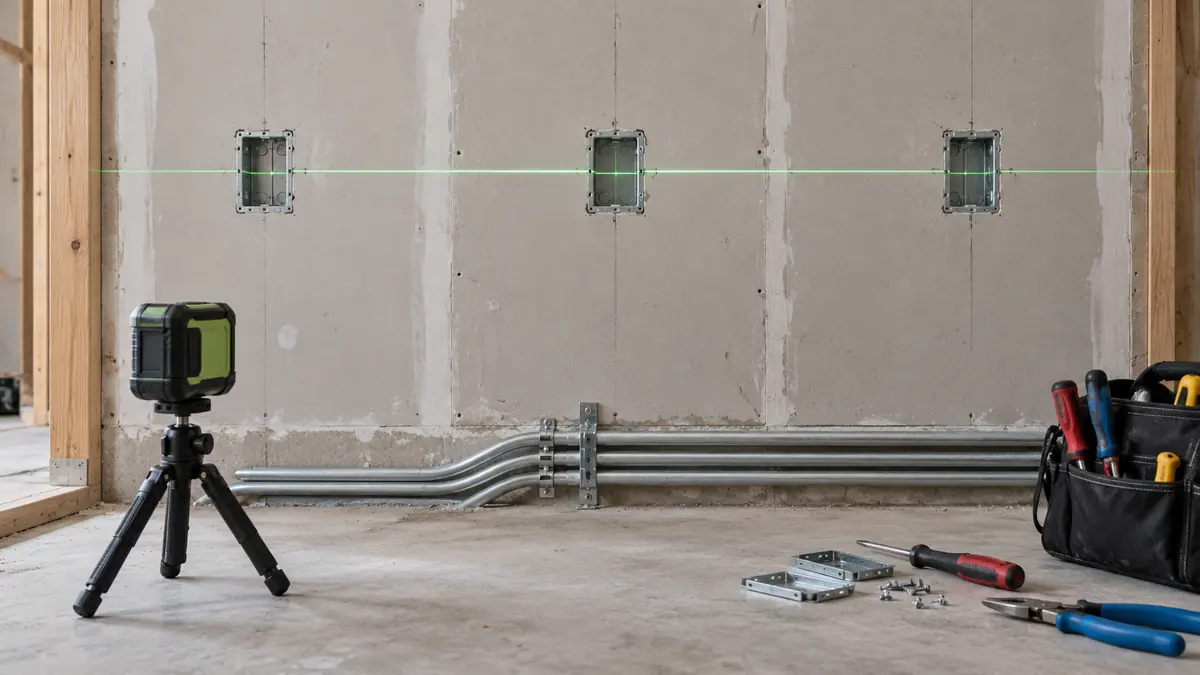
A row of boxes can look fine one at a time and still reveal a wandering height when you step back. Electrical layout often depends on repeating a reference cleanly, whether it is a wall height, an upright conduit line, or a point carried to the ceiling. The right laser geometry makes those relationships easier to mark. The best laser level for electricians needs the right combination of visible lines and documented point functions for the transfers you repeat.
Dedicated plumb dots can help transfer a ceiling position, while a horizontal plane can carry one height around a room. A magnetic mount is useful on suitable steel, and a ceiling clamp can serve a different overhead setup. Those working details can matter more than another mode you will rarely use.
The best laser level for electricians should fit the layout stage of the job and the surfaces available for positioning. These nine picks emphasize point transfer, connected line references, and practical mounting arrangements. Choose the reference first, then consider power and the accessories that keep it where you need it.
Quick Answer
- Best Overall: Klein Tools 93LCLS. Red cross lines and plumb points.
- Best for Connected Room Heights: DEWALT DW089LG. Three green 360° planes.
- Best for Controlled Multi-Plane Layout: Bosch GLL3-330CG. Three green 360° planes.
Compare the Nine Picks
| Product | Best fit | Reference layout | Power and positioning |
|---|---|---|---|
| Klein Tools 93LCLS | Best Overall | Red cross lines and plumb points | Three AA batteries; Magnetic bracket and ceiling clamp |
| DEWALT DW089LG | Best for Connected Room Heights | Three green 360° planes | DEWALT 12V MAX battery platform; Magnetic bracket and ceiling bracket |
| Bosch GLL3-330CG | Best for Controlled Multi-Plane Layout | Three green 360° planes | Bosch 12V Max or AA adapter; BM1 positioning device |
| Klein Tools 93PLL | Best for Rechargeable Plane Intersections | Three green 360° planes | Integrated rechargeable battery; Magnetic bracket; hard case |
| DEWALT DW089K | Best for Fine Right-Angle Line Adjustment | Three red lines for 90° layout | Four AA batteries; Magnetic pivot bracket; ceiling mount |
| Bosch GLL50-40G | Best for a Ceiling-Clip Package | Green 360° horizontal plus vertical line | Four AA batteries; LB10 bracket and DK10 ceiling clip |
| Huepar B03CG Pro | Best for a Removable-Battery Three-Plane Kit | Three green 360° planes | Removable rechargeable battery; Magnetic pivoting base |
| DEWALT DW088CG | Best for Compact Wall Alignment | Green horizontal and vertical cross lines | Three AA batteries; Integrated magnetic bracket |
| Bosch GLL50-20G | Best for Flexible Compact Power Options | Green horizontal and vertical lines | AA or specified Bosch Li-ion pack; Integrated magnetic mount |
1. Klein Tools 93LCLS (Best Overall)

The 93LCLS combines the local usefulness of a cross-line laser with dedicated up-and-down plumb points. That makes it a strong fit for electrical layout that moves between a wall reference and a ceiling position. Its magnetic bracket and ceiling-grid clamp also address two different positioning situations.
The tool combines horizontal and vertical lines with dedicated plumb-up and plumb-down points. Klein supplies a magnetic bracket, ceiling-grid clamp, AA batteries, and hard case. Cross-line accuracy is specified separately from the two plumb-point tolerances.
Pros
- Dedicated upward and downward plumb points.
- Lines can operate independently or together.
- Magnetic bracket rotates for positioning.
- Supports 1/4-20 and 5/8-11 mounting threads.
- Ceiling clamp and hard case included.
Cons
- No three-plane continuous projection.
- Additional point-transfer functions may be unnecessary for simple wall work.
Choose it when the point-transfer function has a real place in the workflow. Use the separate accuracy specification for the dots rather than assuming that the cross-line tolerance applies to every reference.
To buy this product, click here.
2. DEWALT DW089LG (Best for Connected Room Heights)

The DW089LG can carry a horizontal reference around a room while providing two vertical planes for related alignment. For several box positions or repeated installation heights, that continuous geometry can reduce the need to rotate a short wall line. Its ceiling accessory adds a mounting option for appropriate overhead work.
The DW089LG projects three 360° green planes and uses the specified 12V MAX battery platform. The documented kit includes a battery, charger, extended ceiling bracket, target card, and carrying case. Full-time pulse operation supports a compatible detector, supplied separately, while the housing carries an IP65 rating.
Pros
- Three full green reference planes.
- Uses the specified removable 12V MAX battery.
- Battery and charger included in the listed kit.
- Extended ceiling bracket and case supplied.
- Documented detector mode and IP65 housing.
Cons
- Detector and full-height tripod are separate.
- Battery compatibility is limited to the documented platform.
Match the specified battery platform and check the mounting surface before starting. Keep the controlling plane clear so related marks remain easy to identify as the layout grows.
To buy this product, click here.
3. Bosch GLL3-330CG (Best for Controlled Multi-Plane Layout)

The GLL3-330CG pairs three planes with connected controls and the BM1 positioning device. It suits a more involved interior layout where height and vertical directions must relate across several surfaces. Changing settings from a useful working position can help when the instrument itself is not conveniently within reach.
Three green planes can be controlled through Bosch’s connected operating system. The listed package supports its Bosch 12V Max battery or four AA batteries with the required adapter. The specified LR8 receiver extends the operating range to 330 feet in diameter, not radius, and is separate from the base kit.
Pros
- Three-plane green layout.
- Connected operating controls.
- Documented 12V and AA-adapter power options.
- BM1 positioning device included.
- Supported LR8 receiver operation.
Cons
- LR8 receiver is separate.
- Connected functions add setup beyond basic wall alignment.
Remote settings do not physically move the beam onto a mark. Establish the instrument position first, then use the available controls to keep the active references relevant to the current task.
To buy this product, click here.
4. Klein Tools 93PLL (Best for Rechargeable Plane Intersections)

The 93PLL is the Klein option for users who prefer continuous green planes over a cross with dedicated dots. Its horizontal and vertical intersections can support connected interior references. The rechargeable arrangement and hard case make it a distinct kit for repeated layout sessions.
The X, Y, and Z planes can project independently or together. Intersecting vertical planes provide plumb reference locations rather than separate point emitters. The current product page lists a rechargeable power arrangement, magnetic bracket, USB charging cable, and hard case.
Pros
- Three continuous green planes.
- Independent or combined plane operation.
- Plumb reference at vertical-plane intersections.
- Integrated magnetic mount.
- Charging cable and hard case supplied.
Cons
- No conventional AA-battery fallback.
- Plane intersections are different from dedicated point emitters.
Plane intersections and isolated plumb dots create different working experiences. Decide which reference you need on the ceiling or adjoining surface before selecting between Klein’s two configurations here.
To buy this product, click here.
5. DEWALT DW089K (Best for Fine Right-Angle Line Adjustment)

The DW089K’s third line and micro-adjustment knob can help position a right-angle reference beside a planned run. That is useful when a small orientation change matters more than projecting complete planes around the room. Its AA supply also keeps it independent of a particular rechargeable tool platform.
Three red line references support 90-degree layout rather than three continuous planes. A micro-adjustment knob helps position the intersecting references; DEWALT specifies ±1/8 inch at 30 feet for level applications. The kit includes a ceiling mount, box, and four AA batteries; receiver operation uses the separately supplied compatible DW0892.
Pros
- Three lines support 90-degree layout.
- Micro-adjustment control.
- Magnetic pivot bracket.
- Four-AA supply.
- Documented DW0892 detector compatibility.
Cons
- Detector is supplied separately.
- Not a three-plane 360° system.
Use the adjustment to align with an established reference, and check the result before making permanent marks. It remains a three-line instrument rather than a full three-plane system.
To buy this product, click here.
6. Bosch GLL50-40G (Best for a Ceiling-Clip Package)

The GLL50-40G combines a continuous horizontal plane with a vertical line, and its package includes the DK10 ceiling clip and LB10 bracket. That gives it a particular fit where the support arrangement matters. It can carry a shared room height without adding two complete vertical planes.
The GLL50-40G combines one continuous horizontal plane with a vertical line. The specified package includes four AA batteries, an LB10 bracket, a DK10 ceiling clip, and hard case. Bosch describes an IP64 housing, recessed windows, and pendulum transport lock.
Pros
- Continuous horizontal reference.
- Vertical alignment line.
- AA power avoids a proprietary charger.
- Bracket and ceiling clip supplied.
- Hard case and pendulum lock.
Cons
- Not a three-plane square-layout system.
- No rechargeable pack included in this configuration.
Check that the clip suits the actual ceiling support. Included hardware is most useful when it matches the available surface and puts the reference at the required height.
To buy this product, click here.
7. Huepar B03CG Pro (Best for a Removable-Battery Three-Plane Kit)

The B03CG Pro supplies three selectable planes with a removable rechargeable battery. It suits an indoor electrical layout involving several connected surfaces, especially when a horizontal reference must continue around a corner. A magnetic pivoting base offers a position on suitable steel.
One horizontal and two vertical planes can be selected in different combinations. The listed package contains a removable 5,200mAh battery, USB-C charging equipment, magnetic base, target, and hard case. Receiver operation requires an appropriate Huepar receiver, which is separate from this kit.
Pros
- Three full planes cover adjoining surfaces.
- Selectable beam combinations avoid unnecessary lines.
- Removable rechargeable battery supports repeated indoor projects.
- Magnetic base provides positioning on suitable steel.
- Hard case and charging equipment are included.
Cons
- Full-height positioning tripod is not included.
- Outdoor receiver must be supplied separately.
Arrange another support when suitable metal is absent. The battery and plane layout are useful features, while the final position of boxes, fixtures, or supports still comes from the installation plan.
To buy this product, click here.
8. DEWALT DW088CG (Best for Compact Wall Alignment)

A small wall task may need only a horizontal height and a vertical line beside it. The DW088CG supplies that green cross-line arrangement with an integrated magnetic bracket and AA power. It is a focused choice when complete planes or additional point emitters would not change the layout method.
The DW088CG provides a green cross-line configuration with a magnetic mounting bracket. DEWALT’s operating instructions list ±1/8 inch at 30 feet for the line reference. Detector-assisted use requires the compatible green-line detector; it is not included in the basic laser kit.
Pros
- Green wall-layout references.
- Documented line accuracy at a stated distance.
- AA battery power.
- Integrated magnetic bracket.
- Supports specified green-line detector operation.
Cons
- Compatible detector is separate.
- No continuous horizontal plane around the room.
Choose it for local wall references and verify the exact detector if exterior operation is needed. Do not assume that every green accessory is compatible with the transmitter.
To buy this product, click here.
9. Bosch GLL50-20G (Best for Flexible Compact Power Options)

The GLL50-20G supports AA operation and a specified Bosch rechargeable pack while keeping a compact cross-line layout. That can suit an occasional marking tool that later sees more frequent use. The integrated magnetic mount helps where the support surface provides a secure connection.
The Smart Pendulum System self-levels, indicates excessive tilt, and locks for transport. The package includes two AA batteries and a soft pouch; the compatible Bosch 3.7V rechargeable pack is separate. The compact cross-line configuration prioritizes a wall reference over continuous room coverage.
Pros
- Horizontal and vertical green reference lines.
- Included AA batteries avoid an initial charger requirement.
- Supports Bosch’s specified rechargeable pack.
- Integrated magnetic positioning mount.
- Pendulum lock and out-of-level warning.
Cons
- No continuous 360° horizontal plane.
- Manufacturer and retailer accuracy figures differ; check the exact unit.
Keep battery compatibility specific and allow for the rechargeable pack separately. A full horizontal plane is the better geometry when the same height needs to connect several walls without turning the instrument.
To buy this product, click here.
Choosing the Best Laser Level for Electricians
Identify Whether You Need a Point or a Line
A discrete floor-to-ceiling transfer and a repeated wall-box height ask for different references. Dedicated plumb dots support one type of transfer, while a horizontal plane carries a shared height across surfaces. Choose the geometry around the installation marks rather than a general promise of more beams. Compare line references versus dedicated plumb points when deciding how the planned ceiling and wall positions will relate.
Plan the Reference Height From the Finished Surface
A rough floor and a finished floor can establish different measuring points. Decide which surface the installation dimensions use before transferring a horizontal reference. The laser repeats its height consistently only when the starting measurement is connected to the correct surface and layout requirements. The process of relating electrical layout marks to a shared datum helps avoid mixing rough-floor and finished-surface measurements in one room.
Check the Mounting Opportunity
A magnetic base needs suitable ferrous material, and a ceiling-grid clamp needs an appropriate support. A finished wall may call for a tripod or another approved attachment. Plan the position so the beam reaches the required marks and the instrument stays outside the active installation path.
Keep Plumb-Point Tolerances Separate
A manufacturer may give different specifications for upward points, downward points, and lines. Use the figure relevant to the transfer and the actual distance involved. A fine-looking ceiling dot does not establish that the setup or chosen reference point is correct.
Choose Power for the Working Routine
AA batteries, integrated rechargeables, and removable packs provide different preparation options. Check the exact configuration and charging connection before adding spares to the kit. For a tool used across several rooms, keeping its support and power accessories together can make the next reference quicker to establish.
Separate Layout From Detection and Installation
A laser provides a geometric reference. It does not identify hidden services, verify a circuit condition, or choose a safe fixing point. Keep those checks within the appropriate installation process while using the laser to make the planned positions easier to repeat.
Frequently Asked Questions
Are Plumb Dots Worth Having for Electrical Layout?
They can be useful when a discrete reference needs to transfer between floor and ceiling. For repeated wall heights alone, a suitable horizontal line or plane may be the more relevant feature.
Can the Laser Locate Wiring in a Wall?
No. The projected reference shows alignment, not hidden services. Use the appropriate detection and installation checks separately.
Does a Ceiling Clip Fit Every Ceiling?
No. Its design must match an appropriate support surface or grid arrangement. Check the clip and mounting instructions before relying on it overhead.
Is a Three-Plane Tool Better Than a Compact Cross?
It provides more reference directions and continuous coverage. That helps with some room layouts, while a small local task may need only a horizontal and vertical wall line.
Should Box Heights Be Measured From the Rough Floor?
Use the reference surface specified for the actual installation layout. Account for the relationship to the finished surface before transferring the height with the laser.
Can I Substitute Plane Intersections for Dedicated Dots?
Some tasks can use plane intersections, but they are not identical to separate up-and-down emitters. Select the reference geometry and positioning method appropriate to the intended transfer.
Final Verdict
The Klein 93LCLS is our overall choice for electricians because it combines cross lines, dedicated plumb points, and useful mounting hardware. The DEWALT DW089LG and Bosch GLL3-330CG are better fits when continuous references across several surfaces drive the layout.
For local wall marks, the DW088CG or GLL50-20G can provide the narrower geometry you need. Decide how the reference relates to the finished surface and where the instrument will sit before transferring the first mark.
