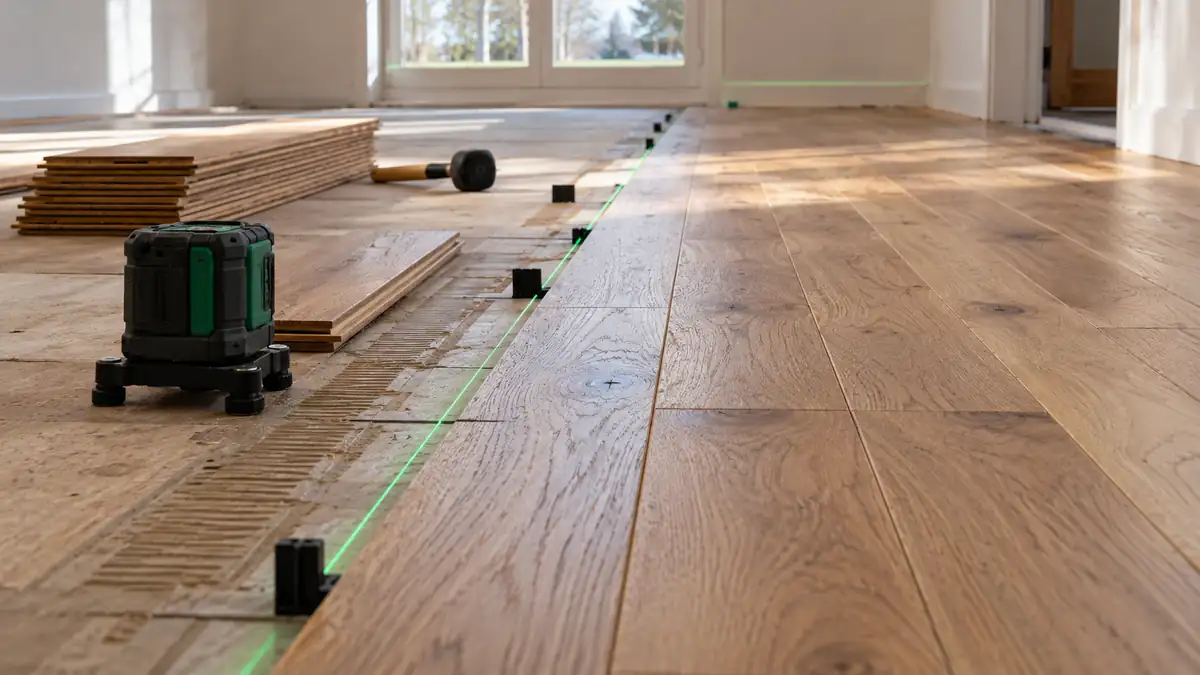
A floor can feel reasonably flat underfoot and still reveal a ridge when a long board bridges the room. A laser gives you a reference from which to measure height differences, while a square-layout tool helps establish pattern direction. Those are related flooring jobs, but they need different ways of reading the reference. The best laser level for flooring depends on whether you are setting pattern direction or measuring the surface against a height reference.
For height checks, a horizontal plane and repeated measurements at marked locations can show how the surface relates to the datum. For a square or diagonal layout, surface guides can make the intended geometry easier to follow. Neither reference automatically decides whether the substrate meets the flooring system’s requirements.
The best laser level for flooring should match the measurement or layout problem in front of you. These nine picks cover low horizontal references, connected planes, and a dedicated floor-layout square. Choose the reference first, then plan how you will measure from it or transfer the pattern to the surface.
Quick Answer
- Best Overall: Huepar S04CG-C Kit. Two horizontal and two vertical 360° planes.
- Best for Square and Diagonal Layout: Bosch GTL3. 0°, 90°, and optional 45° surface layout.
- Best for Connected Floor and Wall References: Huepar B03CG Pro. Three green 360° planes.
Compare the Nine Picks
| Product | Best fit | Reference layout | Power and positioning |
|---|---|---|---|
| Huepar S04CG-C Kit | Best Overall | Two horizontal and two vertical 360° planes | Rechargeable pack or AA holder; Magnetic bracket and lifting base |
| Bosch GTL3 | Best for Square and Diagonal Layout | 0°, 90°, and optional 45° surface layout | AA batteries; Steel positioning plate |
| Huepar B03CG Pro | Best for Connected Floor and Wall References | Three green 360° planes | Removable rechargeable battery; Magnetic pivoting base |
| CIGMAN CM-701 | Best for Remote Beam Selection | Three green 360° planes | Built-in rechargeable battery; Magnetic L-base and mini base |
| Klein Tools 93PLL | Best for a Rechargeable Three-Plane Setup | Three green 360° planes | Integrated rechargeable battery; Magnetic bracket; hard case |
| Bosch GLL3-300 | Best for AA-Powered Multi-Surface References | Three red 360° planes | Four AA batteries; BM1 positioning device |
| Bosch GLL50-40G | Best for a Single Horizontal Room Datum | Green 360° horizontal plus vertical line | Four AA batteries; LB10 bracket and DK10 ceiling clip |
| SKIL LL932201 | Best for an Included Compact Stand | Red 360° horizontal plus vertical line | Integrated rechargeable battery; Included adjustable tripod |
| Huepar 902CG | Best for Two Continuous Planes With AA Power | Green 360° horizontal and vertical planes | Four AA batteries; Magnetic base; tripod interface |
1. Huepar S04CG-C Kit (Best Overall)

The S04CG-C’s lower horizontal plane and lifting base give it a particularly clear role near the floor. You can establish a reference close to the work while retaining an upper horizontal plane and vertical references for related room measurements. That flexibility suits a renovation moving between floor preparation and wall relationships.
Four green planes include a low horizontal reference in addition to the upper horizontal plane. The S04CG documentation describes LCD status, Bluetooth controls, rechargeable-pack power, and an AA holder. The lifting base changes the low reference position; pulse operation requires an appropriate Huepar receiver, supplied separately.
Pros
- Upper and lower horizontal references.
- Two vertical planes for connected layouts.
- Lifting base helps position the low line.
- Rechargeable and AA-holder power choices.
- LCD status and remote operating controls.
Cons
- Four-plane setup adds bulk and complexity.
- Compatible receiver and full-height tripod are separate.
A low line is a reference, not an automatic flatness report. Take consistent measurements at planned locations and compare the results with the requirements for the flooring system.
To buy this product, click here.
2. Bosch GTL3 (Best for Square and Diagonal Layout)

The GTL3 is the specialist here for surface geometry. Its perpendicular guides and optional 45-degree reference can help establish a square or diagonal pattern on the floor. That is a more direct role for pattern layout than projecting an elevation plane and trying to make it serve every marking task.
The GTL3 creates square and diagonal references for wall or floor covering layout. An offset pivot point assists positioning, while raised beams can clear small surface obstructions. Magnets secure it to the included steel positioning plate or suitable ferrous surfaces; it is not a substitute for a self-leveling elevation plane.
Pros
- Purpose-built square floor-layout references.
- Additional 45° guide for diagonal patterns.
- Offset pivot point supports centering.
- Raised beams help clear small obstructions.
- Steel positioning plate supplied.
Cons
- Does not provide automatic room-height leveling.
- Surface layout still needs deliberate positioning and a sound reference.
Choose it for the layout directions rather than height measurement. Surface placement and the starting baseline still need deliberate checking before the pattern is transferred across the room.
To buy this product, click here.
3. Huepar B03CG Pro (Best for Connected Floor and Wall References)

The B03CG Pro can relate a horizontal datum to vertical planes across several surfaces. That can help when the flooring project also involves checking the relationship to wall finishes, cabinetry, or adjoining spaces. The removable battery and selectable planes make it a useful mixed-renovation configuration.
One horizontal and two vertical planes can be selected in different combinations. The listed package contains a removable 5,200mAh battery, USB-C charging equipment, magnetic base, target, and hard case. Receiver operation requires an appropriate Huepar receiver, which is separate from this kit.
Pros
- Three full planes cover adjoining surfaces.
- Selectable beam combinations avoid unnecessary lines.
- Removable rechargeable battery supports repeated indoor projects.
- Magnetic base provides positioning on suitable steel.
- Hard case and charging equipment are included.
Cons
- Full-height positioning tripod is not included.
- Outdoor receiver must be supplied separately.
Position the horizontal reference where measurements can be taken consistently. More planes do not remove the need to record the surface location and the distance from the same datum each time.
To buy this product, click here.
4. CIGMAN CM-701 (Best for Remote Beam Selection)

The CM-701’s remote is useful when you are already at a measurement station and need a different reference direction. Its three planes can support a broader room layout while the compact base gives a positioning option near the work. The appeal is control over a fixed setup rather than moving the instrument repeatedly.
One horizontal and two vertical planes support multi-surface references. The listed kit includes a remote, magnetic L-base, mini tripod base, target plate, USB-C cable, and bag. A built-in 4,000mAh battery powers the tool; the mini base is not a full-height stand.
Pros
- Three continuous planes for connected layouts.
- Remote beam controls included.
- USB-C charging.
- Magnetic and mini-base positioning choices.
- Self-leveling and manual modes.
Cons
- No AA-battery fallback.
- Mini base does not replace a full-height tripod.
Secure the base before beginning the measurement sequence. A remote changes controls, while physical movement of the instrument changes the reference and calls for a benchmark recheck.
To buy this product, click here.
5. Klein Tools 93PLL (Best for a Rechargeable Three-Plane Setup)

Klein’s 93PLL provides a horizontal plane and two vertical planes in a rechargeable package. It can suit repeated room-reference work where the same tool also serves wall and overhead layout. Independent plane operation helps keep the visible reference connected to the measurement currently being taken.
The X, Y, and Z planes can project independently or together. Intersecting vertical planes provide plumb reference locations rather than separate point emitters. The current product page lists a rechargeable power arrangement, magnetic bracket, USB charging cable, and hard case.
Pros
- Three continuous green planes.
- Independent or combined plane operation.
- Plumb reference at vertical-plane intersections.
- Integrated magnetic mount.
- Charging cable and hard case supplied.
Cons
- No conventional AA-battery fallback.
- Plane intersections are different from dedicated point emitters.
Choose a support that gives an accessible datum above the floor. The tool’s intersections do not automatically establish whether a local ridge or depression meets the flooring manufacturer’s limit.
To buy this product, click here.
6. Bosch GLL3-300 (Best for AA-Powered Multi-Surface References)

The GLL3-300 brings three red planes and AA power to a connected-room setup. For floor-height checks with related wall references, that is a distinct supply and geometry choice. Its BM1 positioning device can help establish a workable instrument position when the support arrangement fits the room.
The GLL3-300 projects three red planes and uses four AA batteries. Its package includes the BM1 positioning device, target, pouch, and hard case. Bosch documents receiver-assisted operation with the appropriate LR8 and a 300-foot diameter range; this is different from the green connected GLL3-330CG.
Pros
- Three full reference planes.
- Standard AA battery supply.
- BM1 positioning device.
- Target and hard case included.
- Documented LR8 receiver support.
Cons
- Compatible receiver must be supplied separately.
- Red visible lines do not guarantee outdoor daylight readability.
Use one consistent measurement method across the floor. Keep the reference independent of loose materials or a support that may move as preparation work proceeds.
To buy this product, click here.
7. Bosch GLL50-40G (Best for a Single Horizontal Room Datum)

The GLL50-40G offers a continuous horizontal reference with a vertical line rather than three complete planes. That can be enough for a floor-height measurement grid and a related upright check. AA power and the supplied positioning hardware provide a clear alternative to a larger rechargeable planar kit.
The GLL50-40G combines one continuous horizontal plane with a vertical line. The specified package includes four AA batteries, an LB10 bracket, a DK10 ceiling clip, and hard case. Bosch describes an IP64 housing, recessed windows, and pendulum transport lock.
Pros
- Continuous horizontal reference.
- Vertical alignment line.
- AA power avoids a proprietary charger.
- Bracket and ceiling clip supplied.
- Hard case and pendulum lock.
Cons
- Not a three-plane square-layout system.
- No rechargeable pack included in this configuration.
Choose it when the horizontal datum is the main need. Extra vertical directions can be useful elsewhere, but they do not add information to a height measurement taken from the same horizontal plane.
To buy this product, click here.
8. SKIL LL932201 (Best for an Included Compact Stand)
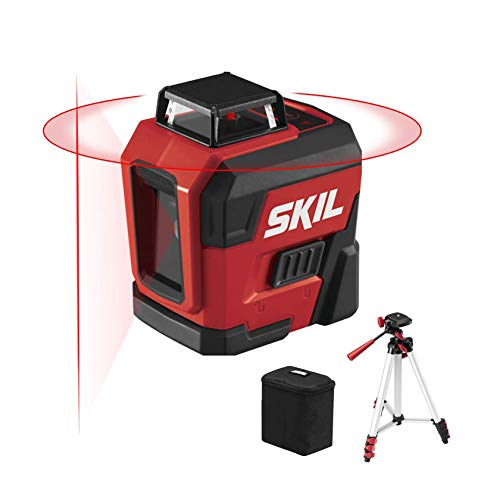
The SKIL supplies a continuous horizontal plane and an adjustable tripod. Its short stand can be useful for a low reference in a cleared room, provided the required height falls within its range. That gives the included accessory a specific role rather than making it an automatic advantage for every installation.
The laser projects one continuous horizontal plane and a vertical reference line. The included tripod reaches approximately 3½ feet; charging is by micro-USB. SKIL specifies ±3/16 inch at 30 feet and provides a locking mode for intentional angled lines.
Pros
- Continuous horizontal reference around the room.
- Vertical line adds a second reference direction.
- Adjustable tripod included.
- Integrated rechargeable battery.
- Manual mode supports intentionally angled layouts.
Cons
- Included tripod has limited maximum height.
- Micro-USB charging requires the matching cable.
Check that the tripod can stand securely without blocking the measurement path. Keep the micro-USB charging lead with the kit so power preparation stays separate from setting the datum.
To buy this product, click here.
9. Huepar 902CG (Best for Two Continuous Planes With AA Power)

The 902CG provides one full horizontal plane and one full vertical plane. That can support a room-height reference and a related alignment direction without adding a second vertical plane. Its AA supply is useful for users who prefer a straightforward replaceable-cell arrangement.
The 902CG projects one full horizontal and one full vertical plane. Its manual specifies four AA batteries and independent or combined plane operation. Pulse mode supports use with a suitable Huepar line receiver, supplied separately.
Pros
- Two continuous green reference planes.
- Standard AA battery supply.
- Independent plane selection.
- Magnetic positioning base.
- Documented receiver operating mode.
Cons
- No second vertical plane for a three-plane layout.
- Compatible receiver is separate.
Confirm that these two reference directions cover the wider project. For a dedicated floor pattern, the GTL3’s surface-square geometry serves a different purpose from this elevated planar reference.
To buy this product, click here.
Choosing the Best Laser Level for Flooring
Separate Height Measurement From Pattern Layout
A horizontal laser plane lets you compare distances to the surface at selected locations. A floor-layout square establishes perpendicular or diagonal directions on the surface. Choose the tool around the actual problem so an attractive pattern reference is not mistaken for a measurement of substrate flatness.
Measure From One Consistent Datum
Keep the laser reference stable and record where each measurement is taken. With a level plane above the surface, larger distances generally indicate lower points and smaller distances higher points. Use the same measuring convention throughout rather than moving the instrument without reconnecting to the original datum. The method for relating floor layout to the surrounding finish references keeps the floor layout connected to the intended adjoining surfaces without treating level and flat as synonyms.
Use a Deliberate Measurement Pattern
A few convenient readings can miss a ridge or local depression. Plan measurement locations that reflect the flooring system’s assessment requirements and inspect the relevant spans. A laser can support that process, while an appropriate straightedge or other specified method may reveal local relationships the chosen measurement spacing misses.
Choose a Working Height You Can Read
A low plane can make floor-adjacent work convenient, but it still needs a clear path and an accessible measurement method. A higher datum can also work if the readings remain manageable. Choose the position around the room and measuring tool rather than assuming the lowest possible line is always preferable. Consider keeping the support clear of the installation path before the next row of material makes a previously convenient position inaccessible.
Follow the Flooring System’s Substrate Requirements
Flat and level are different properties. Some installations can tolerate a consistent slope while requiring close control of local variation. Use the actual flooring and underlayment instructions to decide what needs correction; do not treat a level laser plane as a universal pass-or-fail standard.
Preserve References Between Preparation Stages
Material removal, patching, and traffic can disturb a support or cover control marks. Keep the datum connected to a stable point outside the active work where practical. Recheck it before comparing readings taken at different stages so changes in setup are not mistaken for changes in the floor.
Frequently Asked Questions
Does a Laser Automatically Measure Floor Flatness?
No. It provides a reference from which you take measurements. The location and spacing of readings, the measuring method, and the flooring system’s requirements determine how the surface is assessed.
Are Flat and Level the Same Thing?
No. A surface can be consistently sloped yet relatively flat, or generally level with local ridges and depressions. Check which property and limits the installation requires.
What Does a Larger Distance Below the Laser Mean?
If the laser stays at one horizontal height, a larger downward measurement generally indicates a lower surface point. Keep the measurement vertical and use the same convention at each station.
Why Is the Bosch GTL3 Included?
It addresses square and diagonal pattern layout rather than automatic elevation leveling. That is a useful flooring task, but it should be selected for the geometry it actually provides.
Do I Need a Low Horizontal Plane?
It can be convenient for measurements close to the floor. A higher horizontal datum can also be useful if the measuring arrangement is consistent and accessible.
Can I Keep Comparing Readings After Moving the Laser?
Only after reconnecting the new setup to the established datum. Otherwise, a different instrument height can make the readings misleading.
Final Verdict
The Huepar S04CG-C is our overall flooring choice for its lower horizontal reference and lifting base. The Bosch GTL3 is the specialist for square and diagonal surface layout, while the SKIL is relevant when its included compact tripod creates a useful low setup.
Choose the reference around the task: height measurements, connected room relationships, or pattern direction. Keep the datum stable and use the flooring system’s actual substrate requirements to decide what the measurements mean.
