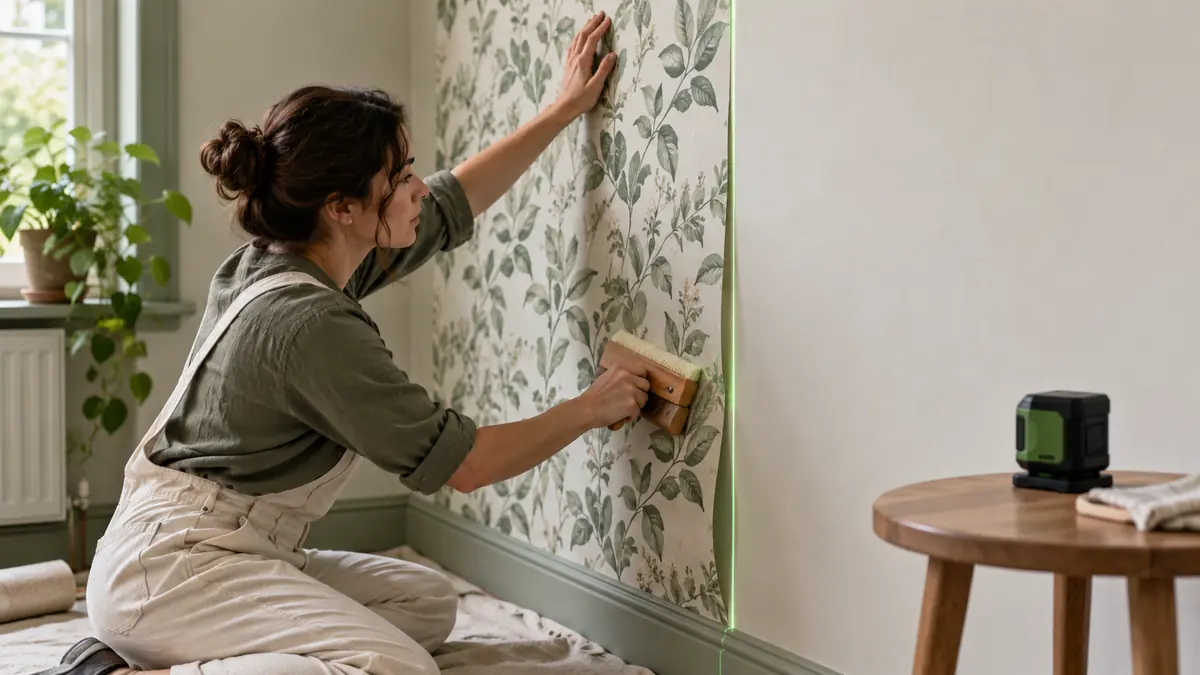
The first strip looks straight until its edge reaches the ceiling. A corner that seemed upright has quietly led the pattern away from the intended line. Wallpaper is a good example of why a reliable vertical reference can be more useful than following an existing wall edge. The best laser level for wallpaper should give you a dependable starting vertical without treating a crooked corner as the reference.
The laser does not hang the paper, measure the pattern repeat, or make an uneven corner plumb. It gives you a reference to work from. The useful features are clear vertical projection, a stable position away from paste and moving strips, and enough control to reconnect the layout after the tool moves.
These nine choices range from compact crosses to continuous horizontal references and a three-plane option. Choose around the number of walls, the available mounting surfaces, and how often the reference must change direction. A manageable setup is more helpful than a room crowded with unnecessary lines.
Quick Answer
- Best Overall: Bosch GLL50-20G. Green horizontal and vertical lines.
- Best Compact DEWALT Cross: DEWALT DW088CG. Green horizontal and vertical cross lines.
- Best Rechargeable Pocket Tool: Fanttik D2. Green horizontal and vertical cross lines.
Comparison Table
| Product | Best fit | Reference layout | Power and positioning |
|---|---|---|---|
| Bosch GLL50-20G | Best Overall | Green horizontal and vertical lines | AA or specified Bosch Li-ion pack; Integrated magnetic mount |
| DEWALT DW088CG | Best Compact DEWALT Cross | Green horizontal and vertical cross lines | Three AA batteries; Integrated magnetic bracket |
| Fanttik D2 | Best Rechargeable Pocket Tool | Green horizontal and vertical cross lines | Integrated 2200mAh rechargeable battery; USB-C; Magnetic rotating bracket |
| Huepar M-9011G | Best Simple AA-Powered Cross | Green horizontal and vertical cross lines | AA battery supply; Magnetic pivoting base |
| Motovera LL-T2 | Best Brightness-Control Alternative | Green horizontal and vertical cross lines | AA battery supply; Adjustable magnetic bracket |
| Bosch GLL55 | Best Red Cross for Controlled Indoor Light | Red horizontal and vertical cross lines | AA battery supply; Magnetic L-mount |
| Bosch GLL50-40G | Best for a Continuous Border Height | Green 360° horizontal plus vertical line | Four AA batteries; LB10 bracket and DK10 ceiling clip |
| Huepar B03CG Pro | Best for Several Connected Walls | Three green 360° planes | Removable rechargeable battery; Magnetic pivoting base |
| PREXISO PLC30GLIT Tripod Kit | Best with a Compact Support Kit | Green horizontal and vertical cross lines | Integrated rechargeable battery; Included tripod and magnetic base |
1. Bosch GLL50-20G (Best Overall)

An old corner can lean even when it looks like a convenient starting edge. The GLL50-20G supplies an independent upright guide for that first strip. Its horizontal cross is available for a related border or height mark, while the compact body suits one-wall-at-a-time work.
The Smart Pendulum System self-levels, indicates excessive tilt, and locks for transport. The package includes two AA batteries and a soft pouch; the compatible Bosch 3.7V rechargeable pack is separate. The compact cross-line configuration prioritizes a wall reference over continuous room coverage. Its compact body and magnetic mounting arrangement can be convenient where a suitable support exists, while AA power makes occasional decorating sessions easy to plan. Set the instrument where hanging paper and your own body will not repeatedly block the beam. A reference you can keep seeing is more useful than a nominally longer one behind the strip.
Pros
- Horizontal and vertical green reference lines.
- Included AA batteries avoid an initial charger requirement.
- Supports Bosch’s specified rechargeable pack.
- Integrated magnetic positioning mount.
- Pendulum lock and out-of-level warning.
Cons
- No continuous 360° horizontal plane.
- Manufacturer and retailer accuracy figures differ; check the exact unit.
For the first strip beside an imperfect corner, the GLL50-20G offers the reference that matters: an upright line independent of that corner. Its compact cross is also easy to keep relevant while working one wall at a time. A continuous border around the room gives the GLL50-40G a stronger purpose, while the B03CG Pro suits more connected layouts. For ordinary strip alignment, the smaller Bosch keeps attention on the paper’s edge and the planned starting position rather than on managing extra planes.
To buy this product, click here.
2. DEWALT DW088CG (Best Compact DEWALT Cross)

The DW088CG fits wallpaper work centered on a local plumb guide rather than complete planes around the room. Its green cross can relate the first strip to an intended direction, with AA preparation and a magnetic bracket providing a straightforward tool arrangement.
The DW088CG provides a green cross-line configuration with a magnetic mounting bracket. DEWALT’s operating instructions list ±1/8 inch at 30 feet for the line reference. Detector-assisted use requires the compatible green-line detector; it is not included in the basic laser kit. The integrated bracket is useful on appropriate steel, but it should not dictate an awkward instrument position. A stable alternative support can keep the line clear of wet adhesive and the path of the hanging strip. This is a local reference, so plan how a second wall will be re-established if the projection does not reach it.
Pros
- Green wall-layout references.
- Documented line accuracy at a stated distance.
- AA battery power.
- Integrated magnetic bracket.
- Supports specified green-line detector operation.
Cons
- Compatible detector is separate.
- No continuous horizontal plane around the room.
The DW088CG is a comfortable fit for a decorator who wants a local green cross and conventional AA preparation. Its bracket can be useful, but the support should keep the instrument out of the long strip’s path, not force the hanging position around the tool. The plane models are more relevant when several walls must share another reference. For one wall and a deliberate plumb starting line, the DEWALT’s focused geometry provides a clear reason to favor simplicity.
To buy this product, click here.
3. Fanttik D2 (Best Rechargeable Pocket Tool)

A decorating tool moving between rooms has a good reason to stay compact. The D2 provides a local green cross in a rechargeable pocket format, with a bracket for suitable metal. That can keep the upright guide manageable beside the current strip instead of adding a large setup.
The D2 is a pocket-format green cross-line laser with automatic and manual modes. The selected package includes a magnetic bracket, USB-C cable, and drawstring pouch. An out-of-level flashing signal identifies when the automatic leveling range is exceeded; the bracket rotates for positioning rather than projecting a continuous plane. USB-C charging fits a familiar preparation routine: charge before the room is cleared, then establish the support before opening the first roll. The rotating bracket changes where the local cross points; it does not create a continuous plane through the room. That distinction matters if the plan includes a border around several walls.
Pros
- Pocket-format housing.
- Green cross-line reference.
- USB-C charging.
- Magnetic bracket included.
- Out-of-level indication.
Cons
- Battery is integrated.
- Rotating the bracket does not provide a projected 360° plane.
The D2’s appeal is portability through a decorating project: a compact rechargeable tool that can be prepared before the room fills with paper and paste. It serves a nearby plumb guide well when the support and line remain visible. A continuous horizontal border is a better reason to consider a full-plane option here, particularly the GLL50-40G. For local strip work and a familiar USB-C routine, the Fanttik keeps the required reference manageable without turning every wall into a larger setup.
To buy this product, click here.
4. Huepar M-9011G (Best Simple AA-Powered Cross)

Restarting the paper after a doorway may need only a nearby upright reference. The M-9011G provides that local green cross without full planes or detector controls. Its compact format is useful when the support can keep the projection clear of the sheet being positioned.
This compact Huepar model projects horizontal and vertical green lines rather than full-room planes. The published product information describes self-leveling and locked manual operation with a magnetic pivoting base. It is an indoor-focused cross-line option; do not assume that another Huepar model’s receiver capability applies. Its automatic mode and manual mode should remain clearly distinguished. A fixed angled projection can be useful for a deliberate decorative layout, but it is not a gravity-based plumb reference. Set the pendulum appropriately and wait for the indication to settle before using the line to guide the vertical edge.
Pros
- Green horizontal and vertical references.
- Compact cross-line arrangement.
- Self-leveling operation.
- Manual mode for intentional angles.
- Magnetic pivoting positioning base.
Cons
- No continuous 360° horizontal plane.
- Receiver compatibility must not be assumed.
The M9011G is most at home in a visibly readable indoor layout where a nearby cross is enough. It gives a starting strip a plumb reference without requiring a screen or a multi-plane control routine. Its lack of receiver support is not an obstacle to that defined job, but it rules out buying it with an outdoor detector upgrade in mind. For wallpaper alone, the stronger question is whether the support keeps the upright guide clear while the paper moves through the room.
To buy this product, click here.
5. Motovera LL-T2 (Best Brightness-Control Alternative)

A dark pattern and a bright window can make a reference appear different from one section to another. Motovera’s four brightness settings address readability on the actual wall. The local cross and adjustable magnetic bracket then serve the focused task of keeping a planned edge upright.
The LL-T2 uses green cross lines with four selectable brightness settings. The listing describes a magnetic fine-adjustment bracket and a 1/4-20 tripod interface. Self-leveling and locked manual modes serve different layouts; its rotating mount does not make it a rotary grading laser. A dark pattern, bright window, and reflective finish can change how the beam appears. Check the line on the actual surface before deciding where to start. Select the center of the reference consistently, and keep the instrument in automatic leveling mode when the purpose is an upright starting edge.
Pros
- Green horizontal and vertical references.
- Four brightness settings.
- Self-leveling and manual modes.
- Magnetic positioning bracket.
- Standard tripod interface.
Cons
- Not a rotary elevation laser despite some listing terminology.
- Bundle contents should be checked for the selected variant.
The Motovera is worth considering when the wall finish and daylight make brightness adjustment useful. That is a practical benefit if it helps the intended line remain clear, rather than an assumption that the brightest setting is the most accurate. The other compact crosses can serve the same local geometry with different power routines. For this tool, the combination of a suitable mounting position and controllable projection is the reason to shortlist it for one-wall-at-a-time decorating.
To buy this product, click here.
6. Bosch GLL55 (Best Red Cross for Controlled Indoor Light)

The GLL55 is worth considering in a room where a red cross is clearly readable on the working surface. Its AA supply and L-shaped mount support local marking. For wallpaper, a usable vertical guide beside the first strip can matter more than projecting extra directions elsewhere.
The GLL55 provides separately selectable horizontal, vertical, and combined cross-line modes. VisiMax manages line visibility under standard working conditions. The pendulum self-levels, warns when out of range, and locks when switched off for transport. The practical test is visibility on the surface, not the color label alone. Establish the reference away from a bright window if the layout permits, and check that the strip and working position do not hide it. Reconnect the next wall from a deliberate mark rather than assuming the corner supplies a new plumb baseline.
Pros
- Independent or combined reference lines.
- Pendulum self-leveling system.
- Out-of-level indication.
- Transport lock.
- Magnetic L-mount for suitable metal.
Cons
- Red projection is not a sunlight-visibility solution.
- No full horizontal plane for several walls.
A readable red cross can be all a wallpaper task needs, which is why the GLL55 remains a relevant option in suitable room light. Its AA routine and local mount suit someone who wants a focused tool rather than a larger plane kit. If a border must continue around the room, the GLL50-40G changes that working experience more than a color change alone. For an upright first strip with a clear nearby projection, the GLL55 can keep the setup refreshingly direct.
To buy this product, click here.
7. Bosch GLL50-40G (Best for a Continuous Border Height)

A border continuing around the room needs a different reference from the first upright strip. The GLL50-40G supplies a continuous horizontal plane for that repeated height, with a vertical line available at the current wall. That gives its geometry a specific decorating purpose.
The GLL50-40G combines one continuous horizontal plane with a vertical line. The specified package includes four AA batteries, an LB10 bracket, a DK10 ceiling clip, and hard case. Bosch describes an IP64 housing, recessed windows, and pendulum transport lock. The distinction is that the vertical projection remains a line, not two complete vertical planes. Plan which wall it must serve. The included bracket and ceiling clip provide mounting options, but a secure support with a clear path is still needed before the first strip makes moving the tool inconvenient.
Pros
- Continuous horizontal reference.
- Vertical alignment line.
- AA power avoids a proprietary charger.
- Bracket and ceiling clip supplied.
- Hard case and pendulum lock.
Cons
- Not a three-plane square-layout system.
- No rechargeable pack included in this configuration.
The GLL50-40G is the one to consider when the papering design includes a common horizontal border as well as upright strips. Its continuous height reference addresses the first task, while the local vertical line serves the wall currently being covered. Two complete vertical planes are not automatically necessary for that combination. A buyer doing only one plain wall may be just as well served by the smaller GLL50-20G, but the border gives this Bosch a distinct and useful role.
To buy this product, click here.
8. Huepar B03CG Pro (Best for Several Connected Walls)

A more involved papering layout can need references related across several surfaces before the control marks are covered. The B03CG Pro provides three selectable planes for that arrangement. Its removable rechargeable supply also gives a longer session a different preparation routine from a compact AA cross.
One horizontal and two vertical planes can be selected in different combinations. The listed package contains a removable 5,200mAh battery, USB-C charging equipment, magnetic base, target, and hard case. Receiver operation requires an appropriate Huepar receiver, which is separate from this kit. It is also more tool than a single upright strip requires. Switch off unneeded planes so the guide remains obvious, and place the body where long sheets will not sweep against it. The removable battery is useful when a session extends, provided a compatible charged spare has actually been arranged.
Pros
- Three full planes cover adjoining surfaces.
- Selectable beam combinations avoid unnecessary lines.
- Removable rechargeable battery supports repeated indoor projects.
- Magnetic base provides positioning on suitable steel.
- Hard case and charging equipment are included.
Cons
- Full-height positioning tripod is not included.
- Outdoor receiver must be supplied separately.
The B03CG Pro is easier to justify when wallpaper is part of a more involved room layout with several related surfaces. The three planes provide options beyond one upright guide, and the removable battery suits a planned longer session. For a single wall, most of that capability may add little. Its strongest case is a project where the reference needs to connect several surfaces before paper covers the control marks, with unused planes switched off so the intended guide stays obvious.
To buy this product, click here.
9. PREXISO PLC30GLIT Tripod Kit (Best with a Compact Support Kit)

A freestanding support can keep the laser off a wall that is about to be papered. PREXISO includes that option with its cross-line tool, alongside a magnetic base. The package is useful when the stand places the vertical reference clearly beside the hanging area.
The PLC30GLIT selects horizontal, vertical, or cross-line projection. The manufacturer’s package description includes a tripod, magnetic base, target, bag, and USB-C cable. Its 1/4-20 connection allows a compatible alternative support when a taller working position is needed. The included tripod’s height is part of the purchase decision. Check that it places the vertical projection over the required working area without resting on an unstable pile. The rechargeable supply also needs planning before the room is cleared and the decorating session begins.
Pros
- Green cross-line layout.
- Tripod included.
- Magnetic base supplied.
- USB-C rechargeable arrangement.
- Standard 1/4-20 interface.
Cons
- No continuous horizontal plane.
- Included compact stand does not suit every installation height.
The PREXISO package is appealing when the missing ingredient is a secure freestanding position. That can keep the tool off a wall that is about to be covered and leave the hanging area accessible. The tripod’s working height still needs to fit the projection, so its presence alone should not decide the purchase. For a room with no useful magnetic support, a suitable included stand and rechargeable cross can form a more practical starting arrangement than a laser body with nowhere convenient to sit.
To buy this product, click here.
Choosing the Best Laser Level for Wallpaper
Establish Plumb Independently of the Corner
An existing corner may lean. Choose the starting reference according to the wallpaper layout and use a properly set automatic vertical projection. The pattern repeat and trimming allowance remain separate planning decisions. The method for setting a wall reference for the first wallpaper drop explains how to choose a starting position without treating an existing corner as proof of plumb.
Check Visibility on the Real Finish
Dark colors, glossy surfaces, and bright windows change how a line appears. Test the reference where the strip will be positioned. Avoid treating a reflected duplicate as the intended line.
Keep the Support Outside the Paper Path
Long sheets, ladders, and people can block or strike a tool positioned too close to the work. Choose a stable position that preserves the vertical reference while the strip is handled. Plan supporting the laser without disturbing the marking area before pasted material and loose drops make the original support position awkward.
Use Continuous Coverage Only When Helpful
A horizontal plane can help with a room-wide border. A compact cross may be enough for one upright strip. Extra planes should provide useful references rather than make the active guide harder to identify.
Preserve Control Marks Before Moving
A new instrument position can change both height and orientation. Keep an appropriate reference mark and reconnect the setup deliberately. Automatic leveling does not remember where the previous vertical plane was located.
Keep the Mode Appropriate
Use automatic leveling for gravity-based upright references. A supported manual angle mode serves deliberate angled layouts. A locked projection should not be assumed plumb merely because it looks straight on the wall.
FAQ
Is a Cross-Line Laser Enough for Wallpaper?
Often yes. A local vertical guide can establish the starting direction. Continuous planes become useful when the layout needs related references across several surfaces.
Should I Follow the Existing Corner?
Not automatically. Check its relationship to plumb and plan the paper layout. A laser reference does not decide pattern placement or trimming allowance.
Can the Laser Match the Pattern Repeat?
No. It provides alignment references. Pattern matching and strip positioning still follow the wallpaper’s design and installation instructions.
Do I Need Green Projection?
Use a beam that is readable on the actual surface. Lighting, distance, finish, and support position matter alongside color.
Why Does the Line Disappear Behind the Strip?
The paper or your body may block its path. Reposition the support thoughtfully and preserve a control mark before changing the setup.
Is a Locked Line Still Plumb?
Not necessarily. A supported manual mode can project at an angle. Check the operating mode before using the reference for an upright edge.
Final Verdict
A first strip beside an imperfect corner is a strong reason to favor the GLL50-20G’s focused upright reference. It is our overall wallpaper choice because the compact cross fits the ordinary one-wall task without making the setup unnecessarily elaborate. The DW088CG and Fanttik D2 provide useful alternatives with different power and storage routines, depending on what fits the rest of the decorating kit.
A border around the room changes the useful geometry, making the GLL50-40G’s continuous horizontal reference more relevant. The B03CG Pro has a clearer purpose when several surfaces need a connected layout before paper covers the marks. Whichever arrangement fits, preserve the intended starting reference and place the support where sheets can move without hiding or striking it. The best guide is one that remains usable during the hanging work.
