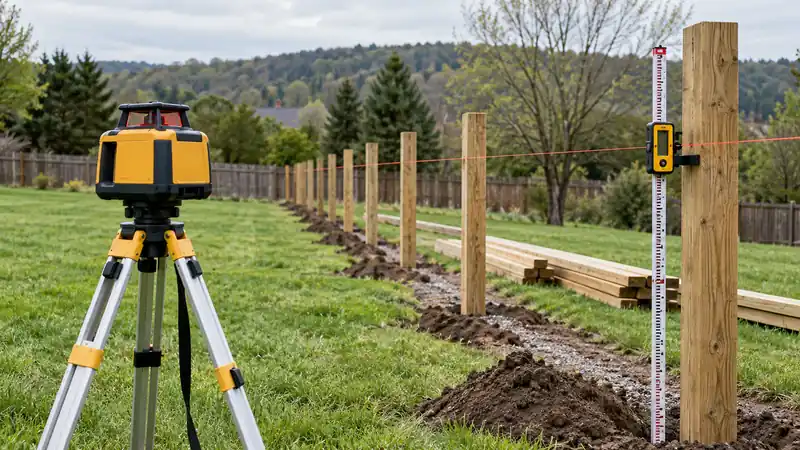
A fence can follow a slope gracefully or advertise every uncertain post mark. The difference starts with the layout. A laser can transfer heights between posts, but the intended top line may be level, stepped, or sloped, and those are three different marking jobs. The best laser level for fencing should support the reference you actually need, since straight alignment and matching heights are different tasks.
Open yards also bring sunlight and interrupted sightlines. A rotary instrument and matching receiver make height references more practical than hunting for a visible wall line on rough timber. They do not establish a legal boundary or automatically keep the fence on its intended path.
The nine picks below emphasize repeatable outdoor measurements, receiver packages, and the choice between a level datum and supported slope adjustment. Decide how the fence should meet the terrain first. Then choose the system that makes those height offsets easy to mark and recheck.
Quick Answer
- Best Overall: Bosch GRL900-20HVK Kit. Horizontal and vertical rotary operation.
- Best Focused Outdoor Datum: Topcon RL-H5A Receiver Kit. Horizontal rotary reference.
- Best for Manual Slope Workflows: Bosch GRL2000-40HVK Kit. Horizontal/vertical rotary; manual dual slope.
Compare the Nine Picks
| Product | Best fit | Reference layout | Power and positioning |
|---|---|---|---|
| Bosch GRL900-20HVK Kit | Best Overall | Horizontal and vertical rotary operation | Selected alkaline-battery kit; LR10 receiver, BT160 tripod and grade rod |
| Topcon RL-H5A Receiver Kit | Best Focused Outdoor Datum | Horizontal rotary reference | Specified D-cell or rechargeable configuration; Receiver holder; tripod separate |
| Bosch GRL2000-40HVK Kit | Best for Manual Slope Workflows | Horizontal/vertical rotary; manual dual slope | Battery-powered selected kit; Receiver, tripod, rod, remote and wall mount |
| Spectra Precision LL100N-2 Kit | Best Complete Inch-Based Setup | Horizontal rotary reference | Two D-cell batteries; Tripod, HR320 receiver and inch-graduated rod |
| Johnson Level 99-027K System | Best for Stepped Fence References | Horizontal rotary; manual vertical alignment | Four C-cell batteries; Detector, tripod and 13-foot rod |
| Spectra Precision LL300N with HL450 | Best for Repeated Offset Readings | Horizontal rotary reference | Four D-cell batteries; HL450 receiver and clamp; tripod separate |
| Spectra Precision LL500 with HL700 | Best for Long Sessions on One Datum | Horizontal rotary reference | Four D-cell batteries; Three-screw base; HL700 receiver |
| DEWALT DW074KD | Best for Existing DEWALT Field Accessories | Horizontal rotary; manually aligned vertical mode | Two D-cell batteries; DW0742 detector, clamp and wall mount |
| Milwaukee M18 3701-21T System | Best M18 Complete Field System | Red exterior horizontal rotary reference | M18 rechargeable platform; 3711 receiver, tripod and grade rod |
1. Bosch GRL900-20HVK Kit (Best Overall)

The GRL900-20HVK provides a complete receiver, tripod, and rod arrangement for transferring post heights. That is useful when the fence runs across open ground and the equipment needs to be readable away from the instrument. Its disturbance monitor adds a useful reason to revisit the benchmark.
The selected kit includes an LR10 receiver, tripod, grade rod, remote, wall mount, and case. Horizontal and vertical operation supports elevation transfer and interior alignment. Electronic leveling and a disturbance monitor help identify a changed setup; the linked package lists D-cell power for the transmitter.
Pros
- Horizontal and vertical operation.
- Electronic leveling.
- Disturbance monitor.
- Receiver, tripod, and rod included.
- Remote and wall mount supplied.
Cons
- Larger package than a compact wall laser.
- Do not assume numeric slope entry.
Keep horizontal height transfer separate from fence-line direction. The property boundary and alignment need their own established references.
To buy this product, click here.
2. Topcon RL-H5A Receiver Kit (Best Focused Outdoor Datum)

The RL-H5A is a strong fit for a fence where many marks relate back to one horizontal reference. With the receiver on a rod, you can compare the ground and planned post heights even when the beam itself is not easy to see.
Topcon specifies an 800-meter working diameter and ±10 arc-second horizontal accuracy for the RL-H5A. Electronic horizontal self-leveling and IP66 protection suit outdoor elevation work with a receiver. The selected listing identifies an LS-80L receiver and holder; verify the exact battery and support-equipment bundle.
Pros
- Horizontal rotary reference for elevation checks.
- Receiver and holder identified in the selected kit.
- Electronic self-leveling.
- Documented IP66 protection.
- Manual slope capability described by the manufacturer.
Cons
- Not a three-plane interior wall-layout tool.
- Tripod, rod, and exact battery bundle need separate confirmation.
The selected package needs a tripod and rod. Set the reference clear of the digging area so post-hole work does not disturb it.
To buy this product, click here.
3. Bosch GRL2000-40HVK Kit (Best for Manual Slope Workflows)

The GRL2000-40HVK adds manual dual-slope adjustment for layouts that genuinely need an inclined reference. A sloping fence top still requires an established start, end, and intended relationship to the terrain. The tilt control serves that plan rather than inventing it.
Manual dual-slope adjustment allows the reference angle to be changed on both axes. Electronic self-leveling and a disturbance monitor support repeatable site setup. The linked complete package includes a receiver, tripod, grade rod, remote, wall mount, and carrying case.
Pros
- Manual slope adjustment on two axes.
- Horizontal and vertical operation.
- Electronic self-leveling.
- Disturbance monitor.
- Receiver, tripod, rod, and remote included.
Cons
- Manual slope is different from automatic numeric grade entry.
- Complete kit takes more storage space than a line laser.
Check the documented axes and known endpoints. For a stepped fence, a level datum with measured offsets may be easier to manage.
To buy this product, click here.
4. Spectra Precision LL100N-2 Kit (Best Complete Inch-Based Setup)

The LL100N-2 supplies an inch-graduated rod alongside its receiver and tripod. That can suit post marks taken from a plan expressed in feet and inches. A consistent reading routine is more useful than changing the instrument position for every post.
The LL100N automatically establishes a horizontal reference and provides a height-change alert. This LL100N-2 package includes an HR320 receiver, rod clamp, tripod, inch-graduated rod, and system case. Manual slope operation requires the appropriate optional RC601 remote; it is not a numeric dial-in grade laser.
Pros
- Horizontal self-leveling.
- Height-change alert.
- HR320 receiver and clamp included.
- Tripod and inch-graduated rod included.
- System case organizes the selected package.
Cons
- Optional remote is needed for the documented slope workflow.
- Not a three-plane interior line laser.
Record the benchmark and choose the same rod face throughout. Account for the intended panel or rail relationship before cutting posts.
To buy this product, click here.
5. Johnson Level 99-027K System (Best for Stepped Fence References)
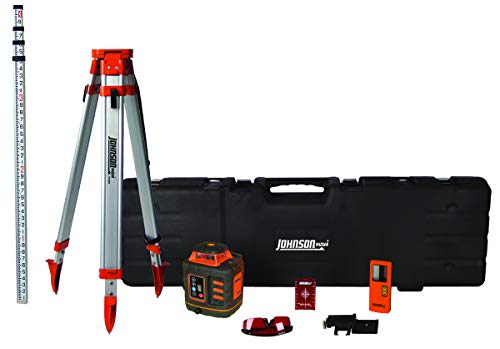
A stepped fence can use one horizontal datum and different measured offsets at each group of posts. The Johnson system includes the accessories for that approach. It gives a complete level-reference arrangement without asking the operator to manage a slope function.
The 99-027K self-levels horizontally and supports manual vertical alignment with a split beam. The system includes a detector and clamp, tripod, dual-graduated grade rod, batteries, target, and hard case. Its IP66 housing and locking compensator support site use and transport; this model does not provide slope adjustment.
Pros
- Detector, tripod, and rod included.
- Horizontal self-leveling.
- Dual rod graduations.
- IP66 enclosure.
- Locking compensator for transport.
Cons
- No slope-adjustment function.
- Vertical setup is manual.
There is no slope adjustment on this model. Mark each intended step from the plan and verify the transition before making cuts.
To buy this product, click here.
6. Spectra Precision LL300N with HL450 (Best for Repeated Offset Readings)

The HL450 receiver makes the LL300N package interesting when you need to see how far a mark is from the reference. That can help compare several posts before choosing the final cutting sequence. The protective housing suits equipment moving through an active outdoor site.
The LL300N combines automatic horizontal leveling with a protective rotor housing and IP66 enclosure. The selected alkaline package includes an HL450 receiver and clamp but does not include a tripod. Its single-axis slope workflow requires the optional RC601 remote, with leveling retained on the other axis.
Pros
- Automatic horizontal leveling.
- IP66 enclosure.
- Protective rotor housing.
- HL450 receiver included.
- Optional single-axis slope workflow.
Cons
- Tripod and rod are separate in this package.
- RC601 remote is separate.
Arrange a suitable rod and tripod. Its optional slope workflow also needs the specified remote, which is separate.
To buy this product, click here.
7. Spectra Precision LL500 with HL700 (Best for Long Sessions on One Datum)

The LL500 favors a deliberate initial setup followed by repeated horizontal readings. A fixed datum can remain useful as you move from ground comparisons to post-height checks. The HL700 receiver adds a broad reception window and readable elevation offsets.
The LL500 uses a three-screw base and circular bubble for initial setup before its limited self-leveling compensation takes over. Its horizontal tolerance is specified at approximately ±1/16 inch at 100 feet. The selected package identifies an HL700 receiver, rod clamp, batteries, and case; tripod and rod are separate.
Pros
- Dedicated horizontal elevation reference.
- Fine horizontal tolerance at a stated distance.
- HL700 receiver supplied in the selected package.
- Circular bubble and three-screw setup base.
- Replaceable D-cell supply.
Cons
- Initial setup is more manual than broad-range servo-leveling models.
- No automatic numeric grade entry.
Prepare the three-screw base carefully. Choose this when a horizontal datum is the main requirement and the support equipment is already planned.
To buy this product, click here.
8. DEWALT DW074KD (Best for Existing DEWALT Field Accessories)

A supplied detector and clamp make the DW074KD an option for someone with a suitable tripod and measuring rod already available. Horizontal self-leveling supports the height-transfer role. Its separate vertical alignment mode is manual and serves a different job.
Horizontal operation self-levels, while vertical setup uses manual alignment. The kit includes a DW0742 detector and clamp, wall mount, target, contractor bag, and batteries. A protective cage surrounds the rotary head; the selected package does not include a full-height tripod.
Pros
- Horizontal self-leveling.
- Included compatible detector and clamp.
- Vertical alignment option.
- Wall mount supplied.
- Protected rotor head and storage bag.
Cons
- Vertical leveling is manual.
- Tripod and rod are separate.
Do not use a height reference as proof of boundary position. Keep the fence direction, terrain plan, and post elevations independently understandable.
To buy this product, click here.
9. Milwaukee M18 3701-21T System (Best M18 Complete Field System)

The selected Milwaukee exterior system includes a receiver, tripod, and rod. For an M18 user handling fencing alongside other outdoor construction, those components form a practical shared setup. Masking shutters help control unwanted beam directions around the working area.
The selected exterior system combines the red rotary transmitter with a 3711 receiver. Its linked package identifies an M18 battery, charger, receiver clamp, tripod, grade rod, and case. Masking shutters and selectable bump sensitivity support controlled setup; quoted field coverage is a diameter rather than a receiver radius.
Pros
- Compatible receiver supplied.
- Tripod and grade rod included.
- M18 battery and charger package.
- Masking shutters.
- Selectable bump sensitivity.
Cons
- No dual-slope control like the 3704 family.
- Large field system for a simple indoor wall mark.
Choose it for a field receiver workflow. It is a substantially larger arrangement than needed for a single nearby marking task.
To buy this product, click here.
Choosing the Best Laser Level for Fencing
Choose Level, Stepped, or Sloped Before Marking
A level top line can create changing gaps above uneven ground. A stepped arrangement changes height in planned groups, while a sloped line follows a chosen incline. Sketch the intended result and panel relationships before applying one common laser datum to every post. The guide to carrying the intended height along an outdoor layout explains how one reference can support different designed top relationships along changing terrain.
Preserve a Height Benchmark
Use a stable reference outside the disturbed ground and write down its reading. Digging, tamping, and moving materials can shift support feet. Return to the benchmark after interruptions, especially before transferring marks that will determine permanent cuts.
Treat Boundary and Elevation as Separate Tasks
A height-transfer laser does not verify ownership boundaries or the lawful fence position. Establish those references through the appropriate project information. Use the laser for the elevation or alignment function actually documented for the selected instrument.
Plan Sightlines Along the Run
Trees, existing panels, and changing terrain can block the beam. Position the instrument so the receiver has a clear path to the required posts. If you must move the setup, transfer the datum through a preserved mark and verify the connection before continuing.
Keep Rod Readings Consistent
A tilted rod changes the reading and can create a misleading comparison between posts. Hold it vertically, secure the receiver clamp, and use one graduation system. Label the intended offsets so a ground-height reading is not mistaken for a finished post-top mark. Use the routine for taking repeatable readings from a rotary system so a change in scale convention or receiver position does not become a false height difference.
Use Slope Controls Only When They Help
A level reference can support a sloping or stepped result through calculated offsets. A slope-capable laser provides another method, but manual tilt is not necessarily percentage entry. Choose the workflow you can establish, check, and repeat across the actual run.
FAQ
Should Fence Posts All Be Cut to One Laser Line?
Only if the planned top line is level. A stepped or sloped fence needs the intended height changes represented through offsets or an appropriately established inclined reference.
Can a Rotary Laser Find My Property Line?
No. It can transfer a reference, but it cannot determine the legal boundary. Establish the permitted fence position before relying on layout marks.
Will a Receiver Work When I Cannot See the Beam?
A compatible receiver is designed to detect its supported signal in conditions where visual reading is difficult. It still needs a clear path and must remain within the system’s operating limits.
Do I Need Dual Slope for Fencing?
Usually the height-transfer method matters more. Many layouts can use a horizontal datum with measured offsets. Dual slope is useful only when its specific operating method supports the intended layout.
What If the Ground Changes Height Halfway Along?
Keep the benchmark consistent and calculate the planned post or panel relationship at each location. Do not assume ground-following and a level fence top produce the same result.
Can I Move the Tripod Between Posts?
Yes, but the datum must be re-established from a preserved reference after each move. Automatic leveling alone does not retain the original height.
Final Verdict
The Bosch GRL900-20HVK leads for its complete outdoor reading package. Choose the Topcon RL-H5A for a focused horizontal datum, or the GRL2000-40HVK when documented manual slope control belongs in the plan.
The Johnson system is a useful level-reference choice for stepped layouts. Decide what the fence top should do across the terrain, preserve the benchmark, and check the marks before the first irreversible cut.
