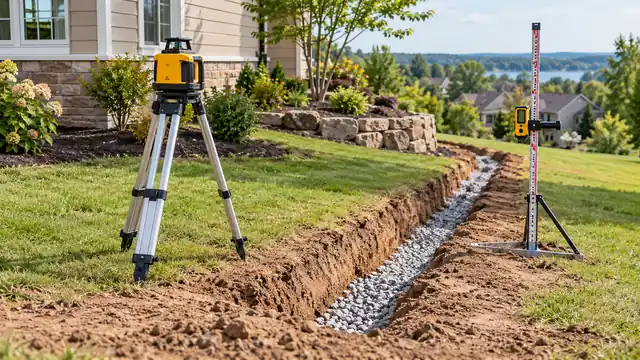
A yard can look almost flat until the first heavy shower leaves a puddle beside the patio. For grading and drainage, the useful laser reference is one you can measure against repeatedly, across the work area and in daylight. That usually means a rotary laser, a receiver, a stable tripod, and a properly graduated rod. The best laser level for grading and drainage must help you read the planned elevations consistently, with the right receiver and rod arrangement.
There are two different ways to work. Keep the laser level and measure the planned fall with the rod, or use a supported slope mode to tilt the reference itself. A manual slope adjustment is different from entering a percentage on a digital grade laser. Getting that distinction right prevents an impressive feature list from choosing the wrong equipment.
The best laser level for grading and drainage should fit your measurement method, site size, and accessory needs. These nine picks cover complete field kits, horizontal-reference specialists, and tools with manual slope workflows. Start with the drainage layout and intended outlet, then choose how you will transfer those elevations to the ground.
Quick Answer
- Best Overall: Bosch GRL2000-40HVK Kit. Horizontal/vertical rotary; manual dual slope.
- Best for Horizontal Elevation Transfer: Topcon RL-H5A Receiver Kit. Horizontal rotary reference.
- Best for Optional Single-Axis Slope: Spectra Precision LL300N with HL450. Horizontal rotary reference.
Compare the Nine Picks
| Product | Best fit | Reference layout | Power and positioning |
|---|---|---|---|
| Bosch GRL2000-40HVK Kit | Best Overall | Horizontal/vertical rotary; manual dual slope | Battery-powered selected kit; Receiver, tripod, rod, remote and wall mount |
| Topcon RL-H5A Receiver Kit | Best for Horizontal Elevation Transfer | Horizontal rotary reference | Specified D-cell or rechargeable configuration; Receiver holder; tripod separate |
| Spectra Precision LL300N with HL450 | Best for Optional Single-Axis Slope | Horizontal rotary reference | Four D-cell batteries; HL450 receiver and clamp; tripod separate |
| Spectra Precision LL100N-2 Kit | Best for an Included Inch-Graduated Rod | Horizontal rotary reference | Two D-cell batteries; Tripod, HR320 receiver and inch-graduated rod |
| Spectra Precision LL500 with HL700 | Best for a Dedicated Level Datum | Horizontal rotary reference | Four D-cell batteries; Three-screw base; HL700 receiver |
| Johnson Level 99-027K System | Best for a Complete Level-Reference System | Horizontal rotary; manual vertical alignment | Four C-cell batteries; Detector, tripod and 13-foot rod |
| Bosch GRL900-20HVK Kit | Best for Mixed Site and Building Layout | Horizontal and vertical rotary operation | Selected alkaline-battery kit; LR10 receiver, BT160 tripod and grade rod |
| DEWALT DW074KD | Best for a Detector-Included DEWALT Setup | Horizontal rotary; manually aligned vertical mode | Two D-cell batteries; DW0742 detector, clamp and wall mount |
| Spectra Precision HV101-4 Kit | Best for Occasional Exterior Work Alongside Interior Layout | Horizontal, vertical and plumb rotary functions | Two D-cell batteries; HR150U receiver, wall mount and remote |
1. Bosch GRL2000-40HVK Kit (Best Overall)

A drainage layout often needs a reference across more than one direction. The GRL2000-40HVK combines manual dual-axis slope adjustment with a complete support-and-receiver package, giving it a clear reason to lead this selection. You can work from a level datum or use its documented slope procedure, depending on the layout.
Manual dual-slope adjustment allows the reference angle to be changed on both axes. Electronic self-leveling and a disturbance monitor support repeatable site setup. The linked complete package includes a receiver, tripod, grade rod, remote, wall mount, and carrying case.
Pros
- Manual slope adjustment on two axes.
- Horizontal and vertical operation.
- Electronic self-leveling.
- Disturbance monitor.
- Receiver, tripod, rod, and remote included.
Cons
- Manual slope is different from automatic numeric grade entry.
- Complete kit takes more storage space than a line laser.
Choose it when manual slope control is part of the plan and the supplied field equipment solves real setup needs. Establish the reference at known points before treating the tilted plane as the target fall.
To buy this product, click here.
2. Topcon RL-H5A Receiver Kit (Best for Horizontal Elevation Transfer)

For checking excavation depth or comparing several points along a yard, the RL-H5A offers a dedicated horizontal rotary reference and receiver. A level plane lets you calculate the intended fall through rod readings rather than continually changing the instrument angle. Its manual slope capability adds another operating route when the job calls for it.
Topcon specifies an 800-meter working diameter and ±10 arc-second horizontal accuracy for the RL-H5A. Electronic horizontal self-leveling and IP66 protection suit outdoor elevation work with a receiver. The selected listing identifies an LS-80L receiver and holder; verify the exact battery and support-equipment bundle.
Pros
- Horizontal rotary reference for elevation checks.
- Receiver and holder identified in the selected kit.
- Electronic self-leveling.
- Documented IP66 protection.
- Manual slope capability described by the manufacturer.
Cons
- Not a three-plane interior wall-layout tool.
- Tripod, rod, and exact battery bundle need separate confirmation.
The selected receiver package still needs an appropriate tripod and rod. Decide on the rod units before ordering so the measurements follow the same system as your drainage layout.
To buy this product, click here.
3. Spectra Precision LL300N with HL450 (Best for Optional Single-Axis Slope)

A driveway or drainage run can benefit from slope on one axis while the perpendicular direction stays level. The LL300N supports that workflow with its optional RC601 remote. Its protective housing and HL450 receiver suit repeated elevation checks when the work moves between excavation, base preparation, and a final reference pass.
The LL300N combines automatic horizontal leveling with a protective rotor housing and IP66 enclosure. The selected alkaline package includes an HL450 receiver and clamp but does not include a tripod. Its single-axis slope workflow requires the optional RC601 remote, with leveling retained on the other axis.
Pros
- Automatic horizontal leveling.
- IP66 enclosure.
- Protective rotor housing.
- HL450 receiver included.
- Optional single-axis slope workflow.
Cons
- Tripod and rod are separate in this package.
- RC601 remote is separate.
The remote, tripod, and rod are separate from this package. Build the complete setup around the slope method you intend to use instead of assuming every advertised function is available from the supplied controls alone.
To buy this product, click here.
4. Spectra Precision LL100N-2 Kit (Best for an Included Inch-Graduated Rod)

The LL100N-2 is useful when the missing pieces are the support and reading equipment as much as the laser. Its receiver, tripod, and inch-graduated rod form a coherent field package. For a short drainage run, that can make the transition from a drawing to repeated ground readings more straightforward.
The LL100N automatically establishes a horizontal reference and provides a height-change alert. This LL100N-2 package includes an HR320 receiver, rod clamp, tripod, inch-graduated rod, and system case. Manual slope operation requires the appropriate optional RC601 remote; it is not a numeric dial-in grade laser.
Pros
- Horizontal self-leveling.
- Height-change alert.
- HR320 receiver and clamp included.
- Tripod and inch-graduated rod included.
- System case organizes the selected package.
Cons
- Optional remote is needed for the documented slope workflow.
- Not a three-plane interior line laser.
Keep the rod upright and use its actual graduations consistently. The optional remote is needed for the model’s slope workflow; a level plane with calculated rod offsets remains a separate way to check fall.
To buy this product, click here.
5. Spectra Precision LL500 with HL700 (Best for a Dedicated Level Datum)

The LL500 concentrates on a stable horizontal reference for comparing elevations. Picture checking the bottom of a trench at several stations while leaving the laser level. Its three-screw setup and fine horizontal tolerance suit a deliberate measurement routine, particularly for someone comfortable preparing the instrument before the first reading.
The LL500 uses a three-screw base and circular bubble for initial setup before its limited self-leveling compensation takes over. Its horizontal tolerance is specified at approximately ±1/16 inch at 100 feet. The selected package identifies an HL700 receiver, rod clamp, batteries, and case; tripod and rod are separate.
Pros
- Dedicated horizontal elevation reference.
- Fine horizontal tolerance at a stated distance.
- HL700 receiver supplied in the selected package.
- Circular bubble and three-screw setup base.
- Replaceable D-cell supply.
Cons
- Initial setup is more manual than broad-range servo-leveling models.
- No automatic numeric grade entry.
Choose this for level-datum measurements, not automatic percentage entry. The limited compensation range makes careful initial bubble alignment part of the setup, and you will need to arrange the tripod and rod.
To buy this product, click here.
6. Johnson Level 99-027K System (Best for a Complete Level-Reference System)
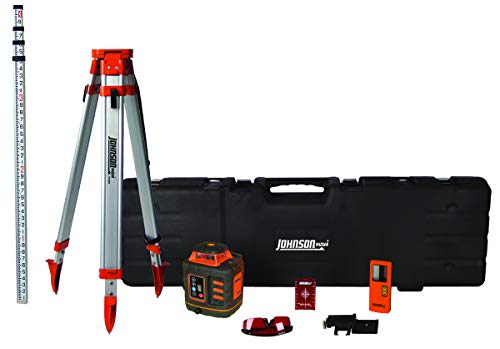
Johnson’s 99-027K includes the detector, tripod, and a rod with two graduation systems. That is useful for checking ground heights where the laser stays horizontal and the intended fall is represented by changing rod readings. The package also gives the measuring equipment a dedicated storage case between jobs.
The 99-027K self-levels horizontally and supports manual vertical alignment with a split beam. The system includes a detector and clamp, tripod, dual-graduated grade rod, batteries, target, and hard case. Its IP66 housing and locking compensator support site use and transport; this model does not provide slope adjustment.
Pros
- Detector, tripod, and rod included.
- Horizontal self-leveling.
- Dual rod graduations.
- IP66 enclosure.
- Locking compensator for transport.
Cons
- No slope-adjustment function.
- Vertical setup is manual.
This model has no slope adjustment, so choose it for the level-reference method. The dual graduations are convenient only if you read the correct face and keep the unit convention consistent throughout the run.
To buy this product, click here.
7. Bosch GRL900-20HVK Kit (Best for Mixed Site and Building Layout)

The GRL900-20HVK supplies a receiver, tripod, rod, and additional mounting equipment. It suits someone who needs ground-height checks outside and horizontal or vertical layout elsewhere in the building. For drainage, its useful role is a repeatable elevation reference connected to a clear benchmark.
The selected kit includes an LR10 receiver, tripod, grade rod, remote, wall mount, and case. Horizontal and vertical operation supports elevation transfer and interior alignment. Electronic leveling and a disturbance monitor help identify a changed setup; the linked package lists D-cell power for the transmitter.
Pros
- Horizontal and vertical operation.
- Electronic leveling.
- Disturbance monitor.
- Receiver, tripod, and rod included.
- Remote and wall mount supplied.
Cons
- Larger package than a compact wall laser.
- Do not assume numeric slope entry.
Select the package for its combination of measuring accessories and alignment modes. Do not infer numeric grade entry from its rotary design, and check a known point after any disturbance to the support.
To buy this product, click here.
8. DEWALT DW074KD (Best for a Detector-Included DEWALT Setup)

The DW074KD offers horizontal self-leveling with a supplied detector and clamp. For localized elevation checks, those components establish the working relationship between instrument and reading point. Its wall mount adds an indoor option, while the outdoor reference still depends on the separately arranged tripod and measuring rod.
Horizontal operation self-levels, while vertical setup uses manual alignment. The kit includes a DW0742 detector and clamp, wall mount, target, contractor bag, and batteries. A protective cage surrounds the rotary head; the selected package does not include a full-height tripod.
Pros
- Horizontal self-leveling.
- Included compatible detector and clamp.
- Vertical alignment option.
- Wall mount supplied.
- Protected rotor head and storage bag.
Cons
- Vertical leveling is manual.
- Tripod and rod are separate.
Its vertical setup is manual and its kit does not supply every field accessory. For grading, use the horizontal reference to check planned elevations and keep the rod method consistent rather than improvising a slope function.
To buy this product, click here.
9. Spectra Precision HV101-4 Kit (Best for Occasional Exterior Work Alongside Interior Layout)

The HV101-4 has a strong interior role with its scan controls, wall mount, and remote. It can also provide a horizontal reference for suitable exterior measurement, subject to the supplied receiver’s operating limits. It makes more sense here for a buyer with mixed jobs than for someone measuring a large yard every day.
The HV101 provides automatic horizontal and vertical leveling, with scan and rotation controls for interior layout. The selected HV101-4 package includes an HR150U receiver, RC601 remote, wall mount, and carrying case. The interior-oriented HR150U package should be distinguished from other HV101 kits supplied with an HR320 site receiver.
Pros
- Horizontal and vertical self-leveling.
- Scan and rotation controls.
- RC601 remote included.
- Wall mount supplied.
- HR150U receiver included.
Cons
- Tripod and grade rod are separate.
- Confirm receiver suitability for the intended site distance.
The HR150U package is different from HV101 field kits supplied with an HR320. Confirm the receiver arrangement for the intended distances; do not transfer the capability of one accessory package to another.
To buy this product, click here.
Choosing the Best Laser Level for Grading and Drainage
Choose Between a Level Datum and a Sloped Plane
A level laser can still help establish drainage. Measure the planned change in height with the rod while keeping the reference horizontal. A slope-capable laser can tilt the reference instead, but the operating method and checks matter. Decide which approach fits your job before comparing buttons or range figures. First understand reading a receiver against a fixed benchmark, since that relationship is what gives a station reading its elevation meaning.
Translate the Fall Into the Same Units as the Rod
A one-percent fall over twenty feet corresponds to 0.2 foot, or 2.4 inches, of elevation change. That arithmetic describes a measurement example, not a universal drainage requirement. Use the slope specified for the actual layout and a rod whose divisions make the required offsets easy to follow. The worked approach to relating the planned grade to your readings keeps percentage, run length, elevation difference, and rod units from being mixed.
Understand What Manual Slope Means
A manual slope mode lets you adjust an axis; it does not necessarily accept a percentage or hold both axes automatically. Some workflows require a separate remote. Establish two known reference points and follow the instrument’s procedure rather than assuming that a tilted beam has the intended fall.
Read Range Conventions Before Positioning the Tripod
An operating diameter spans both sides of the instrument. It is different from the maximum instrument-to-receiver distance. Place the tripod where the receiver can maintain a clear path around the required stations, with enough space to work without knocking the support or blocking the reference.
Keep the Benchmark Separate From Loose Ground
A reference mark on a surface that moves during excavation cannot preserve the original datum. Choose a stable benchmark, record the initial reading, and recheck it after interruptions or a warning. Soft ground under tripod feet can settle even when nobody visibly touches the instrument.
Buy the Whole Reading System
A detector alone is not a complete grading setup. You also need an appropriate holder, rod, stable support, and power arrangement. Check the selected package component by component. Inches, tenths of a foot, and metric divisions are different reading systems, not interchangeable labels on the same measurement.
Frequently Asked Questions
Can I Check Drainage With a Laser That Has No Slope Mode?
Yes. A horizontal laser provides a datum from which you compare rod readings at planned locations. The desired fall comes from your layout and calculated offsets. The instrument does not need to tilt for that method.
Does Manual Dual Slope Mean Digital Grade Entry?
No. Manual adjustment on two axes describes control over the plane’s angle. Numeric grade entry is a separate feature. Check the exact model’s controls rather than inferring that capability from a dual-slope label.
Will a Green Line Laser Replace a Rotary Receiver System?
Not automatically. Sunlight can make visible lines difficult to read. Some line lasers support a compatible receiver, but their geometry and operating limits differ from a dedicated horizontal rotary system.
Why Do Rod Readings Change as the Ground Gets Lower?
With the laser at a fixed horizontal height, a lower ground point usually produces a larger rod reading when the rod is held vertically. Keep the same reference surface and reading method so the comparison remains meaningful.
Which Kit Includes the Equipment to Start Taking Field Readings?
The Bosch complete rotary kits, Johnson system, and selected LL100N-2 package include a tripod, receiver, and rod. You still need to establish the benchmark, confirm the rod units, and follow the model’s setup procedure.
Can the Laser Decide Where Water Should Drain?
No. It transfers or compares elevations. The drainage layout must establish an appropriate outlet, route, and required fall before those elevations can be marked and checked.
Final Verdict
The Bosch GRL2000-40HVK is our overall choice for a buyer who wants manual dual-axis slope control and the supporting field equipment together. The Topcon RL-H5A is the more focused option for repeated horizontal elevation transfer with a receiver.
For a complete level-reference package, consider the Johnson 99-027K or LL100N-2. Choose the LL300N when its optional single-axis slope workflow fits the work, and include the remote in your setup plan. A stable benchmark and consistent rod readings will matter long after the case is opened.
