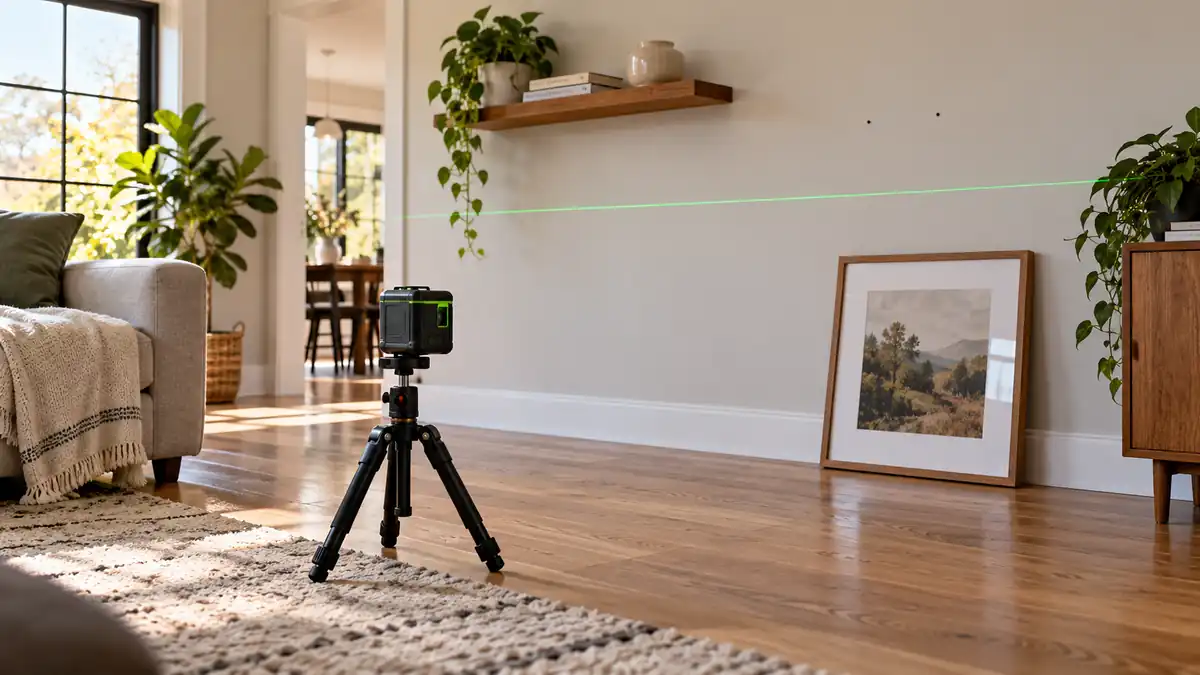
The last picture goes up, you step back from the sofa, and one frame is just high enough to bother you every time you walk past. A laser level puts a visible reference across the wall so you can plan the hook positions before the drill comes out. The best laser level for home use is the one whose beam layout and mounting method fit the jobs you actually have waiting.
That might mean a simple horizontal line for curtain rods, a vertical reference for wallpaper, or a continuous plane around a room for cabinets and trim. A rotating wall attachment and a 360° laser plane are different things, and manual bubble-vial alignment is different from automatic self-leveling. Get those distinctions right and the tool becomes easier to choose.
These nine picks cover everyday decorating through more involved indoor renovations, with attention to beam configuration, positioning, power, and included accessories. Start with the task in front of you, then use the quick choices below to narrow the field.
Quick Answer
Our overall pick is the Huepar B03CG Pro for a household with several renovation jobs ahead: its three green 360° planes cover more layouts than a simple cross-line tool. For curtains, shelves, and everyday wall references, the Bosch GLL50-20G offers a more compact configuration. Choose the SKIL LL932201 if an included floor-standing tripod solves your setup problem, or the Klein Tools 93LCLS when transferring points between floor and ceiling is part of the work.
Best Laser Level for Home Use Comparison Table
Use the beam and setup columns to spot the practical differences. Each product name jumps to its full review.
| Product | Best For | Beam Layout | Power and Setup |
|---|---|---|---|
| Huepar B03CG Pro | Best Overall | Three green 360° planes | Removable rechargeable battery; magnetic base |
| Bosch GLL50-20G | Simple Everyday Layout | Green horizontal and vertical cross lines | Two AA batteries; integrated magnetic mount |
| SKIL LL932201 | an Included Tripod | Red 360° horizontal plane and vertical line | Integrated rechargeable battery; adjustable tripod |
| DEWALT DW088K | a Protective Carrying Kit | Red horizontal and vertical cross lines | Three AA batteries; magnetic bracket; hard case |
| Klein Tools 93LCLS | Plumb Point Transfer | Red cross lines with plumb-up and plumb-down points | Three AA batteries; magnetic bracket; ceiling clamp |
| CIGMAN CM-701 | Remote Beam Control | Three green 360° planes | Built-in rechargeable battery; remote; mini base |
| BLACK+DECKER BDL220S | Angled Wall Decorating | Single wall line; manual vial alignment | Two AA batteries; rotating wall attachment |
| Johnson Level 9250 Laser Mouse | Adhesive Wall Positioning | Single red line; manual vial alignment | Two AA batteries; reusable adhesive strip |
| Bosch GLL1P | a Pocket-Size Line and Point Tool | Single red line or point; manual vial alignment | Bubble vials; multipurpose mounting accessory |
The reviews below explain where each setup helps, and which limitations could matter once you start marking the wall.
1. Huepar B03CG Pro (Best Overall)

Picture a weekend that starts with a row of floating shelves and ends with a cabinet run around the corner. The Huepar B03CG Pro is our overall pick for that mix of home projects because its one horizontal and two vertical 360° planes give you references across several surfaces from one position. You can keep a shelf line running around the room, then use the intersecting vertical planes when the layout needs more than a single cross on one wall.
The removable 5,200mAh battery and USB-C charging arrangement make this a different proposition from a little AA-powered decorating laser. The Amazon-listed kit includes a magnetic pivoting base, target plate, charging equipment, and hard case. For a kitchen layout, that combination gives you several positioning and storage options, although you still need a suitable mounting surface or a separately supplied tripod. The three-plane layout is the reason to choose it, rather than an assumption that every extra line improves a simple picture-hanging job.
Pros
- One horizontal and two vertical 360° planes support multi-surface layouts.
- Individually selectable beam combinations keep the active reference relevant.
- Removable rechargeable battery offers an alternative to disposable cells.
- Magnetic pivoting base provides a mounting option on suitable steel surfaces.
- Hard case and charging equipment are included in the listed kit.
Cons
- Full-size positioning tripod is not part of the listed kit.
- Three-plane configuration is more equipment than occasional single-wall decorating needs.
There is a catch to all that coverage: this is more equipment than you need to put two hooks above a nightstand. Its horizontal plane also does not turn the tool into a floor-flattening machine or an outdoor grading laser. We would choose the B03CG Pro for someone with a growing list of indoor renovations, then switch off unnecessary planes and keep the working line clear of obstructions. That is where its flexibility starts earning its space in the cupboard.
To buy this product, click here.
2. Bosch GLL50-20G (Best for Simple Everyday Layout)

For a curtain rod, a pair of shelves, or a picture above the sofa, a compact cross-line laser keeps the setup refreshingly straightforward. The Bosch GLL50-20G projects horizontal and vertical green lines, without asking you to manage three separate 360° planes. Its integrated magnetic mount lets you pivot the reference on suitable metal, while the small body is easier to tuck into a household tool drawer than a larger renovation kit.
Two included AA batteries get the tool running, and Bosch also supports its specified 3.7V lithium-ion pack as a separate option. That flexibility suits a room-by-room project: spare AAs can stay with the drill bits, while a frequent user can choose the compatible rechargeable pack. The Smart Pendulum System self-levels within its operating range, signals excessive tilt, and locks for transport. Set it on a stable support rather than balancing it on a wobbly stack of books, and those features make much more sense.
Pros
- Green horizontal and vertical lines cover common wall-layout tasks.
- Included AA batteries allow operation without a proprietary charger.
- Supports Bosch’s specified rechargeable battery as an alternative power source.
- Integrated magnetic mount helps position the tool on suitable metal.
- Pendulum transport lock and out-of-level indication support careful handling and setup.
Cons
- Does not project a continuous 360° horizontal plane.
- Rechargeable battery is separate, and listing accuracy information needs checking against the exact unit.
This is a sensible pick when you want a cross on the wall rather than a reference wrapped around the room. Bosch’s published specifications list ±1/4 inch at 30 feet; the Amazon listing presents a different figure, so confirm the specification for the exact unit before precision-sensitive work. For lining up everyday wall fixtures, we like the uncomplicated configuration, while a continuous cabinet layout may call for a 360° model instead.
To buy this product, click here.
3. SKIL LL932201 (Best With an Included Tripod)
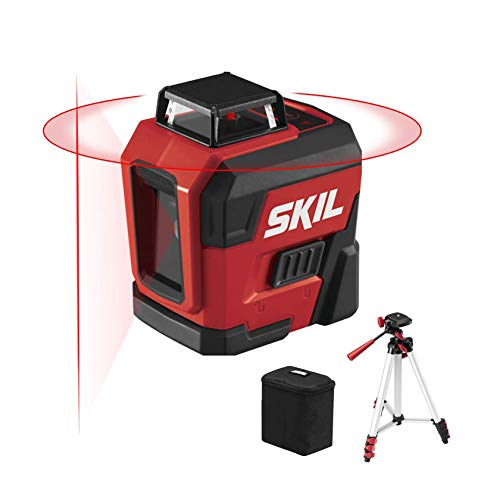
An empty room exposes a surprisingly practical problem: where do you put the laser? The SKIL LL932201 tackles that with an adjustable tripod in the box, alongside a red 360° horizontal reference and a vertical line. When you are marking chair rail around a dining room, the continuous horizontal plane is the useful part. You can mark several walls from the same setup instead of turning a short line toward each new section.
SKIL lists the included tripod at roughly 3½ feet maximum height, so it works for lower references without pretending to be a tall ceiling-installation stand. The integrated rechargeable battery uses micro-USB, and the charge indicators help you see when it is time to plug in. Its published accuracy is ±3/16 inch at 30 feet. For a row of matching frames around a room, that is a specification to evaluate at your actual working distance, rather than a promise of perfectly placed hooks.
Pros
- Includes an adjustable tripod rather than requiring one immediately.
- Continuous horizontal plane supports references around multiple walls.
- Vertical line adds an alignment reference for wall layouts.
- Integrated rechargeable battery reduces reliance on disposable cells.
- Manual locking mode permits intentionally angled reference lines.
Cons
- Included tripod reaches only about 3½ feet.
- Charging uses micro-USB rather than USB-C.
For tall curtain rods, the bundled tripod may leave you arranging another stable support or choosing a taller compatible stand. Also, micro-USB is a different cable from the USB-C leads many households now keep beside their chargers. Those are practical compromises, but the basic package has a clear purpose: a ready-made floor-standing setup for ordinary indoor layout. Choose it when the tripod solves a real positioning problem, rather than collecting another accessory you will never unfold.
To buy this product, click here.
4. DEWALT DW088K (Best for a Protective Carrying Kit)

A laser that travels between a closet shelf, a garage bench, and a half-finished hallway needs somewhere sensible to live. The DEWALT DW088K comes in a hard storage case and uses an overmolded housing with a manufacturer-listed one-meter drop rating. That makes it an appealing option for a household that actually moves its tools between jobs. The rating describes a stated protection feature, though, and is no invitation to drop a precision instrument down the stairs.
Its red horizontal and vertical lines address familiar indoor jobs, such as aligning wall brackets or setting a vertical reference beside a door opening. DEWALT’s manual specifies ±1/8 inch at 30 feet and three AA batteries. The magnetic bracket provides one mounting route, while the 1/4-20 thread gives you another if you already own a suitable tripod. A case is useful; a secure working position is still the part you must arrange.
Pros
- Hard storage case is included.
- Overmolded housing has a documented one-meter drop rating.
- Horizontal and vertical lines address common interior alignment jobs.
- Integrated magnetic bracket provides a positioning option.
- Standard AA power avoids dependence on a tool-platform battery.
Cons
- Tripod and compatible detector are separate accessories.
- Cross-line projection does not provide continuous room-wide horizontal coverage.
For hanging shelves in one room, the simple cross-line layout may be all you need. For continuous references around several walls, the Huepar or SKIL configurations are a closer fit. The DW088K’s quoted extended range also depends on a compatible detector sold separately, not on seeing the red line across a sunny yard. We would choose this model for indoor layouts where a protective storage package and conventional battery supply matter more than room-wrapping coverage.
To buy this product, click here.
5. Klein Tools 93LCLS (Best for Plumb Point Transfer)

Sometimes the awkward part is above your head. If a ceiling position needs to correspond with a mark below, the Klein Tools 93LCLS adds plumb-up and plumb-down points to its horizontal and vertical lines. That gives it a specific job in a home renovation, beyond another line across the wall. Think of transferring a reference while planning a ceiling layout, then returning to the horizontal line for a nearby mounting rail.
The integrated bracket rotates and provides 1/4-20 and 5/8-11 mounting threads, while an additional ceiling-grid clamp broadens the setup options. Klein includes three AA batteries and a hard case. Its specification separates cross-line accuracy from plumb-point accuracy, an important distinction when a tiny ceiling mark matters. Do not borrow the horizontal-line tolerance and assume the upward and downward points share it.
Pros
- Separate plumb-up and plumb-down points support vertical reference transfer.
- Horizontal and vertical lines can be selected independently or together.
- Integrated magnetic bracket offers rotational positioning.
- Two documented tripod thread sizes broaden mounting options.
- Ceiling-grid clamp, AA batteries, and hard case are included.
Cons
- Does not provide three continuous 360° planes.
- Additional plumb functions and mounting pieces are unnecessary for basic decorating alone.
For a simple hallway gallery, those point-transfer functions may stay unused. For an unfinished room where ceiling and wall references need to relate, they can be the feature that makes the choice worthwhile. This is still a cross-line-and-point tool, not three continuous planes. Pick it for that extra vertical reference capability, and check your final fixture position and mounting requirements before reaching for the drill.
To buy this product, click here.
6. CIGMAN CM-701 (Best for Remote Beam Control)

You have the tape measure stretched across a wall, a pencil between your fingers, and the wrong laser plane glowing beside your mark. A remote control is a small convenience that makes sense in exactly that sort of setup. The CIGMAN CM-701 combines remote beam control with one horizontal and two vertical 360° planes, giving it a clear role in larger indoor layouts where repeatedly walking back to the unit gets tiresome.
The kit lists a magnetic L-base, mini tripod base, target plate, remote, and USB-C cable. Those pieces offer several ways to position the tool while planning tile or matching trim on adjoining walls, but the mini base is not a full-height tripod. CIGMAN specifies a built-in 4,000mAh rechargeable battery and self-leveling operation within the stated tilt range. The remote changes the operating controls; it does not move the physical laser line onto your pencil mark, so careful positioning still comes first.
Pros
- Included remote controls beam settings without returning to the tool.
- One horizontal and two vertical planes support multi-surface layout.
- USB-C charging suits a rechargeable household setup.
- Magnetic L-base and mini tripod base provide positioning choices.
- Selectable self-leveling and manual modes support different reference tasks.
Cons
- Built-in battery does not provide an AA-battery fallback.
- Mini tripod base does not replace a full-height positioning stand.
Choose this over the Huepar when remote operation is a feature you expect to use, rather than treating two three-plane models as identical boxes of green light. The built-in battery also means you cannot simply swap in fresh AA cells midway through a task. For a small picture wall, the extra planes are optional complexity. For several connected surfaces in a room, remote beam selection is the detail worth paying attention to before you unfold the measuring tape.
To buy this product, click here.
7. BLACK+DECKER BDL220S (Best for Angled Wall Decorating)

A staircase picture arrangement creates a different puzzle from a straight row of shelves: the reference may need to slope on purpose. The BLACK+DECKER BDL220S has a rotating wall attachment and an angle-reference ring for that sort of decorating layout. It is a wall-line tool with backlit bubble vials, rather than a three-plane laser designed to stand in the middle of a room. That distinction matters before the first pin touches the drywall.
Although some listings call it self-leveling, the manufacturer’s operating instructions tell you to rotate the unit until the bubble is centered. Treat it as manually aligned. The same instructions describe a drywall pin for hands-free mounting, so this is not a promise of hole-free attachment. For a line of frames along a stairwell, the rotating arrangement is useful; for a rental wall, the mounting method deserves a closer look.
Pros
- Rotating wall attachment allows intentional angled layouts.
- Angle-reference ring helps set a chosen direction on the wall.
- Backlit horizontal and vertical vials aid manual alignment.
- Listed package includes the wall attachment and AA batteries.
- Wall-mounted operation keeps the reference close to decorating work.
Cons
- Requires manual bubble alignment despite self-leveling wording in some listings.
- Drywall-pin mounting leaves a hole and is not suitable for every surface.
The backlit vials and included AA batteries keep the setup focused on ordinary decorating, with no rechargeable pack to manage. Be careful with the “360-degree” wording: it describes the attachment’s rotation, not a horizontal laser plane projected around the room. We would choose the BDL220S for deliberate angled lines and short wall-layout jobs, then move to a pendulum self-leveling model when the project calls for repeated independent level references.
To buy this product, click here.
8. Johnson Level 9250 Laser Mouse (Best for Adhesive Wall Positioning)

If the wall is where you need the reference, an adhesive-mounted laser offers a different approach from arranging a tripod across the room. The Johnson Level 9250 Laser Mouse uses the manufacturer’s reusable SuperStick strip and built-in horizontal and vertical vials. It is a compact manual tool for tasks such as lining up a small picture arrangement or marking a shelf position, with the reference sitting close to the work.
Johnson lists a 30-foot interior range, but its stated accuracy is ±1/2 inch at 20 feet. That is an important limit, and it keeps us from recommending it for demanding cabinet or tile layouts simply because the beam can reach the wall. For a short decorative alignment, consider the tolerance over the distance you actually need. Test adhesive compatibility discreetly and follow surface instructions rather than assuming that a claim of non-marking attachment guarantees an undamaged finish on every paint or wallpaper.
Pros
- Reusable adhesive strip provides a wall-positioning alternative to a pin.
- Horizontal and vertical vials support manual reference alignment.
- Compact body keeps the setup close to the work surface.
- Included AA batteries avoid a separate charging setup.
- Protective carrying pouch is supplied for storage.
Cons
- Manual vial alignment is required.
- Stated ±1/2-inch accuracy at 20 feet limits precision-sensitive applications.
Two included AA batteries and a carrying pouch make it a compact addition to a small household toolkit. There is no automatic pendulum to take care of alignment, so check the vial after positioning the tool. We would pick the Laser Mouse when adhesive attachment is the particular convenience you want for light decorating. For longer references or closer tolerances, the manual setup and published accuracy are reasons to choose one of the other options.
To buy this product, click here.
9. Bosch GLL1P (Best for a Pocket-Size Line and Point Tool)

Sometimes the useful tool is the one that fits beside a pencil and small tape measure. The Bosch GLL1P combines a single laser line, a point projection, and built-in bubble vials in a pocket-size format. For a short shelf reference or a nearby wall mark, it offers a different way to work from carrying a three-plane unit and its case into the room. You supply the alignment rather than waiting for a pendulum to settle.
The distinction between the line and the point is particularly important here. Bosch’s product information separates a shorter line projection from the longer point function, so do not read the advertised point reach as a promise of the same length of visible wall line. The mounting accessory supports different positions, including a compatible 1/4-20 tripod connection. On a cramped desk-side project, a compact reference can help; across several walls, a continuous plane is the more suitable geometry.
Pros
- Pocket-size format is convenient for small household layouts.
- Combines line and point projection in one tool.
- Built-in bubble vials allow manual reference alignment.
- Mounting accessory offers alternatives to holding the unit by hand.
- Compatible tripod interface provides another positioning option.
Cons
- Manual alignment offers no automatic self-leveling compensation.
- Single-line geometry does not provide a simultaneous cross or room-wide plane.
We see this as a small-job companion for someone comfortable checking bubble vials, not a direct replacement for the self-leveling models above. The point function transfers a visible reference in its direction of projection; it is not the same as the Klein’s dedicated plumb-up and plumb-down arrangement. Choose the GLL1P for its pocket-size line-and-point combination, and keep that distinction in mind when the next job moves from a shelf to a ceiling.
To buy this product, click here.
Buying Guide
Match the Beam to the Layout
Look at the room before looking at the number of laser lines. A shelf bracket needs a horizontal reference; a wallpaper drop needs a vertical one. A cross-line tool provides both directions on the wall, while a full horizontal plane can carry a cabinet or chair-rail reference around several walls from one position. For the first few fixtures, positioning a laser for household jobs helps separate establishing the beam from transferring the fitting dimensions.
Point transfer is another task again. A ceiling mark directly over a floor reference calls for appropriate plumb capability, not simply a longer visible line. For an ordinary picture wall, that extra function may sit idle, so let the layout tell you which geometry is useful.
Decide How You Will Hold the Reference
A magnetic bracket is handy on suitable steel, but the painted wall above your sofa is not a magnetic surface. A tripod can create a stable position away from the wall, while a mounting pole may be useful higher up. Check the connection and usable height before assuming that a spare camera stand or bundled mini base solves the problem. Work through choosing a stable support at the required height before assuming the spare stand in the closet will put the reference where you need it.
Wall pins and adhesives have their own trade-offs. A pin makes a hole; an adhesive depends on the surface and finish. For a rental apartment or delicate wallpaper, plan the mounting method before the tool arrives rather than discovering the limitation with a fresh pencil mark on the wall.
Read Accuracy at Its Stated Distance
An accuracy number without a distance tells you very little. A tolerance stated at 20 feet is not directly equivalent to one stated at 30 feet, and a long working range does not guarantee a fine reference. Use the exact model’s documentation and consider the width of the room and the finish you are trying to achieve.
Before a cabinet run or another alignment-sensitive project, follow the manufacturer’s accuracy-check procedure. A transport lock and protective case help with handling, but neither proves calibration after a knock. Mark the reference carefully and recheck it if the stand or laser moves.
Understand Self-Leveling and Manual Modes
A self-leveling laser compensates only within its stated operating range. If it flashes an out-of-level warning, correct the setup rather than treating the line as ready to use. A crowded worktop or springy floor can still disturb the reference even when the pendulum itself is functioning.
Manual mode is useful when an angled line is intentional, as with a stairway picture arrangement. That line is straight but deliberately not level. Do not treat a locked pendulum or a rotating wall attachment as calibrated slope control for drainage work.
Choose a Power Arrangement You Will Maintain
AA batteries are straightforward to replace during an afternoon of hanging fixtures. Rechargeable packs reduce the need to keep spare cells nearby, while removable packs and built-in batteries offer different ways of managing longer projects. Check the actual configuration rather than assuming that a USB port makes the battery replaceable.
Also check the cable. The SKIL uses micro-USB; the Huepar and CIGMAN selections use USB-C charging arrangements. Keeping the right lead with the case is a small detail that prevents the next project from starting with a hunt through the cable drawer.
Keep Indoor and Outdoor Expectations Separate
A green line can be useful indoors, but it is not a guarantee of visibility across a sunny yard. Outdoor elevation work may need a compatible receiver, a suitable rod, and a tool designed for the task. Receiver support and an included receiver are separate claims, so read the kit contents closely.
For the indoor projects covered here, mounting and beam layout usually deserve more attention than a headline extended-range number. Avoid direct eye exposure, follow the model’s safety instructions, and remember that a bright reference line does not locate hidden wiring or establish a safe anchor point for a heavy shelf.
Best Laser Level for Home Use FAQ
Do I Need a 360° Laser Level for Hanging Pictures?
Usually, a single-wall picture arrangement does not require a full 360° plane. A suitable line or cross-line tool can provide the reference. A continuous plane becomes more useful when you want matching heights on several walls, such as frames arranged around a dining room.
Does a Rotating Wall Attachment Mean the Laser Projects All Around the Room?
No. Rotation describes movement of the mount or tool. A 360° plane describes the projected reference itself. The BLACK+DECKER BDL220S has a rotating wall attachment; the SKIL LL932201 projects a continuous horizontal plane. Those produce different working setups.
Will a Laser Level Make My Shelves Perfectly Straight?
It provides a reference for positioning, not a guarantee about the finished installation. Hook offsets, bracket holes, shelf construction, anchor choice, and movement during drilling still matter. A laser also cannot confirm that the wall will safely support a loaded shelf.
Can I Use the Floor or Ceiling as My Starting Reference?
You can measure from either surface, but do not assume it is level. In an older room, repeatedly measuring the same distance below a sloping ceiling can produce a sloping row of marks. Establish the intended laser reference and decide how the layout should relate visually to the surrounding room.
Do All Magnetic Laser Levels Stick to Walls?
No. A magnetic mount needs suitable metal. Drywall, wood, tile, and many other household surfaces do not provide that connection by themselves. Check whether your setup needs a tripod, pole, clamp, screw-mounted bracket, or another manufacturer-supported positioning method.
Is a Pocket Line-and-Point Laser the Same as a Plumb Laser?
No. A point projected forward is not automatically a reference directly above or below the instrument. If you need to transfer a floor point to a ceiling, choose a model with documented plumb capability and follow its positioning instructions.
Should I Buy the Model With the Most Accessories?
Only if the included pieces solve your setup needs. A short tripod may be useful for low trim but unsuitable for a high curtain rod. A ceiling-grid clamp has little purpose on a plain living-room wall. Match the accessories to the height, surface, and connection you will actually use.
Final Verdict
The Huepar B03CG Pro is our overall choice for a household moving beyond occasional decorating into several indoor renovation jobs. Its three-plane layout and removable rechargeable battery give it room to handle changing tasks. If your list is mostly shelves, curtains, and wall fixtures, the compact Bosch GLL50-20G is the simpler configuration to consider instead.
The setup can be just as decisive as the laser. Choose the SKIL LL932201 when its included tripod fits the working height, or the Klein Tools 93LCLS when you need dedicated plumb-point transfer. Before you make the first mark, decide where the tool will sit, which reference the job needs, and whether the mounting surface will cooperate. Those choices matter more than collecting beams you will never use.
