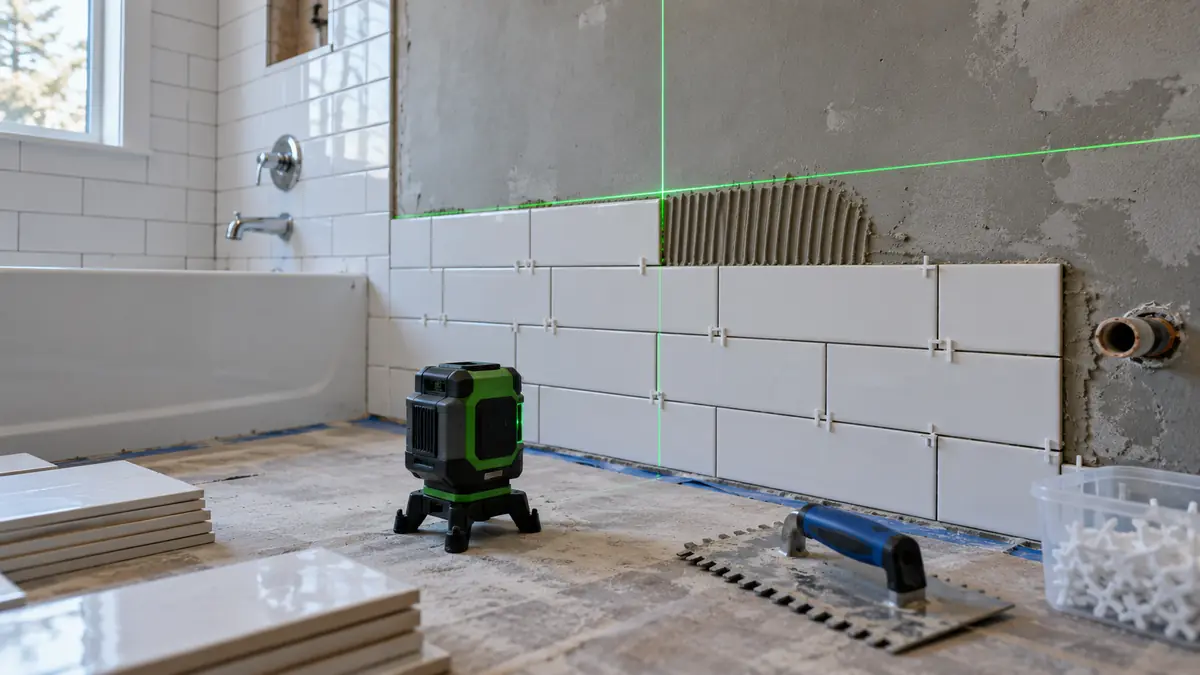
A tile layout can drift a little at every joint until the last row makes the problem obvious. The right laser provides a reference before adhesive turns a tentative arrangement into a permanent one. The first decision is whether you need a level line on a wall, a square pattern on the floor, or both. The best laser level for tile work depends on whether you need a wall-course reference, a square floor layout, or both.
Those are different jobs. A low horizontal plane can help compare heights, while a surface-layout laser projects perpendicular references for the pattern. Neither physically flattens a floor or proves that a shower has the correct drainage. Choose the geometry for the work rather than the most impressive line count on the box.
Our nine selections cover wall alignment, connected planes, low references, and dedicated tile squares. Positioning and surface conditions matter as much as the projected lines, especially when the job moves from a backsplash to a full bathroom.
Quick Answer
- Best Overall: Huepar S04CG-C Kit. Two horizontal and two vertical 360° planes. Power: Rechargeable pack or AA holder.
- Best for Floor Pattern Layout: Bosch GTL3. 0°, 90°, and optional 45° surface layout. Power: AA batteries.
- Best for Connected Wall Layouts: Huepar B03CG Pro. Three green 360° planes. Power: Removable rechargeable battery.
Compare the Nine Picks
| Laser level | Best fit | Reference layout | Power and positioning |
|---|---|---|---|
| Huepar S04CG-C Kit | Best Overall | Two horizontal and two vertical 360° planes | Rechargeable pack or AA holder; Magnetic bracket and lifting base |
| Bosch GTL3 | Best for Floor Pattern Layout | 0°, 90°, and optional 45° surface layout | AA batteries; Steel positioning plate |
| Huepar B03CG Pro | Best for Connected Wall Layouts | Three green 360° planes | Removable rechargeable battery; Magnetic pivoting base |
| CIGMAN CM-701 | Best for Remote Plane Control | Three green 360° planes | Built-in rechargeable battery; Magnetic L-base and mini base |
| DEWALT DW089LG | Best for a DEWALT Battery Setup | Three green 360° planes | DEWALT 12V MAX battery platform; Magnetic bracket and ceiling bracket |
| Bosch GLL3-330CG | Best for Fine Positioning Options | Three green 360° planes | Bosch 12V Max or AA adapter; BM1 positioning device |
| Klein Tools 93PLL | Best for Plane Intersections | Three green 360° planes | Integrated rechargeable battery; Magnetic bracket; hard case |
| Huepar 902CG | Best for Two-Plane Wall References | Green 360° horizontal and vertical planes | Four AA batteries; Magnetic base; tripod interface |
| Motovera LL-T2 | Best for Small Backsplash Layouts | Green horizontal and vertical cross lines | AA battery supply; Adjustable magnetic bracket |
1. Huepar S04CG-C Kit (Best Overall)

For a project that moves from a bathroom floor to tiled walls, the S04CG-C’s low horizontal reference and additional upper plane offer a useful combination. Two vertical planes extend the available layout references. The lifting base is particularly relevant when a small change in the lower line’s position helps the measurements.
Four green planes include a low horizontal reference in addition to the upper horizontal plane. The S04CG documentation describes LCD status, Bluetooth controls, rechargeable-pack power, and an AA holder. The lifting base changes the low reference position; pulse operation requires an appropriate Huepar receiver, supplied separately.
Pros
- Upper and lower horizontal references.
- Two vertical planes for connected layouts.
- Lifting base helps position the low line.
- Rechargeable and AA-holder power choices.
- LCD status and remote operating controls.
Cons
- Four-plane setup adds bulk and complexity.
- Compatible receiver and full-height tripod are separate.
Choose this for mixed height-reference and wall-layout work. For a floor pattern that primarily needs perpendicular surface guides, the dedicated Bosch GTL3 serves a different and more specialized function.
To buy this product, click here.
2. Bosch GTL3 (Best for Floor Pattern Layout)

A diagonal pattern needs more than a level height around the room. The GTL3 supplies square and 45° surface references, with a pivot arrangement that assists centering. Its raised beams are intended to pass small obstructions, which can matter as the work area fills with tiles and spacers.
The GTL3 creates square and diagonal references for wall or floor covering layout. An offset pivot point assists positioning, while raised beams can clear small surface obstructions. Magnets secure it to the included steel positioning plate or suitable ferrous surfaces; it is not a substitute for a self-leveling elevation plane.
Pros
- Purpose-built square floor-layout references.
- Additional 45° guide for diagonal patterns.
- Offset pivot point supports centering.
- Raised beams help clear small obstructions.
- Steel positioning plate supplied.
Cons
- Does not provide automatic room-height leveling.
- Surface layout still needs deliberate positioning and a sound reference.
Use it to establish pattern geometry, not to claim the substrate is level. The positioning plate helps locate the tool but does not compensate automatically for a tilted or unstable support.
To buy this product, click here.
3. Huepar B03CG Pro (Best for Connected Wall Layouts)

A horizontal plane around a room can carry a wall-course reference through several tiled areas. The B03CG Pro adds two vertical planes for the intersections and edges you need to compare. That coverage is useful when the layout extends beyond one small backsplash.
One horizontal and two vertical planes can be selected in different combinations. The listed package contains a removable 5,200mAh battery, USB-C charging equipment, magnetic base, target, and hard case. Receiver operation requires an appropriate Huepar receiver, which is separate from this kit.
Pros
- Three full planes cover adjoining surfaces.
- Selectable beam combinations avoid unnecessary lines.
- Removable rechargeable battery supports repeated indoor projects.
- Magnetic base provides positioning on suitable steel.
- Hard case and charging equipment are included.
Cons
- Full-height positioning tripod is not included.
- Outdoor receiver must be supplied separately.
Plan the support so that stacks of tile do not hide every reference. It is a three-plane layout laser rather than a dedicated square that projects along the floor surface.
To buy this product, click here.
4. CIGMAN CM-701 (Best for Remote Plane Control)

The CM-701 lets you select its green planes remotely while remaining near the wall being marked. That can help when the instrument sits beyond a protected work area. Three continuous planes provide several layout relationships without repeatedly turning the laser toward the next wall.
One horizontal and two vertical planes support multi-surface references. The listed kit includes a remote, magnetic L-base, mini tripod base, target plate, USB-C cable, and bag. A built-in 4,000mAh battery powers the tool; the mini base is not a full-height stand.
Pros
- Three continuous planes for connected layouts.
- Remote beam controls included.
- USB-C charging.
- Magnetic and mini-base positioning choices.
- Self-leveling and manual modes.
Cons
- No AA-battery fallback.
- Mini base does not replace a full-height tripod.
Keep the mini base away from disturbed substrate and remember that it is not a tall stand. Remote beam selection cannot correct an instrument that has physically moved.
To buy this product, click here.
5. DEWALT DW089LG (Best for a DEWALT Battery Setup)

For repeated wall-layout work, the DW089LG combines three green planes with a documented 12V MAX battery kit. Its brackets offer alternative working positions, and the protective case gives the instrument a storage location away from the tile-cutting area.
The DW089LG projects three 360° green planes and uses the specified 12V MAX battery platform. The documented kit includes a battery, charger, extended ceiling bracket, target card, and carrying case. Full-time pulse operation supports a compatible detector, supplied separately, while the housing carries an IP65 rating.
Pros
- Three full green reference planes.
- Uses the specified removable 12V MAX battery.
- Battery and charger included in the listed kit.
- Extended ceiling bracket and case supplied.
- Documented detector mode and IP65 housing.
Cons
- Detector and full-height tripod are separate.
- Battery compatibility is limited to the documented platform.
Check battery compatibility and keep the windows clear of dust. The housing rating describes protection, not resistance to being covered with adhesive or dropped onto a newly tiled floor.
To buy this product, click here.
6. Bosch GLL3-330CG (Best for Fine Positioning Options)

The BM1 positioning device is a practical reason to consider the GLL3-330CG for detailed room layouts. It pairs with three green planes and connected operating controls. Where the reference must meet an existing mark without upsetting the whole support, positioning features deserve real attention.
Three green planes can be controlled through Bosch’s connected operating system. The listed package supports its Bosch 12V Max battery or four AA batteries with the required adapter. The specified LR8 receiver extends the operating range to 330 feet in diameter, not radius, and is separate from the base kit.
Pros
- Three-plane green layout.
- Connected operating controls.
- Documented 12V and AA-adapter power options.
- BM1 positioning device included.
- Supported LR8 receiver operation.
Cons
- LR8 receiver is separate.
- Connected functions add setup beyond basic wall alignment.
Use its capability where the layout needs it. The line remains a reference, and a clean intersection does not certify the flatness, waterproofing, or bond of the completed tile work.
To buy this product, click here.
7. Klein Tools 93PLL (Best for Plane Intersections)

The 93PLL provides horizontal and vertical planes that can be selected independently or together. Their intersections add useful layout references around a room, including plumb locations when the geometry supports them. This is a different arrangement from a single line following one wall.
The X, Y, and Z planes can project independently or together. Intersecting vertical planes provide plumb reference locations rather than separate point emitters. The current product page lists a rechargeable power arrangement, magnetic bracket, USB charging cable, and hard case.
Pros
- Three continuous green planes.
- Independent or combined plane operation.
- Plumb reference at vertical-plane intersections.
- Integrated magnetic mount.
- Charging cable and hard case supplied.
Cons
- No conventional AA-battery fallback.
- Plane intersections are different from dedicated point emitters.
Choose it when continuous planes and their intersections simplify the layout. Keep the charging supply available and avoid treating an intersection as an automatically chosen starting point for the pattern.
To buy this product, click here.
8. Huepar 902CG (Best for Two-Plane Wall References)

For a tiled wall, one continuous horizontal plane can carry the course height while a vertical plane provides an upright reference. The 902CG offers that combination without adding a second vertical plane. Its AA supply and magnetic base provide a different setup from the rechargeable three-plane options.
The 902CG projects one full horizontal and one full vertical plane. Its manual specifies four AA batteries and independent or combined plane operation. Pulse mode supports use with a suitable Huepar line receiver, supplied separately.
Pros
- Two continuous green reference planes.
- Standard AA battery supply.
- Independent plane selection.
- Magnetic positioning base.
- Documented receiver operating mode.
Cons
- No second vertical plane for a three-plane layout.
- Compatible receiver is separate.
Use it for wall-height and vertical references, with an appropriate stable support. Its geometry is different from the GTL3’s surface-square guides, so do not treat the two instruments as interchangeable floor-layout tools.
To buy this product, click here.
9. Motovera LL-T2 (Best for Small Backsplash Layouts)

For a contained wall area, the LL-T2’s green cross can provide the horizontal and vertical references without a large multi-plane kit. Brightness adjustment and its positioning bracket are the useful features when the line needs to meet a visible pencil mark near the work.
The LL-T2 uses green cross lines with four selectable brightness settings. The listing describes a magnetic fine-adjustment bracket and a 1/4-20 tripod interface. Self-leveling and locked manual modes serve different layouts; its rotating mount does not make it a rotary grading laser.
Pros
- Green horizontal and vertical references.
- Four brightness settings.
- Self-leveling and manual modes.
- Magnetic positioning bracket.
- Standard tripod interface.
Cons
- Not a rotary elevation laser despite some listing terminology.
- Bundle contents should be checked for the selected variant.
Use it for the wall-reference task and inspect the selected bundle. A rotating bracket does not turn this compact cross-line model into a floor-pattern square or rotary grade laser.
To buy this product, click here.
Choosing the Best Laser Level for Tile Work
Separate Wall Alignment From Floor Squaring
A horizontal line can guide a wall course; perpendicular surface lines help establish a floor pattern. A tool that provides one function does not necessarily provide the other. Decide which references must remain visible as the work covers the substrate. The process of carrying an interior layout reference between surfaces helps keep the tile reference connected to the adjoining cabinet and finish layout.
Check the Lowest Usable Reference
For low-level work, the height of the laser plane above its support matters. A low window or lifting base may be useful, but it does not measure floor flatness automatically. Compare distances from a known reference at the points that matter.
Plan Around Tile and Adhesive Obstructions
Tiles, spacers, tools, and adhesive can block a surface line. Raised layout beams can help clear small obstructions, while an overhead horizontal plane may remain visible elsewhere. Position the instrument so that the next section of work does not immediately hide the reference.
Verify Pattern References Independently
Do not assume the room’s walls are square or that every edge should determine the pattern. Check dimensions, intended cuts, and the layout plan. A laser square provides geometric references, but it does not choose attractive or appropriately sized edge cuts for you. Understanding the difference between a cross and a continuous plane makes it easier to choose useful coverage without assuming that every pattern needs the same geometry.
Keep the Instrument Out of the Work
Use a stable support beyond the main traffic and adhesive area. Magnetic brackets need suitable metal; a lifting base needs a steady surface. Dust and splashes can affect visibility, and an IP rating is not permission to coat or immerse the instrument.
Check the Reference Before Committing
Follow the model’s accuracy checks, establish the intended datum, and recheck after movement. Manual surface tools require careful bubble alignment where relevant. For showers or exterior paving, the required slope and waterproofing remain separate installation requirements.
Frequently Asked Questions
Is a Tile Laser the Same as a Self-Leveling Laser?
No. A dedicated surface-layout tool may project square or diagonal references without automatically establishing level height. Read the actual operating method rather than assuming that every tile laser has a pendulum.
Does a Laser Remove the Need to Check Floor Flatness?
No. It provides a reference for measurements. You still need to assess the substrate and follow the tile and installation-system requirements. A projected line does not flatten high spots or fill low areas.
Why Would I Need a Low Horizontal Plane?
It can make height comparisons close to the floor more convenient. The useful height depends on the job and support arrangement. It should not be confused with surface-projected square layout lines.
Can I Use Manual Mode for Shower Drainage?
A tilted line can be a reference, but a generic manual mode does not establish a calibrated drainage slope. Follow the installation design and use an appropriate method to measure and confirm the required fall.
Do More Vertical Planes Improve Every Tile Job?
No. They can help with connected wall layouts and intersections, but a small backsplash may only need a suitable cross-line reference. Consider coverage and mounting before adding complexity.
Can Adhesive Mounts Be Used on Finished Tile?
Only where the attachment instructions and surface finish permit it. Cleanliness, texture, residue, and removal all matter. Test compatibility and do not assume an adhesive strip is suitable for every glazed or porous surface.
Final Verdict
The Huepar S04CG-C is our overall selection for tile work that benefits from both low and upper horizontal references plus connected vertical planes. The Bosch GTL3 is the more specialized choice for square and diagonal floor-pattern layout. They address different reference problems, so choose between them by the actual work.
For a small backsplash, a compact cross-line model may be enough. Before spreading adhesive, check the instrument, support, substrate, and layout plan. A visible reference can keep the geometry organized, while the installation requirements still determine whether the finished work is sound.
