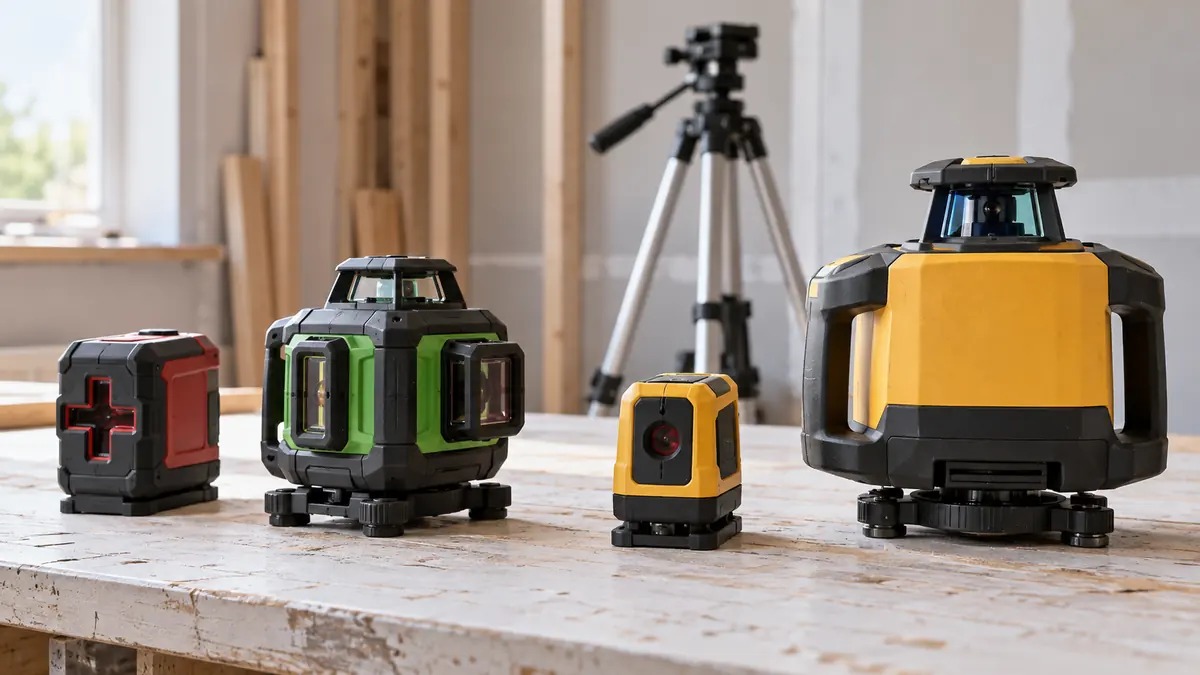
The main types of laser levels differ first in the reference they project: a line on a surface, continuous planes, discrete points, or a rotating reference used across a site. Those differences determine what you can mark. Beam color, battery supply, and mounting equipment matter too, but they describe other parts of the choice.
A rotating bracket is not the same as a laser plane that wraps around a room. Likewise, a dot projected forward is not automatically a point directly above the instrument. Reading those distinctions correctly prevents a tool with an impressive description from arriving with the wrong geometry for the job.
For matching heights around adjoining indoor walls, these 360-degree laser level options show the continuous-plane configurations worth comparing. For a different task, use the reference types below to work out which shortlist will actually help.
Types of Laser Levels at a Glance
| Type | What you work from | Typical reason to use it | A distinction to check |
|---|---|---|---|
| Line or cross-line | One or more lines on the work surface | Wall fixtures and local horizontal/vertical layout | A local cross may not continue around the room |
| Continuous-plane line laser | A reference extending around the instrument | Connected interior heights or intersecting planes | Check which planes are continuous, not just the advertised line count |
| Dot or point | Discrete reference positions | Specified plumb or alignment transfers | Point directions and their relationship vary |
| Combination | Lines plus documented point functions | Jobs needing both surface marks and point transfer | Read the specifications for each function |
| Rotary | A rotating reference, commonly read with a receiver | Comparing elevations across outdoor stations | Level, vertical, and grade capabilities are model-dependent |
Line and Cross-Line Lasers: A Reference Where You Are Working
A horizontal line can connect shelf marks along a wall. Add a vertical line and you can relate a position to a plumb reference as well. This is useful when a task needs a cross at the work surface rather than references spread through the whole room.
Some decorating tools require manual bubble-vial alignment. Other line lasers self-level within their specified conditions. The presence of a projected line does not tell you which mechanism is inside, and intentionally angling a manually aligned tool does not turn its line into a level reference.
Compare cross-line laser configurations when a focused wall layout fits the job. Pay attention to support height and reach: a cross that is hidden by the fitting or projected from an awkward position may be less useful than its product photograph suggests.
Continuous Planes: Useful Coverage, Not Automatic Precision
A continuous horizontal plane lets several walls share a height reference from one instrument position, provided the beam can reach them. That can simplify a cabinet or trim layout around corners. Physical obstructions still interrupt what you can see and mark.
Additional vertical planes can relate other surfaces or create intersections. They do not automatically make a simple shelf installation more accurate. The geometry offers more reference options; the tool’s stated accuracy and the way it is set up remain separate considerations.
Look for a description of the actual plane arrangement. “Three lines,” “three planes,” and a marketing label describing a configuration are not substitutes for a clear diagram of what the instrument projects. Choose the active references the task needs and leave unnecessary ones off when the controls permit it.
Dot Lasers and Combination Tools
Points become useful when you need to relate specific positions rather than draw a visible line across a wall. A documented plumb-up/plumb-down arrangement can transfer a floor reference to an overhead position. Other point layouts serve different alignment functions.
Before selecting a dot tool, check the direction of each point, how the instrument must be positioned over the starting mark, and which accuracy specification applies. Do not borrow a horizontal-line tolerance and apply it to a separate point function.
The dot laser level options guide separates the available point arrangements. A combination tool may be more appropriate if your work alternates between overhead transfers and ordinary wall lines, but those extra functions should have an actual use.
Rotary Lasers: A Reference Read Across the Site
A rotary instrument creates a rotating reference. In a field setup, a compatible receiver on a rod lets you locate that reference at a measurement station where relying on the visible beam would be impractical.
The receiver, rod, support, and benchmark are part of the working arrangement. An advertised transmitter range alone does not tell you what is in the selected package, whether a receiver is compatible, or how the elevations will be read.
Use the rotary laser options when comparing those systems. Then follow how a rotary reference is read with a receiver to understand what the field components actually contribute. A continuous indoor line laser and a rotary instrument can both be described with full-circle coverage, but their measurement routines are not interchangeable.
Red and Green Are Colors, Not Separate Layout Geometries
You can have a red cross-line tool, a green cross-line tool, or other reference arrangements in either color. Beam visibility depends on conditions as well as the instrument. Color alone does not establish the tolerance of the tool, the suitability of its support, or whether it accepts a particular receiver.
When visibility is the reason for comparing green-beam laser level choices, keep the rest of the specification in view. An indoor reference that is easy to find does not become a dependable visible line across a sunny yard simply because it is green.
Choose the Missing Capability
Write down the mark you cannot presently make. If it is a matching height around several walls, continuous coverage may help. If it is an overhead point tied to a floor position, investigate documented plumb transfer. If it is a site elevation, think about the complete receiver-based system.
Next, consider comparing accuracy, power, and kit contents. A useful geometry can still arrive without the support, battery, or receiver needed for your intended routine. Conversely, an accessory-rich kit can add equipment without solving the original marking problem.
Keep that task description beside you while reading specifications. It is a more useful filter than collecting the largest number of beams or treating every full-circle description as the same tool.
