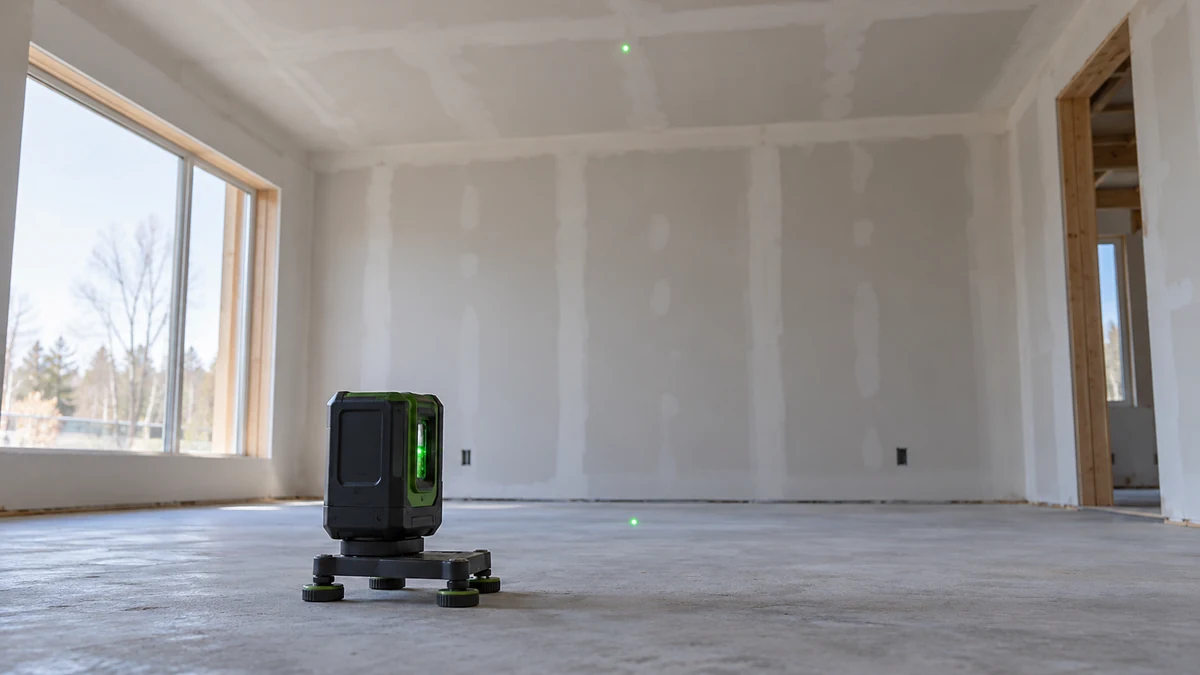
A mark on the floor needs a partner on the ceiling. A long wall line can help with alignment, but a discrete plumb dot makes that particular transfer easier to read. Point lasers keep the reference focused, which is useful when the job is about locations rather than a continuous baseline. The best dot laser level provides the documented point directions you need to carry a position, rather than simply adding a forward-facing dot.
Three-point instruments commonly provide up, down, and forward references. Five-point tools add horizontal directions for square layout. Combination models bring lines and dedicated dots together, while three-plane lasers create intersections instead of necessarily providing isolated spot emitters.
These nine choices include focused three-point instruments, five-point layout tools, and line-and-dot combinations. Each has a different reason to be here. Choose around the mark you need to transfer, the available mounting position, and the tolerance of that particular reference.
Quick Answer
- Best Overall: Bosch GPL100-50G. Five green points.
- Best Focused Three-Point Tool: Bosch GPL100-30G. Three green points.
- Best Green DEWALT Three-Spot Option: DEWALT DW083CG. Three green reference points.
Compare the Nine Picks
| Product | Best fit | Reference layout | Power and positioning |
|---|---|---|---|
| Bosch GPL100-50G | Best Overall | Five green points | Two AA batteries; Integrated magnetic rotating mount; 1/4-20 |
| Bosch GPL100-30G | Best Focused Three-Point Tool | Three green points | AA battery supply; Integrated magnetic mount; 1/4-20 |
| DEWALT DW083CG | Best Green DEWALT Three-Spot Option | Three green reference points | Four AA batteries; Integrated magnetic pivoting bracket |
| DEWALT DW085K | Best for Fine Orientation Adjustment | Five red reference points | AA battery supply; Magnetic pivoting bracket with micro-adjustment |
| STABILA LA-5P G | Best with a Removable Framing Base | Five green reference points | Three AA batteries; Removable framing base, V-groove magnet and wall bracket |
| Pacific Laser Systems PLS 5G | Best Focused PLS Five-Point Tool | Five green reference points | Battery-powered point laser; Pendulum lock and protective housing |
| Klein Tools 93LCLS | Best Red Lines-and-Dots Combination | Red cross lines and plumb points | Three AA batteries; Magnetic bracket and ceiling clamp |
| Bosch GCL 2-160 | Best Rotating Line-and-Point Mount | Red cross lines with dedicated plumb points | AA battery supply; RM1 magnetic rotating mount and ceiling clip |
| Huepar 7211CG | Best with a Continuous Horizontal Reference | Horizontal 360° plane, vertical line and two plumb dots | Rechargeable battery; Magnetic bracket |
1. Bosch GPL100-50G (Best Overall)

The GPL100-50G gives discrete plumb and right-angle references without surrounding the room with wall lines. That is useful for interior point layout where a compact green dot is the clearest mark. Its integrated magnetic mount helps position the tool close to suitable metal framing.
The GPL100-50G produces five discrete green points, including up-and-down plumb and right-angle layout references. Bosch specifies a different tolerance for the bottom point, so one accuracy figure should not be applied to every dot. The integrated magnetic mount, locking pendulum, and hard case support positioning and transport.
Pros
- Five discrete green reference points.
- Right-angle point layout.
- Integrated magnetic mount.
- AA power.
- Locking pendulum and hard case.
Cons
- Bottom-point tolerance differs from the other specified references.
- No projected wall lines.
Check the bottom-point tolerance separately. A five-point layout still needs correct orientation to the intended baseline before the side references are used.
To buy this product, click here.
2. Bosch GPL100-30G (Best Focused Three-Point Tool)

The GPL100-30G is the simpler choice when up, down, and forward points cover the work. It suits a specific floor-to-ceiling transfer without adding square-layout points that may only create confusion. The protective rotating arrangement is useful when the tool moves between positions.
The GPL100-30G projects three discrete green points for level and plumb transfer. Its Smart Pendulum System self-levels within its working range and indicates an out-of-level condition. The magnetic mounting arrangement and protective rotating housing suit focused point work without adding wall-line projection.
Pros
- Three-point reference layout.
- Green point visibility.
- Automatic leveling.
- Magnetic positioning mount.
- Locking pendulum for transport.
Cons
- No right-angle side-point pair like a five-point model.
- Does not project a continuous line.
Choose it for three-point geometry. A layout needing horizontal right-angle references should be compared with a genuine five-point model.
To buy this product, click here.
3. DEWALT DW083CG (Best Green DEWALT Three-Spot Option)

The DW083CG offers dedicated green points with a magnetic pivoting bracket. For a discrete ceiling position, that can be more direct than trying to interpret the crossing of several planes. Replaceable AA power also keeps the instrument independent of a cordless-tool charger.
The DW083CG is a three-spot green laser for discrete plumb and level transfers. Its integrated magnetic bracket and locking pendulum support setup and transport. The operating manual identifies four AA batteries and IP54 protection; its point geometry does not produce a continuous wall line.
Pros
- Three green reference points.
- Self-leveling point transfer.
- Magnetic pivoting bracket.
- Locking pendulum.
- Replaceable AA supply.
Cons
- No projected cross lines.
- No side-point pair for five-point square layout.
It does not project wall lines. Plan a separate line reference if the same job also needs a continuous row of wall marks.
To buy this product, click here.
4. DEWALT DW085K (Best for Fine Orientation Adjustment)

The DW085K adds five red points and a micro-adjustment control. That makes it useful when a small orientation correction is needed to align square references with an established baseline. Its track clearance is relevant when the instrument sits beside interior framing material.
The DW085K provides five discrete red references for point transfer and right-angle layout. Its micro-adjustment control helps orient the horizontal point references over a longer layout. The magnetic pivoting bracket includes track clearance, and the pendulum locks when the tool is switched off.
Pros
- Five discrete points.
- Right-angle point references.
- Micro-adjustment control.
- Integrated magnetic bracket.
- Track clearance and locking pendulum.
Cons
- Red points may be harder to see in bright conditions.
- No continuous line projection.
Confirm the point layout at the required distance. The adjustment control refines orientation but does not establish the baseline for you.
To buy this product, click here.
5. STABILA LA-5P G (Best with a Removable Framing Base)
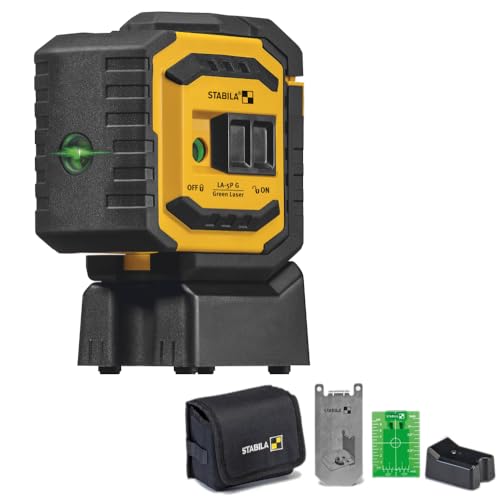
The LA-5P G includes a removable framing base and several mounting routes. That combination suits point layout where the instrument must sit beside track, attach to suitable metal, or use a wall bracket. The distinct point tolerances deserve attention before a tall transfer.
The LA-5P G provides five green dots for plumb transfer and right-angle layout. Its removable framing base and V-groove magnet offer different positioning routes. The selected 03165 set identifies a target plate, wall bracket, and belt pouch; point-specific tolerances should be checked for the actual transfer.
Pros
- Five green points.
- Removable framing base.
- V-groove magnetic mounting.
- Wall bracket supplied.
- AA-powered operation.
Cons
- No projected wall lines.
- Up, down, level, and square references have separate tolerances.
Choose it when the supplied positioning parts fit the job. Read the tolerance for the particular up, down, level, or square reference being used.
To buy this product, click here.
6. Pacific Laser Systems PLS 5G (Best Focused PLS Five-Point Tool)

The PLS 5G concentrates on plumb, level, and square points in a protected green-beam instrument. It suits someone who wants the discrete reference geometry without adding a cross-line function. The pendulum lock is useful when moving the tool between layout stations.
The PLS 5G is a five-point green instrument for plumb, level, and square alignment. Its pendulum locks for transport, and the housing is rated IP54 for dust and water protection. This selected listing is the laser tool, so check the named package when adding a stand or other support accessories.
Pros
- Five green point references.
- Plumb transfer.
- Square alignment geometry.
- Pendulum lock.
- IP54 housing.
Cons
- No continuous wall-line projection.
- Support accessories depend on the selected package.
Check the exact tool package and support accessories. A five-point body does not guarantee that every stand or mount shown elsewhere is included.
To buy this product, click here.
7. Klein Tools 93LCLS (Best Red Lines-and-Dots Combination)

The 93LCLS combines a local red cross with dedicated plumb points. That is useful when one setup must move between wall alignment and ceiling transfer. The ceiling clamp and magnetic bracket give it a different support package from a point-only tool.
The tool combines horizontal and vertical lines with dedicated plumb-up and plumb-down points. Klein supplies a magnetic bracket, ceiling-grid clamp, AA batteries, and hard case. Cross-line accuracy is specified separately from the two plumb-point tolerances.
Pros
- Dedicated upward and downward plumb points.
- Lines can operate independently or together.
- Magnetic bracket rotates for positioning.
- Supports 1/4-20 and 5/8-11 mounting threads.
- Ceiling clamp and hard case included.
Cons
- No three-plane continuous projection.
- Additional point-transfer functions may be unnecessary for simple wall work.
Use the separate dot tolerance when transferring a point. The cross-line specification should not be applied to every optical reference.
To buy this product, click here.
8. Bosch GCL 2-160 (Best Rotating Line-and-Point Mount)
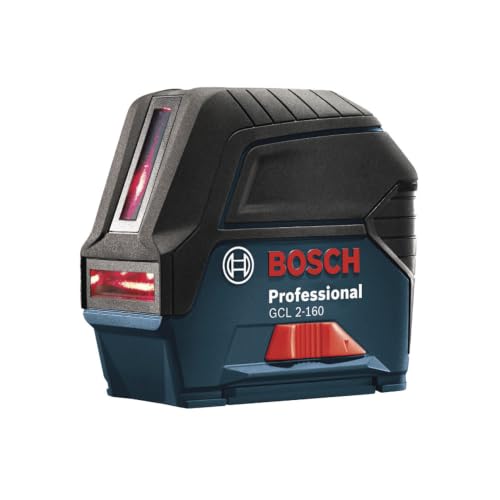
The GCL 2-160 supplies a local red cross and dedicated plumb points on an RM1 rotating mount. That arrangement is useful when you want to change line direction while maintaining the relationship to the plumb reference. A ceiling-grid clip adds another interior mounting route.
The GCL 2-160 combines horizontal and vertical red lines with dedicated up-and-down plumb points. Its RM1 mount rotates around the plumb reference, and the selected package includes a ceiling-grid clip. Receiver mode supports specified Bosch line detectors, including the LR8 identified by Bosch; the receiver is separate.
Pros
- Dedicated plumb points.
- Horizontal and vertical lines.
- RM1 rotating mount.
- Ceiling-grid clip included.
- Specified receiver support.
Cons
- No continuous horizontal plane.
- Receiver is separate.
Check that the support is secure before rotating. If the whole mount moves, the original transferred location must be verified again.
To buy this product, click here.
9. Huepar 7211CG (Best with a Continuous Horizontal Reference)

The 7211CG adds a complete horizontal reference to its vertical line and dedicated plumb dots. That makes it a useful combination when point transfer is only one part of a room layout. It can carry a common height while retaining isolated up-and-down references.
The 7211CG combines a continuous horizontal green reference with a vertical line. Dedicated up-and-down plumb dots add discrete floor-to-ceiling transfer to that line layout. Its rechargeable arrangement and magnetic bracket suit interior setup; this geometry is different from a three-plane laser with intersections only.
Pros
- Dedicated up-and-down dots.
- Continuous horizontal reference.
- Vertical alignment line.
- Rechargeable supply.
- Magnetic bracket.
Cons
- Not a five-point square-layout instrument.
- No second complete vertical plane.
It is not a five-point square-layout instrument. Choose it for the combination of room-height coverage and discrete plumb transfer.
To buy this product, click here.
Choosing the Best Dot Laser Level
Choose Three Points, Five Points, or a Combination
Three points can be enough for discrete plumb transfer. Five points add square-layout directions. A combination model is useful when wall lines and dedicated dots both belong in the job. Picture the exact marks before adding beam types that may not be needed. Understanding what dot and combination lasers actually project keeps a forward-facing spot from being mistaken for a documented overhead transfer.
Check the Tolerance of the Actual Point
Up and down points may have different specifications, and a combination tool can specify lines separately from dots. Use the figure at the stated distance that applies to the transfer. One headline accuracy number is not necessarily valid for every reference on the instrument.
Leave Access to the Floor Mark
A tool body or bracket can obscure the point you need to position over. Check track clearance, base shape, and the mounting instructions before choosing. A useful setup lets you see and mark the reference without moving the instrument midway through the transfer. For framing, transferring plumb references during rough-in starts with positioning the instrument against the correct floor control.
Establish Orientation Before Using Square Points
A five-point tool provides reference geometry, but it still needs to face the intended baseline. Align the relevant forward reference, verify the layout dimensions, and then use the side points. A clearly visible right-angle dot is not proof that the original baseline is correct.
Keep the Support Stable During Transfer
Moving a bracket, touching a tripod, or walking across a springy floor can change the instrument position. Let the leveling system settle and recheck the original mark after adjustments. A locking pendulum protects transport; it does not preserve a moved point during work.
Do Not Confuse Dots with Plane Intersections
Two vertical planes can create a useful plumb intersection, but that is not the same physical reference as an isolated point emitter. The available mounting position and target surface decide which is easier to use. Choose the geometry deliberately rather than relying on a three-plane label.
FAQ
What Is a Dot Laser Used For?
It transfers discrete plumb, level, or square reference points. Common interior tasks include carrying a location from floor to ceiling or establishing related point directions from a planned baseline.
Are Five Points More Accurate Than Three?
Point count describes geometry rather than accuracy. Compare the relevant tolerance at the stated distance and check whether the extra horizontal references are useful for the job.
Can a Three-Plane Laser Replace Plumb Dots?
It can serve some related transfers through plane intersections, but the working reference differs. Check whether the intersection reaches the target clearly from the available instrument position.
Do Dot Lasers Also Project Wall Lines?
Point-only models do not. The Klein 93LCLS, Bosch GCL 2-160, and Huepar 7211CG combine dedicated dots with line references, which is why they have distinct roles here.
Can a Normal Line Receiver Detect the Dots?
Do not assume that. Receivers depend on supported signal types and operating modes. A visible static dot is not automatically compatible with a pulsed-line detector.
What Should I Check After Dropping a Point Laser?
Follow the manufacturer’s accuracy-check procedure before relying on it again. Inspect the mount and body, and verify the relevant point transfer against the documented check arrangement.
Final Verdict
The Bosch GPL100-50G is our overall choice for a five-point green instrument. Choose the GPL100-30G or DEWALT DW083CG when three-point transfer is sufficient, and the DW085K when fine orientation control is useful.
For mixed wall-line and point work, compare the Klein 93LCLS, Bosch GCL 2-160, and Huepar 7211CG. The best dot laser is the one whose actual reference can be positioned, read, and checked clearly at both ends of the transfer.
