
Once a project moves from one shelf to a whole room, the setup begins to matter as much as the line itself. Cabinets turn corners, trim continues behind a doorway, and the place where you planned to stand the laser fills with tools. Useful upgrades are the ones that solve those working problems. A useful search for the best laser level under 200 begins with the room-layout problem your next tool needs to solve.
This selection compares broader indoor capabilities without treating the most elaborate instrument as an automatic winner. Three-plane coverage, a supplied tripod, remote beam controls, or alternative power can each be the important feature for a different household. A simple cross-line model can still be the right choice for a contained job.
The picks below offer different ways to position a reference, power the tool, and carry a line across the work. Confirm the exact model and included components before ordering, then choose the configuration that fits the projects ahead.
Quick Answer
- Best Overall: Huepar B03CG Pro. Three green 360° planes. Power: Removable rechargeable battery.
- Best for Remote Operation: CIGMAN CM-701. Three green 360° planes. Power: Built-in rechargeable battery.
- Best With a Floor-Standing Support: SKIL LL932201. Red 360° horizontal plus vertical line. Power: Integrated rechargeable battery.
Compare the Nine Picks
| Laser level | Best fit | Reference layout | Power and positioning |
|---|---|---|---|
| Huepar B03CG Pro | Best Overall | Three green 360° planes | Removable rechargeable battery; Magnetic pivoting base |
| CIGMAN CM-701 | Best for Remote Operation | Three green 360° planes | Built-in rechargeable battery; Magnetic L-base and mini base |
| SKIL LL932201 | Best With a Floor-Standing Support | Red 360° horizontal plus vertical line | Integrated rechargeable battery; Included adjustable tripod |
| Bosch GLL50-20G | Best for Compact Everyday Work | Green horizontal and vertical lines | AA or specified Bosch Li-ion pack; Integrated magnetic mount |
| DEWALT DW088K | Best for Protective Storage | Red cross lines | Three AA batteries; Magnetic bracket; tripod thread |
| Klein Tools 93LCLS | Best for Dedicated Point Transfer | Red cross lines and plumb points | Three AA batteries; Magnetic bracket and ceiling clamp |
| DEWALT DW088CG | Best for Green Cross-Line References | Green horizontal and vertical cross lines | Three AA batteries; Integrated magnetic bracket |
| Huepar M-9011G | Best for a Small Indoor Kit | Green horizontal and vertical cross lines | AA battery supply; Magnetic pivoting base |
| Motovera LL-T2 | Best for Adjustable Line Brightness | Green horizontal and vertical cross lines | AA battery supply; Adjustable magnetic bracket |
1. Huepar B03CG Pro (Best Overall)

The B03CG Pro is our overall pick when the next project extends beyond a single wall. Three green planes let you carry a cabinet or trim reference around a room and add vertical intersections. The removable rechargeable battery makes its working arrangement different from the integrated-battery alternatives.
One horizontal and two vertical planes can be selected in different combinations. The listed package contains a removable 5,200mAh battery, USB-C charging equipment, magnetic base, target, and hard case. Receiver operation requires an appropriate Huepar receiver, which is separate from this kit.
Pros
- Three full planes cover adjoining surfaces.
- Selectable beam combinations avoid unnecessary lines.
- Removable rechargeable battery supports repeated indoor projects.
- Magnetic base provides positioning on suitable steel.
- Hard case and charging equipment are included.
Cons
- Full-height positioning tripod is not included.
- Outdoor receiver must be supplied separately.
Choose it for a varied indoor renovation list. Plan the stand or pole separately because the magnetic base does not attach to every surface.
To buy this product, click here.
2. CIGMAN CM-701 (Best for Remote Operation)

The CM-701 gives a multi-plane setup a remote beam-control option. That can be useful when you are marking at the far side of a room or working around materials that block the route back to the instrument. Its mini base and magnetic bracket provide distinct positioning choices.
One horizontal and two vertical planes support multi-surface references. The listed kit includes a remote, magnetic L-base, mini tripod base, target plate, USB-C cable, and bag. A built-in 4,000mAh battery powers the tool; the mini base is not a full-height stand.
Pros
- Three continuous planes for connected layouts.
- Remote beam controls included.
- USB-C charging.
- Magnetic and mini-base positioning choices.
- Self-leveling and manual modes.
Cons
- No AA-battery fallback.
- Mini base does not replace a full-height tripod.
Choose it when remote selection will actually help the working sequence. A built-in battery and short base have different practical limits from spare cells and a full-height stand.
To buy this product, click here.
3. SKIL LL932201 (Best With a Floor-Standing Support)
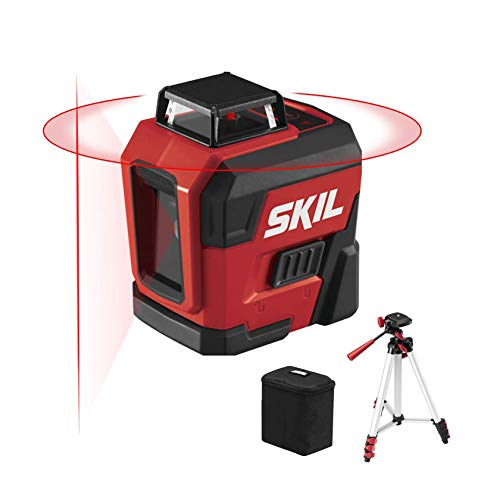
The SKIL’s supplied tripod addresses the empty-room mounting problem directly. Its continuous horizontal plane also carries a common height around several walls. That pairing can be more useful for trim than extra vertical planes that the project does not need.
The laser projects one continuous horizontal plane and a vertical reference line. The included tripod reaches approximately 3½ feet; charging is by micro-USB. SKIL specifies ±3/16 inch at 30 feet and provides a locking mode for intentional angled lines.
Pros
- Continuous horizontal reference around the room.
- Vertical line adds a second reference direction.
- Adjustable tripod included.
- Integrated rechargeable battery.
- Manual mode supports intentionally angled layouts.
Cons
- Included tripod has limited maximum height.
- Micro-USB charging requires the matching cable.
Measure the required working height before relying on the included stand. Its short maximum height and micro-USB cable are practical details to plan around.
To buy this product, click here.
4. Bosch GLL50-20G (Best for Compact Everyday Work)

The GLL50-20G keeps a green cross-line reference in a compact package. Its standard-cell and optional rechargeable-pack arrangements suit different usage patterns. For short shelves and wall fixtures, that can be a more manageable setup than a larger three-plane instrument.
The Smart Pendulum System self-levels, indicates excessive tilt, and locks for transport. The package includes two AA batteries and a soft pouch; the compatible Bosch 3.7V rechargeable pack is separate. The compact cross-line configuration prioritizes a wall reference over continuous room coverage.
Pros
- Horizontal and vertical green reference lines.
- Included AA batteries avoid an initial charger requirement.
- Supports Bosch’s specified rechargeable pack.
- Integrated magnetic positioning mount.
- Pendulum lock and out-of-level warning.
Cons
- No continuous 360° horizontal plane.
- Manufacturer and retailer accuracy figures differ; check the exact unit.
Choose the focused wall configuration when continuous coverage is unnecessary. Check the manufacturer’s exact-unit specification if the job has close alignment requirements.
To buy this product, click here.
5. DEWALT DW088K (Best for Protective Storage)

The DW088K’s hard case, magnetic bracket, and conventional AA supply make it a clear option for tools that move between small projects. Its documented red cross-line reference serves a contained wall layout without adding a rechargeable platform to manage.
The red horizontal and vertical lines are rated at ±1/8 inch at 30 feet in DEWALT’s manual. An integrated magnetic bracket, overmolded housing, and hard carrying case support positioning and storage. The 165-foot extended range requires the compatible DW0892 detector, sold separately.
Pros
- Horizontal and vertical alignment references.
- Standard AA power.
- Integrated magnetic bracket.
- Hard carrying case included.
- Supports a specified detector for extended operation.
Cons
- Detector and tripod are separate.
- Cross lines do not wrap continuously around a room.
Choose it for the handling and storage arrangement, not for full-room horizontal coverage. The extended detector-assisted function requires another compatible accessory.
To buy this product, click here.
6. Klein Tools 93LCLS (Best for Dedicated Point Transfer)

The 93LCLS adds upward and downward plumb points to the usual cross lines. That gives it a role when an indoor layout connects marks at different heights. The ceiling-grid clamp and two mounting thread sizes add setup possibilities beyond a simple magnetic base.
The tool combines horizontal and vertical lines with dedicated plumb-up and plumb-down points. Klein supplies a magnetic bracket, ceiling-grid clamp, AA batteries, and hard case. Cross-line accuracy is specified separately from the two plumb-point tolerances.
Pros
- Dedicated upward and downward plumb points.
- Lines can operate independently or together.
- Magnetic bracket rotates for positioning.
- Supports 1/4-20 and 5/8-11 mounting threads.
- Ceiling clamp and hard case included.
Cons
- No three-plane continuous projection.
- Additional point-transfer functions may be unnecessary for simple wall work.
Choose the Klein when point transfer is part of the project. Its extra functions and mounting pieces may be unnecessary for a basic row of pictures.
To buy this product, click here.
7. DEWALT DW088CG (Best for Green Cross-Line References)

The DW088CG offers a green version of the conventional wall-layout configuration with its own documented detector compatibility. For brackets or fixtures on one wall, the cross-line geometry can be enough. It uses AA power rather than requiring a removable tool-platform battery.
The DW088CG provides a green cross-line configuration with a magnetic mounting bracket. DEWALT’s operating instructions list ±1/8 inch at 30 feet for the line reference. Detector-assisted use requires the compatible green-line detector; it is not included in the basic laser kit.
Pros
- Green wall-layout references.
- Documented line accuracy at a stated distance.
- AA battery power.
- Integrated magnetic bracket.
- Supports specified green-line detector operation.
Cons
- Compatible detector is separate.
- No continuous horizontal plane around the room.
Choose the green cross for its specific indoor role. Do not use it as evidence that every green laser remains visible across a sunny yard.
To buy this product, click here.
8. Huepar M-9011G (Best for a Small Indoor Kit)

The M-9011G focuses on horizontal and vertical green references in a compact body. A smaller wall-layout project can make good use of that configuration without opening a larger multi-plane case. Its manual mode provides an additional route for intentional angled marks.
This compact Huepar model projects horizontal and vertical green lines rather than full-room planes. The published product information describes self-leveling and locked manual operation with a magnetic pivoting base. It is an indoor-focused cross-line option; do not assume that another Huepar model’s receiver capability applies.
Pros
- Green horizontal and vertical references.
- Compact cross-line arrangement.
- Self-leveling operation.
- Manual mode for intentional angles.
- Magnetic pivoting positioning base.
Cons
- No continuous 360° horizontal plane.
- Receiver compatibility must not be assumed.
Choose the exact M-9011G variant for the documented features. Receiver claims from a different Huepar model do not carry over automatically.
To buy this product, click here.
9. Motovera LL-T2 (Best for Adjustable Line Brightness)

The LL-T2 gives you brightness choices and an adjustable bracket for an ordinary green cross-line setup. Those are useful controls when the working wall changes from shade to brighter room lighting. It is still the positioning and reference geometry that determine whether it fits the task.
The LL-T2 uses green cross lines with four selectable brightness settings. The listing describes a magnetic fine-adjustment bracket and a 1/4-20 tripod interface. Self-leveling and locked manual modes serve different layouts; its rotating mount does not make it a rotary grading laser.
Pros
- Green horizontal and vertical references.
- Four brightness settings.
- Self-leveling and manual modes.
- Magnetic positioning bracket.
- Standard tripod interface.
Cons
- Not a rotary elevation laser despite some listing terminology.
- Bundle contents should be checked for the selected variant.
Check the selected bundle and its support equipment. The listing’s rotary terminology should not be mistaken for a spinning elevation laser.
To buy this product, click here.
Choosing the Best Laser Level Under 200
Choose a Useful Upgrade
A full horizontal plane helps carry a reference around several walls. A second vertical plane helps with additional intersections. If the job stays on one wall, neither feature automatically improves the result. Identify what your current setup cannot do before choosing a larger instrument.
Compare Complete Working Setups
An included tripod can matter more than another beam if the room has nowhere to place the laser. A hard case helps storage, while a remote changes operating controls. Compare the support and power arrangement together with the instrument rather than reading the beam configuration alone. A useful buying check is matching the kit contents to the planned work, including the supply and support needed to turn the instrument into a working arrangement.
Keep Battery Arrangements Compatible
AA cells, removable proprietary packs, and integrated batteries behave differently when the charge runs out. Choose the documented supply that suits how you work. The same brand name or a matching voltage label does not establish compatibility between battery series.
Check Fine Positioning and Height
Moving the whole tripod for every small correction can disturb the setup. A useful bracket or fine adjustment may make alignment more practical, but it still needs a stable mounting surface. Check the working height of the actual included support.
Understand Additional Reference Functions
Plumb points and intersecting vertical planes can support point transfer, but they are different optical arrangements. A forward point is not an upward point. Make sure the extra function corresponds to the reference you need rather than counting it as an interchangeable feature. Decide which laser pattern the layout actually needs before counting additional dots or planes as useful upgrades.
Inspect Before an Installation Session
Check the exact model’s accuracy procedure, clean windows, and stable placement before fastening work. Repeat the check if the instrument or mount is knocked. More features do not remove the need to establish and preserve the intended datum.
Frequently Asked Questions
Is a Three-Plane Laser Always the Best Choice?
No. It is useful for connected surfaces and intersecting references. A compact cross-line instrument may be easier to position for a single wall. The right configuration depends on the actual layout.
Does a Remote Adjust the Height of the Line?
Usually it controls operating functions such as beam selection. It does not physically reposition the instrument unless a specific motorized positioning function is documented. Set the support and reference height first.
Should I Choose an Included Tripod Over More Planes?
Choose the feature that solves the job’s constraint. A suitable tripod helps only if it reaches the needed height. More planes help only if their geometry is useful to the layout.
Can I Use Rechargeable AA Cells?
Follow the model’s battery instructions. Do not assume that every tool designed for alkaline cells supports every rechargeable chemistry or voltage. Use the documented power configuration.
What Does a Plumb Point Add?
It provides a reference direction above or below the instrument when specifically designed for that function. That can help transfer locations between surfaces. Its tolerance may differ from the line accuracy.
Why Should I Recheck a Tool With a Hard Case?
A case helps transport and storage, but it does not prove calibration. A knock, unstable setup, or moved support can affect the reference you use. Follow the manufacturer’s checking procedure before critical work.
Final Verdict
The Huepar B03CG Pro is our overall selection for a broader indoor project list, with CIGMAN offering remote controls and SKIL offering a supplied tripod and continuous horizontal reference. The compact cross-line alternatives remain sensible when the job does not need room-wide geometry.
Select the feature that removes a real working limitation. Whether that is point transfer, support height, battery supply, or a second vertical plane, confirm the exact package and check the reference before the installation begins. That is more useful than collecting functions that stay switched off.
