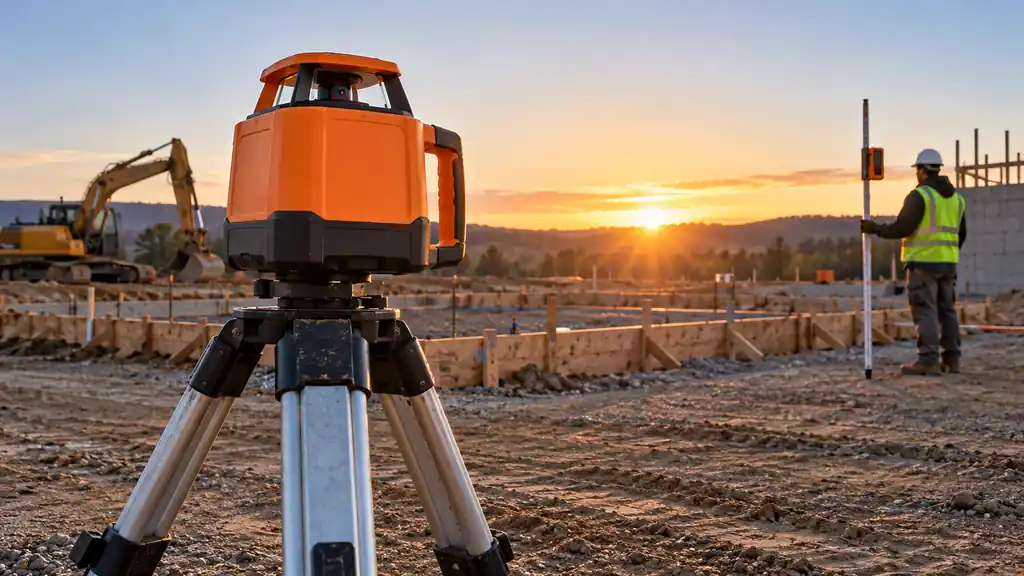
A receiver starts beeping, the rod reaches its mark, and a height reference becomes usable across a bright work area. That is the practical appeal of a rotary laser. Instead of relying on a visible wall line, the rotating beam and compatible detector let you compare elevations around the instrument. The best rotary laser level depends on the reference you need to establish and the field equipment required to read it.
Rotary models are not interchangeable. Some concentrate on a horizontal datum, others operate vertically for alignment, and a few offer manual slope workflows. An automatic horizontal setup also does not mean the same instrument levels itself automatically in vertical mode.
The best rotary laser level fits the work you repeat most often. These nine choices range from dedicated outdoor height-transfer tools to complete field systems and interior-capable packages. Match the operating modes and included receiver first, then decide which accessories you still need to carry to the job.
Quick Answer
- Best Overall: Topcon RL-H5A Receiver Kit. Horizontal rotary reference.
- Best for Repeated Horizontal Site Work: Spectra Precision LL300N with HL450. Horizontal rotary reference.
- Best for Manual Dual Slope: Bosch GRL2000-40HVK Kit. Horizontal/vertical rotary; manual dual slope.
Compare the Nine Picks
| Product | Best fit | Reference layout | Power and positioning |
|---|---|---|---|
| Topcon RL-H5A Receiver Kit | Best Overall | Horizontal rotary reference | Specified D-cell or rechargeable configuration; Receiver holder; tripod separate |
| Spectra Precision LL300N with HL450 | Best for Repeated Horizontal Site Work | Horizontal rotary reference | Four D-cell batteries; HL450 receiver and clamp; tripod separate |
| Bosch GRL2000-40HVK Kit | Best for Manual Dual Slope | Horizontal/vertical rotary; manual dual slope | Battery-powered selected kit; Receiver, tripod, rod, remote and wall mount |
| Bosch GRL900-20HVK Kit | Best for a Mixed-Use Complete Kit | Horizontal and vertical rotary operation | Selected alkaline-battery kit; LR10 receiver, BT160 tripod and grade rod |
| Johnson Level 99-027K System | Best for a Detector, Tripod and Rod System | Horizontal rotary; manual vertical alignment | Four C-cell batteries; Detector, tripod and 13-foot rod |
| Spectra Precision LL100N-2 Kit | Best for an Inch-Graduated Starter System | Horizontal rotary reference | Two D-cell batteries; Tripod, HR320 receiver and inch-graduated rod |
| Spectra Precision LL500 with HL700 | Best for Deliberate Horizontal Setup | Horizontal rotary reference | Four D-cell batteries; Three-screw base; HL700 receiver |
| DEWALT DW074KD | Best for Horizontal Automatic and Vertical Manual Operation | Horizontal rotary; manually aligned vertical mode | Two D-cell batteries; DW0742 detector, clamp and wall mount |
| Spectra Precision HV101-4 Kit | Best for Interior Rotary Layout | Horizontal, vertical and plumb rotary functions | Two D-cell batteries; HR150U receiver, wall mount and remote |
1. Topcon RL-H5A Receiver Kit (Best Overall)

The RL-H5A is a focused choice for outdoor height transfer. Its horizontal rotary reference and receiver arrangement suit repeated ground, form, and elevation checks without asking the user to manage several indoor line planes. For a buyer whose work mostly happens outside, that clear purpose is the main reason to choose it.
Topcon specifies an 800-meter working diameter and ±10 arc-second horizontal accuracy for the RL-H5A. Electronic horizontal self-leveling and IP66 protection suit outdoor elevation work with a receiver. The selected listing identifies an LS-80L receiver and holder; verify the exact battery and support-equipment bundle.
Pros
- Horizontal rotary reference for elevation checks.
- Receiver and holder identified in the selected kit.
- Electronic self-leveling.
- Documented IP66 protection.
- Manual slope capability described by the manufacturer.
Cons
- Not a three-plane interior wall-layout tool.
- Tripod, rod, and exact battery bundle need separate confirmation.
Allow for the tripod and rod alongside the selected receiver kit. The operating diameter describes coverage around the instrument, while the receiver and clear path determine where an individual reading is possible.
To buy this product, click here.
2. Spectra Precision LL300N with HL450 (Best for Repeated Horizontal Site Work)

The LL300N combines a protective rotary housing with automatic horizontal setup and an HL450 receiver. It fits a routine of moving between height checks around a work area while preserving a common datum. Its optional slope workflow adds a specific capability for users who need it, rather than changing the basic horizontal role.
The LL300N combines automatic horizontal leveling with a protective rotor housing and IP66 enclosure. The selected alkaline package includes an HL450 receiver and clamp but does not include a tripod. Its single-axis slope workflow requires the optional RC601 remote, with leveling retained on the other axis.
Pros
- Automatic horizontal leveling.
- IP66 enclosure.
- Protective rotor housing.
- HL450 receiver included.
- Optional single-axis slope workflow.
Cons
- Tripod and rod are separate in this package.
- RC601 remote is separate.
Select the remote only if its operating method fits your work. The base package leaves the tripod and rod to you, which can be useful when suitable supports already have a place in your kit.
To buy this product, click here.
3. Bosch GRL2000-40HVK Kit (Best for Manual Dual Slope)

The GRL2000-40HVK is the choice here when manual adjustment on both axes matters alongside horizontal and vertical operation. The complete package brings the receiver, support, and rod together. That makes it relevant to a buyer moving between elevation checks and controlled alignment tasks across a larger project.
Manual dual-slope adjustment allows the reference angle to be changed on both axes. Electronic self-leveling and a disturbance monitor support repeatable site setup. The linked complete package includes a receiver, tripod, grade rod, remote, wall mount, and carrying case.
Pros
- Manual slope adjustment on two axes.
- Horizontal and vertical operation.
- Electronic self-leveling.
- Disturbance monitor.
- Receiver, tripod, rod, and remote included.
Cons
- Manual slope is different from automatic numeric grade entry.
- Complete kit takes more storage space than a line laser.
Treat manual slope as a setup process that needs verification. The included accessories make a usable package, but they do not turn every adjusted plane into a confirmed percentage grade.
To buy this product, click here.
4. Bosch GRL900-20HVK Kit (Best for a Mixed-Use Complete Kit)

The GRL900-20HVK combines horizontal and vertical rotary functions with a receiver, tripod, rod, wall mount, and remote. It fits the contractor who wants one organized package for different reference tasks. A wall mount can serve an interior setup while the rod and receiver serve exterior height transfer.
The selected kit includes an LR10 receiver, tripod, grade rod, remote, wall mount, and case. Horizontal and vertical operation supports elevation transfer and interior alignment. Electronic leveling and a disturbance monitor help identify a changed setup; the linked package lists D-cell power for the transmitter.
Pros
- Horizontal and vertical operation.
- Electronic leveling.
- Disturbance monitor.
- Receiver, tripod, and rod included.
- Remote and wall mount supplied.
Cons
- Larger package than a compact wall laser.
- Do not assume numeric slope entry.
Choose it for that mixed-use arrangement rather than for an assumed digital-grade function. Confirm the linked package’s battery configuration when matching spares to a particular revision.
To buy this product, click here.
5. Johnson Level 99-027K System (Best for a Detector, Tripod and Rod System)
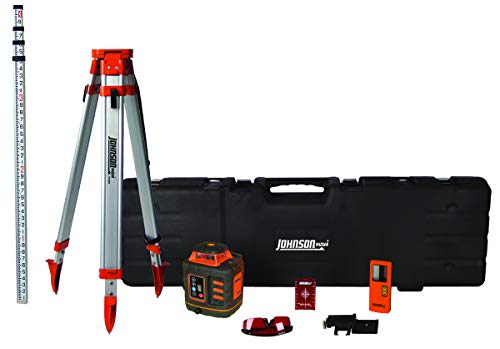
The 99-027K packages the main field components together, including a dual-graduated rod and hard case. It is a practical option for level-reference work where simplicity matters more than slope controls. The locking compensator and enclosure rating address handling and environment as distinct concerns.
The 99-027K self-levels horizontally and supports manual vertical alignment with a split beam. The system includes a detector and clamp, tripod, dual-graduated grade rod, batteries, target, and hard case. Its IP66 housing and locking compensator support site use and transport; this model does not provide slope adjustment.
Pros
- Detector, tripod, and rod included.
- Horizontal self-leveling.
- Dual rod graduations.
- IP66 enclosure.
- Locking compensator for transport.
Cons
- No slope-adjustment function.
- Vertical setup is manual.
Its vertical operation is manually aligned, and there is no slope-adjustment feature. That is a clear boundary for a buyer who needs a horizontal field reference with occasional vertical layout rather than a grade-entry instrument.
To buy this product, click here.
6. Spectra Precision LL100N-2 Kit (Best for an Inch-Graduated Starter System)

The LL100N-2 provides a horizontal laser, HR320 receiver, tripod, rod, and system case. That makes sense when the user needs a complete way to take elevation readings rather than another laser body. The inch-graduated rod also gives this selected package a particular fit for the way some users already measure.
The LL100N automatically establishes a horizontal reference and provides a height-change alert. This LL100N-2 package includes an HR320 receiver, rod clamp, tripod, inch-graduated rod, and system case. Manual slope operation requires the appropriate optional RC601 remote; it is not a numeric dial-in grade laser.
Pros
- Horizontal self-leveling.
- Height-change alert.
- HR320 receiver and clamp included.
- Tripod and inch-graduated rod included.
- System case organizes the selected package.
Cons
- Optional remote is needed for the documented slope workflow.
- Not a three-plane interior line laser.
A remote is additional if you need the documented slope workflow. Keep the supplied rod convention consistent with your notes and layout, especially when moving between inches and decimal-foot measurements.
To buy this product, click here.
7. Spectra Precision LL500 with HL700 (Best for Deliberate Horizontal Setup)

The LL500 uses a three-screw leveling base before its limited self-leveling compensation takes over. That gives it a different setup feel from a broad-range electronic instrument. Its dedicated horizontal role and HL700 receiver suit careful elevation work for someone who values a clear, repeatable measurement routine.
The LL500 uses a three-screw base and circular bubble for initial setup before its limited self-leveling compensation takes over. Its horizontal tolerance is specified at approximately ±1/16 inch at 100 feet. The selected package identifies an HL700 receiver, rod clamp, batteries, and case; tripod and rod are separate.
Pros
- Dedicated horizontal elevation reference.
- Fine horizontal tolerance at a stated distance.
- HL700 receiver supplied in the selected package.
- Circular bubble and three-screw setup base.
- Replaceable D-cell supply.
Cons
- Initial setup is more manual than broad-range servo-leveling models.
- No automatic numeric grade entry.
Choose it with the initial leveling procedure in mind. It is not the most direct option for frequent changes between horizontal and vertical work, and the tripod and rod remain separate from the selected package.
To buy this product, click here.
8. DEWALT DW074KD (Best for Horizontal Automatic and Vertical Manual Operation)

The DW074KD includes its detector and wall mount while keeping a straightforward division between automatic horizontal and manual vertical operation. It can suit someone who primarily transfers heights but occasionally needs an upright reference. The protective head cage and contractor bag provide a practical carrying arrangement.
Horizontal operation self-levels, while vertical setup uses manual alignment. The kit includes a DW0742 detector and clamp, wall mount, target, contractor bag, and batteries. A protective cage surrounds the rotary head; the selected package does not include a full-height tripod.
Pros
- Horizontal self-leveling.
- Included compatible detector and clamp.
- Vertical alignment option.
- Wall mount supplied.
- Protected rotor head and storage bag.
Cons
- Vertical leveling is manual.
- Tripod and rod are separate.
The supplied detector is useful; it does not supply the missing stand or rod. Arrange those accessories around the intended work, and follow the vertical setup procedure instead of assuming both orientations level themselves.
To buy this product, click here.
9. Spectra Precision HV101-4 Kit (Best for Interior Rotary Layout)

The HV101-4 emphasizes interior usefulness through scan controls, a remote, and a wall mount. Those features can help when the reference needs to relate to a ceiling perimeter or wall layout rather than a series of distant ground stations. Automatic horizontal and vertical operation adds flexibility for those changes.
The HV101 provides automatic horizontal and vertical leveling, with scan and rotation controls for interior layout. The selected HV101-4 package includes an HR150U receiver, RC601 remote, wall mount, and carrying case. The interior-oriented HR150U package should be distinguished from other HV101 kits supplied with an HR320 site receiver.
Pros
- Horizontal and vertical self-leveling.
- Scan and rotation controls.
- RC601 remote included.
- Wall mount supplied.
- HR150U receiver included.
Cons
- Tripod and grade rod are separate.
- Confirm receiver suitability for the intended site distance.
The supplied HR150U is an important part of this package’s identity. If your main work is exterior elevation transfer, compare the receiving arrangement with a dedicated field kit before choosing on transmitter features alone.
To buy this product, click here.
Choosing the Best Rotary Laser Level
Begin With the Reference You Repeat
For repeated ground heights, a horizontal rotary system is often the useful configuration. For partitions and interior alignment, vertical operation may matter. Write down the main task before comparing features, because a mode that never leaves the menu adds little to the actual measuring routine. The operating sequence for setting up a rotary laser system connects the transmitter, receiver, and rod to the benchmark before station readings begin.
Separate Rotary Operation From Full-Plane Line Lasers
A rotary instrument sweeps a beam around the work area, commonly read with a receiver. A three-plane line laser projects fixed planes. Both can transfer references, but their receiving accessories, indoor appearance, and setup methods differ. A rotating wall bracket does not make a compact line laser a rotary instrument.
Check Automatic Leveling in Each Orientation
Horizontal self-leveling does not guarantee automatic vertical operation. The Johnson and DEWALT selections here require manual vertical setup, while other models support electronic vertical leveling. Choose around the orientation you use, and read the status indicators before recording measurements. Keep the distinction between a level plane and a designed slope clear when deciding which operating modes the project actually needs.
Compare the Receiver Package
The receiver must match the transmitter and the intended application. A field receiver on a rod and an interior receiver attached near a ceiling perform different working roles. Check the actual supplied model, its mounting clamp, and the relevant operating distance rather than treating “receiver included” as a complete description.
Plan for Moving and Rechecking
A disturbance alert helps identify a changed position, but the response still needs a known reference. Record a benchmark reading before moving around the site. Recheck it after a warning, a battery interruption, a support change, or any knock that could affect the setup.
Match Accessories to Existing Equipment
A receiver-only package can make sense if you already own a suitable tripod and rod. A complete kit can simplify the first setup when you do not. Verify mounting threads and rod graduations as well as component names so the pieces form a useful measurement chain.
Frequently Asked Questions
Is a Rotary Laser Useful in Bright Sunlight?
A compatible receiver is what makes many outdoor rotary measurements practical. Do not rely on seeing the beam across the site. Follow the receiving system’s operating limits and keep the beam path clear.
Is a 360-Degree Line Laser the Same Thing?
No. A continuous projected line plane and a swept rotary beam use different operating arrangements. Choose the geometry and receiver system that fit the task rather than matching the number 360.
Do All Rotary Lasers Set Slope?
No. Some provide a level reference only, and others offer particular manual slope workflows. Numeric grade entry is another feature again. Confirm the exact operating mode before planning the work around it.
Why Does the LL500 Need Initial Manual Setup?
Its three-screw base and circular bubble establish the starting position before the limited compensation range takes over. That differs from models with a broader electronic leveling range.
Should I Buy a Kit With a Grade Rod?
A rod is useful for repeated elevation readings with a receiver. Check its graduations and length against your task. For interior alignment alone, a wall mount and suitable receiver may be more relevant.
Does an Enclosure Rating Prove the Instrument Is Still Accurate?
No. Protection against dust and water describes environmental resistance. Accuracy should still be checked according to the manufacturer’s procedure, especially after transport, impact, or a disturbed setup.
Final Verdict
The Topcon RL-H5A is our overall rotary choice for a focused outdoor height-transfer setup. The Spectra LL300N is another strong fit for repeated horizontal work, particularly when its optional single-axis slope method has a place in your routine.
Choose the Bosch complete kits for broader alignment functions and supplied field equipment, or the HV101-4 for an interior-oriented rotary package. The right receiver, rod units, and support arrangement make the reference usable; they deserve as much attention as the transmitter itself.
