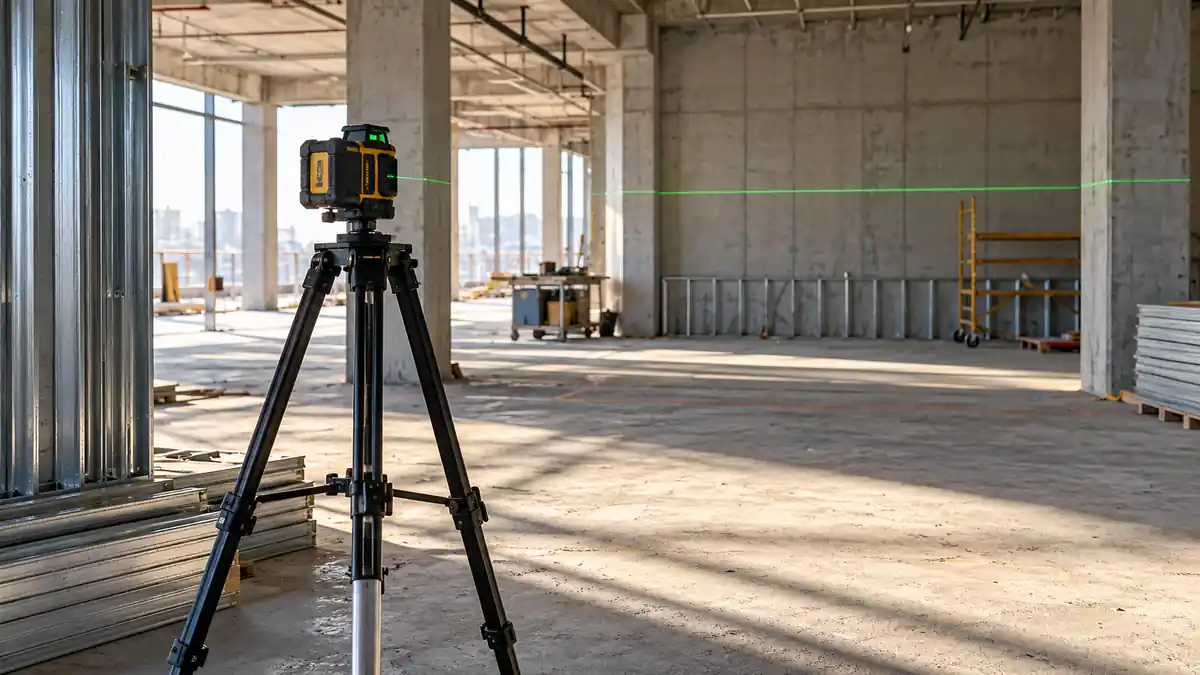
A job can begin with ground levels outside and end with a cabinet line inside. Carrying one familiar laser through both tasks sounds convenient, but the reference geometry changes along the way. The useful choice is the instrument that handles the work you actually repeat, with the accessories that make its reference usable. The best laser level for construction is the instrument that fits your recurring layout task, whether that means room references or site elevations.
Construction can mean receiver-based elevation transfer, wall and partition layout, overhead point transfer, or a shared height around several rooms. A rotary transmitter, a three-plane line laser, and a cross-line tool with plumb dots each have a clear role. Picking between them starts with the task rather than the largest range number.
The best laser level for construction should earn its place in your working kit. These nine picks cover exterior reference systems and interior layout tools, with distinct options for mounting, power, and beam arrangement. Use the quick choices to find the right type, then check how the complete setup will fit the site.
Quick Answer
- Best Overall: Topcon RL-H5A Receiver Kit. Horizontal rotary reference.
- Best for Interior Multi-Plane Layout: Bosch GLL3-330CG. Three green 360° planes.
- Best for Manual Slope and Field Accessories: Bosch GRL2000-40HVK Kit. Horizontal/vertical rotary; manual dual slope.
Compare the Nine Picks
| Product | Best fit | Reference layout | Power and positioning |
|---|---|---|---|
| Topcon RL-H5A Receiver Kit | Best Overall | Horizontal rotary reference | Specified D-cell or rechargeable configuration; Receiver holder; tripod separate |
| Bosch GLL3-330CG | Best for Interior Multi-Plane Layout | Three green 360° planes | Bosch 12V Max or AA adapter; BM1 positioning device |
| Bosch GRL2000-40HVK Kit | Best for Manual Slope and Field Accessories | Horizontal/vertical rotary; manual dual slope | Battery-powered selected kit; Receiver, tripod, rod, remote and wall mount |
| DEWALT DW089LG | Best for a DEWALT Three-Plane Kit | Three green 360° planes | DEWALT 12V MAX battery platform; Magnetic bracket and ceiling bracket |
| Spectra Precision LL300N with HL450 | Best for Repeated Horizontal Site Checks | Horizontal rotary reference | Four D-cell batteries; HL450 receiver and clamp; tripod separate |
| Klein Tools 93LCLS | Best for Floor-to-Ceiling Point Transfer | Red cross lines and plumb points | Three AA batteries; Magnetic bracket and ceiling clamp |
| DEWALT DW089K | Best for Adjustable Right-Angle Line Layout | Three red lines for 90° layout | Four AA batteries; Magnetic pivot bracket; ceiling mount |
| Huepar B03CG Pro | Best for a Removable-Battery Planar Setup | Three green 360° planes | Removable rechargeable battery; Magnetic pivoting base |
| Huepar S04CG-C Kit | Best for Upper and Lower Horizontal References | Two horizontal and two vertical 360° planes | Rechargeable pack or AA holder; Magnetic bracket and lifting base |
1. Topcon RL-H5A Receiver Kit (Best Overall)

When the main work is checking ground, concrete forms, and other exterior heights, the RL-H5A has the most focused role here. A horizontal rotary reference read by its receiver can remain useful where a visible wall line disappears. That makes it a clear starting point for a contractor whose repeated measurements happen outside.
Topcon specifies an 800-meter working diameter and ±10 arc-second horizontal accuracy for the RL-H5A. Electronic horizontal self-leveling and IP66 protection suit outdoor elevation work with a receiver. The selected listing identifies an LS-80L receiver and holder; verify the exact battery and support-equipment bundle.
Pros
- Horizontal rotary reference for elevation checks.
- Receiver and holder identified in the selected kit.
- Electronic self-leveling.
- Documented IP66 protection.
- Manual slope capability described by the manufacturer.
Cons
- Not a three-plane interior wall-layout tool.
- Tripod, rod, and exact battery bundle need separate confirmation.
Choose the tripod and rod to complete the system. If your work is mainly interior partitions or cabinets, a multi-plane line laser offers a more suitable everyday reference.
To buy this product, click here.
2. Bosch GLL3-330CG (Best for Interior Multi-Plane Layout)

The GLL3-330CG can carry a horizontal reference around adjoining surfaces and add intersecting vertical planes. That combination is useful when the project moves from a shared wall height to an upright layout. Its BM1 positioning device and connected controls give it a defined role in a more involved interior setup.
Three green planes can be controlled through Bosch’s connected operating system. The listed package supports its Bosch 12V Max battery or four AA batteries with the required adapter. The specified LR8 receiver extends the operating range to 330 feet in diameter, not radius, and is separate from the base kit.
Pros
- Three-plane green layout.
- Connected operating controls.
- Documented 12V and AA-adapter power options.
- BM1 positioning device included.
- Supported LR8 receiver operation.
Cons
- LR8 receiver is separate.
- Connected functions add setup beyond basic wall alignment.
Use the selectable planes to keep the current reference clear. Its receiver option extends the operating arrangement, but it does not replace planning a stable support at the correct working height.
To buy this product, click here.
3. Bosch GRL2000-40HVK Kit (Best for Manual Slope and Field Accessories)

The GRL2000-40HVK suits construction work that needs a rotary receiver system and manual dual-axis slope. The complete kit brings the rod and support together with the transmitter. For a project moving between level checks and a planned sloped reference, those components belong to the same working process.
Manual dual-slope adjustment allows the reference angle to be changed on both axes. Electronic self-leveling and a disturbance monitor support repeatable site setup. The linked complete package includes a receiver, tripod, grade rod, remote, wall mount, and carrying case.
Pros
- Manual slope adjustment on two axes.
- Horizontal and vertical operation.
- Electronic self-leveling.
- Disturbance monitor.
- Receiver, tripod, rod, and remote included.
Cons
- Manual slope is different from automatic numeric grade entry.
- Complete kit takes more storage space than a line laser.
Manual slope needs a verified setup at known points. Select this package when the rotary geometry serves the work, rather than expecting its extra modes to replace a simpler indoor wall reference.
To buy this product, click here.
4. DEWALT DW089LG (Best for a DEWALT Three-Plane Kit)

The DW089LG offers three green planes on the specified 12V MAX platform, with a battery, charger, and ceiling-positioning accessories. It suits repeated interior installations where a shared horizontal reference and vertical intersections are useful. The included carrying arrangement also keeps the positioning pieces together between rooms.
The DW089LG projects three 360° green planes and uses the specified 12V MAX battery platform. The documented kit includes a battery, charger, extended ceiling bracket, target card, and carrying case. Full-time pulse operation supports a compatible detector, supplied separately, while the housing carries an IP65 rating.
Pros
- Three full green reference planes.
- Uses the specified removable 12V MAX battery.
- Battery and charger included in the listed kit.
- Extended ceiling bracket and case supplied.
- Documented detector mode and IP65 housing.
Cons
- Detector and full-height tripod are separate.
- Battery compatibility is limited to the documented platform.
Match the battery platform exactly. The ceiling bracket is a useful accessory, while a compatible detector and full-height tripod remain additional equipment for jobs that need them.
To buy this product, click here.
5. Spectra Precision LL300N with HL450 (Best for Repeated Horizontal Site Checks)

The LL300N is the horizontal rotary alternative for someone who already has an appropriate stand and rod. Its HL450 receiver and protective housing fit repeated elevation measurements around a work area. The optional slope workflow adds a particular function when the task calls for it.
The LL300N combines automatic horizontal leveling with a protective rotor housing and IP66 enclosure. The selected alkaline package includes an HL450 receiver and clamp but does not include a tripod. Its single-axis slope workflow requires the optional RC601 remote, with leveling retained on the other axis.
Pros
- Automatic horizontal leveling.
- IP66 enclosure.
- Protective rotor housing.
- HL450 receiver included.
- Optional single-axis slope workflow.
Cons
- Tripod and rod are separate in this package.
- RC601 remote is separate.
Build the accessory arrangement around your actual measurements. A receiver-only package can be sensible when the existing support equipment is compatible and in good condition.
To buy this product, click here.
6. Klein Tools 93LCLS (Best for Floor-to-Ceiling Point Transfer)

A ceiling position that needs to sit over a floor mark is a different problem from extending a line along a wall. The 93LCLS adds dedicated upward and downward plumb points to its red cross. That gives it a specific role in overhead and partition-related layout.
The tool combines horizontal and vertical lines with dedicated plumb-up and plumb-down points. Klein supplies a magnetic bracket, ceiling-grid clamp, AA batteries, and hard case. Cross-line accuracy is specified separately from the two plumb-point tolerances.
Pros
- Dedicated upward and downward plumb points.
- Lines can operate independently or together.
- Magnetic bracket rotates for positioning.
- Supports 1/4-20 and 5/8-11 mounting threads.
- Ceiling clamp and hard case included.
Cons
- No three-plane continuous projection.
- Additional point-transfer functions may be unnecessary for simple wall work.
Check the separate point and line tolerances for the task. Choose the additional point capability when you need it, rather than substituting a forward-facing dot from another kind of tool.
To buy this product, click here.
7. DEWALT DW089K (Best for Adjustable Right-Angle Line Layout)

The DW089K adds a third line and a micro-adjustment control to a conventional wall-reference setup. For intersecting alignment work, that control can help bring the reference to the established mark without shifting the entire support. Its AA supply provides another practical difference from platform-battery models.
Three red line references support 90-degree layout rather than three continuous planes. A micro-adjustment knob helps position the intersecting references; DEWALT specifies ±1/8 inch at 30 feet for level applications. The kit includes a ceiling mount, box, and four AA batteries; receiver operation uses the separately supplied compatible DW0892.
Pros
- Three lines support 90-degree layout.
- Micro-adjustment control.
- Magnetic pivot bracket.
- Four-AA supply.
- Documented DW0892 detector compatibility.
Cons
- Detector is supplied separately.
- Not a three-plane 360° system.
Keep its three-line geometry distinct from three full planes. It is useful for controlled local alignment, while a continuous-plane model fits connected surfaces that need wider coverage.
To buy this product, click here.
8. Huepar B03CG Pro (Best for a Removable-Battery Planar Setup)

The B03CG Pro supplies three selectable planes and a removable rechargeable battery. It fits a renovation kit that moves between shelving, cabinet runs, and wall alignment. A magnetic base can help place the reference on suitable steel while preserving the option of another support.
One horizontal and two vertical planes can be selected in different combinations. The listed package contains a removable 5,200mAh battery, USB-C charging equipment, magnetic base, target, and hard case. Receiver operation requires an appropriate Huepar receiver, which is separate from this kit.
Pros
- Three full planes cover adjoining surfaces.
- Selectable beam combinations avoid unnecessary lines.
- Removable rechargeable battery supports repeated indoor projects.
- Magnetic base provides positioning on suitable steel.
- Hard case and charging equipment are included.
Cons
- Full-height positioning tripod is not included.
- Outdoor receiver must be supplied separately.
Choose a support that reaches the actual installation height. The supplied base and case solve positioning and storage tasks, but they do not make a full-height tripod part of the package.
To buy this product, click here.
9. Huepar S04CG-C Kit (Best for Upper and Lower Horizontal References)

The S04CG-C adds a second horizontal plane and a lifting base to a multi-plane setup. That is useful when a room requires both higher wall references and measurements closer to the floor. The lower reference gives the extra plane a purpose beyond simply adding more visible beams.
Four green planes include a low horizontal reference in addition to the upper horizontal plane. The S04CG documentation describes LCD status, Bluetooth controls, rechargeable-pack power, and an AA holder. The lifting base changes the low reference position; pulse operation requires an appropriate Huepar receiver, supplied separately.
Pros
- Upper and lower horizontal references.
- Two vertical planes for connected layouts.
- Lifting base helps position the low line.
- Rechargeable and AA-holder power choices.
- LCD status and remote operating controls.
Cons
- Four-plane setup adds bulk and complexity.
- Compatible receiver and full-height tripod are separate.
Identify the controlling horizontal plane before marking. Extra coverage helps when the layout calls for it, but a busy wall of intersecting lines still needs a clear datum.
To buy this product, click here.
Choosing the Best Laser Level for Construction
Write Down the Main Measurement
Decide whether the repeated job is exterior height transfer, interior line layout, or point transfer overhead. A tool that excels at one can be awkward at another. If your work regularly spans both exterior elevation and interior alignment, choosing two complementary systems can be more practical than forcing every task through one geometry. Inside the building, coordinating framing and rough-in layout marks may require a different geometry from the outdoor measuring system.
Match the Receiving System to Exterior Work
A detector has to match its transmitter and the intended operating mode. Range claims that depend on a receiver are different from visible-line distances. Check the supplied receiver model and rod clamp before treating a kit as ready for measurements in a bright, open work area. For field work, establishing the field reference before taking readings is the step that makes readings from separate stations comparable.
Consider Positioning as Part of the Tool
The best feature list is unhelpful if the laser cannot sit at the required height. A ceiling clip, magnetic bracket, wall mount, and tripod solve different support problems. Think about the available surface and clear beam path while the installation area is still accessible.
Keep Power Compatibility Specific
A familiar brand does not make every battery interchangeable. Check the exact platform, adapter, or charging arrangement for the selected model. If the tool moves between jobs, include the relevant charger or replacement cells in the case so the next setup begins with a working supply.
Treat Protection and Accuracy as Separate Checks
A case, transport lock, and enclosure rating help with carrying and site conditions. They do not prove that a precision reference remains correct after impact. Follow the model’s accuracy-check procedure and use a stable benchmark to confirm the setup when a warning or disturbance occurs.
Avoid Buying Unused Geometry
Three planes, plumb dots, vertical rotary operation, and manual slope each serve particular tasks. Choose the functions that change your working method. A compact cross can be enough for local alignment, while a continuous plane becomes useful when the same reference needs to connect several surfaces.
Frequently Asked Questions
Can One Laser Handle Every Construction Task?
Some models cover several reference tasks, but geometry and receiving systems still set limits. Exterior elevation transfer and interior multi-plane layout often call for different operating arrangements.
Which Type Works Best for Outdoor Elevation Checks?
A horizontal rotary laser with its compatible receiver is a strong fit for repeated site-height measurements. Include an appropriate tripod and rod in the setup.
Why Would a Contractor Choose Plumb Dots?
Dedicated up-and-down points can transfer an appropriate reference between floor and ceiling. That is different from a vertical wall line or a point projected forward.
Is an IP Rating an Accuracy Certification?
No. It describes protection against particular environmental exposure. Accuracy requires its own specification and checking procedure.
Does a Magnetic Mount Attach to Finished Drywall?
Not by itself. It needs suitable ferrous material or another supported mounting arrangement. Plan the attachment before choosing a tool for a finished room.
Should I Order a Complete Rotary Kit?
It can simplify setup when you need the transmitter, receiver, tripod, and rod together. If you already have compatible support equipment, a smaller package may fit the work better.
Final Verdict
Choose the Topcon RL-H5A for a construction kit centered on exterior elevations, or the Bosch GLL3-330CG for involved interior line layout. The Bosch GRL2000-40HVK is the broader field package when manual slope and supplied measuring accessories matter.
The Klein 93LCLS adds a useful point-transfer role, while the DEWALT and Huepar plane lasers fit different indoor power and mounting preferences. Start with a repeated measurement and a realistic support position, then choose the instrument that makes that reference straightforward.
