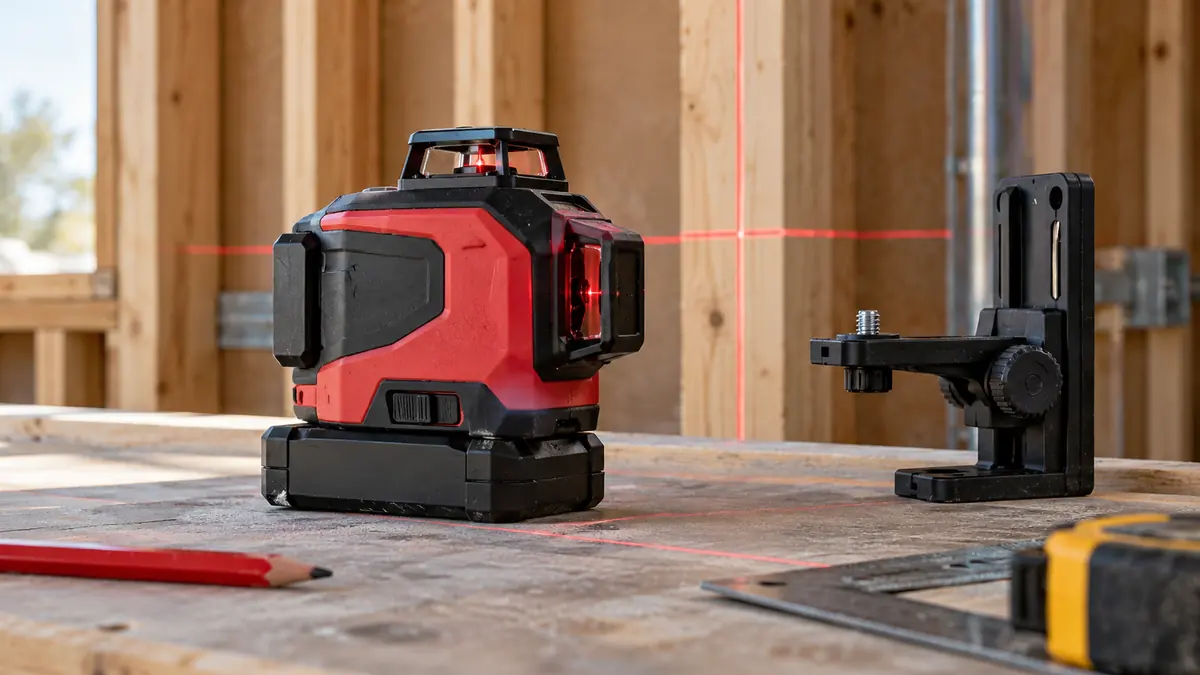
Already owning red batteries makes the power decision familiar. The laser decision still needs more thought. A single horizontal plane for repeated room heights and an exterior rotary system for rod readings belong to very different workdays, even when both carry the Milwaukee name. The best Milwaukee laser level for your work depends on the reference pattern and battery platform you can put to use, rather than the model number alone.
This selection covers four distinct options: an M12 single-plane tool, an M18 exterior level-reference system, an M18 interior rotary kit, and an M18 dual-slope field system. Their receivers, support equipment, and reference geometry should be compared as complete working arrangements.
A focused interior plane and a rotary reading system solve different problems. Choose the job first, then check the battery platform and exactly what the linked package supplies. The reviews below keep the reference geometry, receiver family, and support equipment tied to the individual model.
Quick Answer
- Best Overall: Milwaukee M12 3631-20. One green horizontal 360° plane.
- Best Complete Outdoor Height-Transfer System: Milwaukee M18 3701-21T System. Red exterior horizontal rotary reference.
- Best for Interior Rotary Layout: Milwaukee M18 3702-21. Green interior rotary with scan and vertical functions.
Compare the Four Picks
| Product | Best fit | Reference layout | Power and positioning |
|---|---|---|---|
| Milwaukee M12 3631-20 | Best Overall | One green horizontal 360° plane | M12 battery platform; tool only; Magnetic mounting bracket |
| Milwaukee M18 3701-21T System | Best Complete Outdoor Height-Transfer System | Red exterior horizontal rotary reference | M18 rechargeable platform; 3711 receiver, tripod and grade rod |
| Milwaukee M18 3702-21 | Best for Interior Rotary Layout | Green interior rotary with scan and vertical functions | M18 rechargeable platform; 3712 remote/receiver and wall mount |
| Milwaukee M18 3704-21T System | Best for Exterior Dual-Slope Work | Red exterior dual-slope rotary reference | M18 rechargeable platform; Receiver, remote, grade rod and tripod |
1. Milwaukee M12 3631-20 (Best Overall)

The 3631-20 gives repeated interior heights a continuous green horizontal reference. Think ceiling elevations, soffits, or a common height carried around several walls. Its single-plane geometry stays focused, and the M12 platform is convenient when a compatible battery is already available.
The 3631-20 projects a single green horizontal plane for shared room heights. It does not add a vertical plane or dedicated plumb dots. The selected listing is tool only, and compatible M12 battery power and charging equipment must be arranged separately.
Pros
- Continuous horizontal reference.
- M12 battery compatibility.
- Focused single-plane controls.
- Magnetic positioning.
- Suitable geometry for repeated room heights.
Cons
- No vertical or isolated-dot projection.
- Battery is separate.
Choose it for shared heights rather than vertical alignment. This selected tool-only package needs a compatible battery and charger.
To buy this product, click here.
2. Milwaukee M18 3701-21T System (Best Complete Outdoor Height-Transfer System)

The selected 3701 exterior package combines its rotary transmitter with the matching receiver, tripod, and rod. That is the useful arrangement when the reference must be read across bright open ground. Masking shutters help keep unwanted directions out of the working beam path.
The selected exterior system combines the red rotary transmitter with a 3711 receiver. Its linked package identifies an M18 battery, charger, receiver clamp, tripod, grade rod, and case. Masking shutters and selectable bump sensitivity support controlled setup; quoted field coverage is a diameter rather than a receiver radius.
Pros
- Compatible receiver supplied.
- Tripod and grade rod included.
- M18 battery and charger package.
- Masking shutters.
- Selectable bump sensitivity.
Cons
- No dual-slope control like the 3704 family.
- Large field system for a simple indoor wall mark.
Use it for horizontal field measurements with a preserved benchmark. It does not provide the dual-slope controls of the 3704 family.
To buy this product, click here.
3. Milwaukee M18 3702-21 (Best for Interior Rotary Layout)

The 3702-21 is the interior rotary option with a combined remote/receiver and wall mount. Center Find and scan controls have a specific role when a larger interior reference must be aligned or concentrated. Its vertical plumb dot adds another documented reference.
The 3702-21 includes a combined remote/receiver, receiver clamp, wall mount, battery, charger, and case. Center Find supports automatic alignment, while scan settings concentrate the working reference for interior layout. The green rotary system also provides a vertical plumb dot; its receiver is different from the 48-35-1211 line detector.
Pros
- Combined remote and receiver.
- Center Find alignment.
- Variable scan settings.
- Wall mount included.
- M18 battery and charger supplied.
Cons
- Tripod and grade rod are separate in this package.
- Larger setup than a compact line laser.
The selected package does not supply a field tripod and rod. Its dedicated remote/receiver is different from Milwaukee’s line-laser detector.
To buy this product, click here.
4. Milwaukee M18 3704-21T System (Best for Exterior Dual-Slope Work)

The 3704 system is the choice when the project needs supported slope adjustment as well as a field receiver. The remote allows adjustment without returning to the instrument for every control change. That capability belongs to a checked slope workflow, not a casual tilt toward the ground.
The 3704 exterior dual-slope family supports slope adjustment through its controls and remote. The selected T-style package identifies a receiver, remote, grade rod, and tripod. Its published coverage is a diameter; slope setup still needs the documented axis orientation and a checked reference.
Pros
- Dual-slope capability.
- Remote slope adjustment.
- Compatible receiver package.
- Tripod and rod in the selected system.
- M18 battery platform.
Cons
- More controls than a level-only reference needs.
- Large transport and setup footprint.
Choose it when dual slope is a real requirement. Confirm the reference axes and endpoints before treating the projected plane as the intended grade.
To buy this product, click here.
Choosing the Best Milwaukee Laser Level
Start with the Projection and Reading Method
The M12 tool provides a visible horizontal plane. The exterior rotary systems are designed around compatible receiver readings. The interior rotary kit adds scan and alignment functions. Choose the arrangement that reaches the actual marks without requiring an unrelated accessory to solve the basic geometry.
Keep M12 and M18 Power Separate
These are different Milwaukee battery platforms. The selected 3631-20 listing is tool only, while the rotary kits identify their own battery and charging arrangements. Check the named package and supported pack rather than assuming a battery from the tool bag will fit. The first purchase check is checking power and kit compatibility before choosing; the platform name and the selected package both matter.
Match the Exact Receiver Family
The 48-35-1211 is a line-and-plane detector. The M18 rotary systems use their own specified rotary receivers or remote/receiver units. Matching the brand or beam color is insufficient; the signal and documented pairing must match too. Understanding how a rotary field setup is used also explains why the receiving equipment belongs to a complete field routine rather than a beam-color match.
Compare Full Package Contents
A tripod and rod make a field package more immediately useful for elevation readings. A wall mount serves another positioning job. Check each component individually, including receiver holder and charging equipment, because closely related suffixes can represent different bundles of the same transmitter.
Read Diameter Figures Correctly
A stated coverage diameter spans both sides of the instrument. It is not the distance from the instrument to a receiver on one side. Position the system around the actual required radius and clear sightlines rather than using the headline number directly as a walking distance.
Choose Slope Control Only for a Defined Layout
A horizontal datum can support height changes through measured rod offsets. A dual-slope instrument adds another workflow. Establish the intended grade, axis orientation, and verification points before changing the plane, and follow the exact model’s setup instructions.
FAQ
Which Milwaukee Is Best for Repeated Indoor Heights?
The M12 3631-20 is our choice for that focused task. It projects one continuous horizontal green plane without adding vertical planes or dedicated plumb dots.
Does the 3631-20 Include a Battery?
The listing selected here is tool only. Arrange a compatible M12 battery and charger separately, or verify a different package if a complete power setup is needed.
Can I Use the Line Detector with an M18 Rotary Laser?
Do not assume that pairing. The rotary systems use their specified receivers. Milwaukee’s 48-35-1211 belongs to its cross-line and plane-laser family.
Which Option Includes a Tripod and Rod?
The selected 3701 exterior system and 3704 dual-slope system identify those field accessories. The 3702-21 interior package emphasizes its wall mount and combined remote/receiver instead.
Does a Single Plane Provide Plumb Points?
The 3631-20 here provides a horizontal plane only. Choose a model with the documented vertical or discrete point geometry when the job requires that transfer.
Is Dual Slope Necessary for Ordinary Level Readings?
No. A level-reference instrument can compare elevations with a rod. Dual-slope controls are relevant when the planned workflow specifically needs an inclined reference on the supported axes.
Final Verdict
The M12 3631-20 is our overall choice for focused indoor common-height work. For outdoor elevation transfer, the selected 3701 system supplies the supporting field equipment, while the 3704 system adds dual-slope capability.
Choose the 3702-21 for its interior rotary alignment and scan functions. Keep the battery, receiver, and mounting arrangement tied to the exact model so the chosen system is ready for the work it is meant to do.
