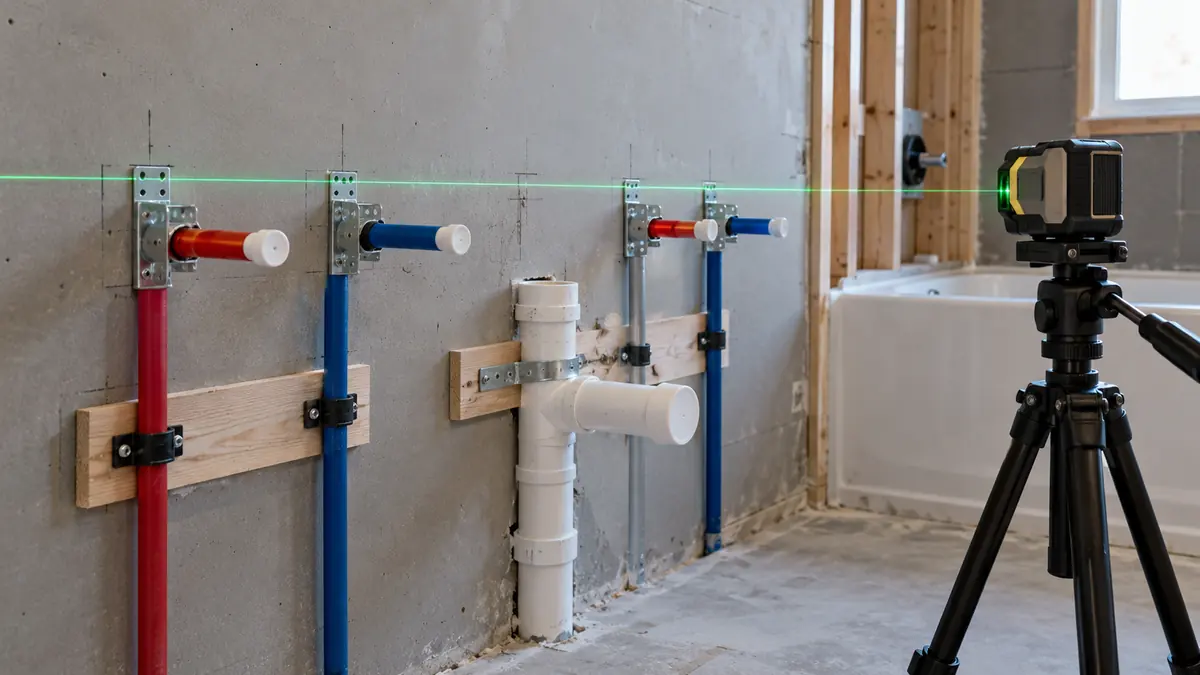
A pipe center marked on the floor needs to meet the planned location overhead, while a row of wall fixtures needs its own height reference. Plumbing layout can involve points, vertical directions, and common elevations in the same room. One kind of beam does not automatically solve all three. The best laser level for plumbing should match the particular height, line, or plumb transfer instead of relying on an angled beam as proof of drainage slope.
Dedicated plumb dots are useful for discrete transfer. Cross lines and complete planes serve related alignment tasks. Drainage fall is a separate measurement problem: a line that is level or plumb does not by itself establish the required pipe slope.
These nine picks emphasize point-and-line geometry and usable positioning for interior layout. Choose according to the references the installation needs, then check the support, body clearance, and relevant tolerance. The right tool makes the planned mark easier to transfer without inventing the installation dimensions.
Quick Answer
- Best Overall: Klein Tools 93LCLS. Red cross lines and plumb points.
- Best Plumb-Centered Rotating Mount: Bosch GCL 2-160. Red cross lines with dedicated plumb points.
- Best Common Height with Plumb Dots: Huepar 7211CG. Horizontal 360° plane, vertical line and two plumb dots.
Comparison Table
| Product | Best fit | Reference layout | Power and positioning |
|---|---|---|---|
| Klein Tools 93LCLS | Best Overall | Red cross lines and plumb points | Three AA batteries; Magnetic bracket and ceiling clamp |
| Bosch GCL 2-160 | Best Plumb-Centered Rotating Mount | Red cross lines with dedicated plumb points | AA battery supply; RM1 magnetic rotating mount and ceiling clip |
| Huepar 7211CG | Best Common Height with Plumb Dots | Horizontal 360° plane, vertical line and two plumb dots | Rechargeable battery; Magnetic bracket |
| DEWALT DW083CG | Best Focused Green Three-Point Tool | Three green reference points | Four AA batteries; Integrated magnetic pivoting bracket |
| Bosch GPL100-50G | Best Five-Point Green Layout | Five green points | Two AA batteries; Integrated magnetic rotating mount; 1/4-20 |
| STABILA LA-5P G | Best Framing-Base Point Package | Five green reference points | Three AA batteries; Removable framing base, V-groove magnet and wall bracket |
| DEWALT DW089LG | Best Connected Room References | Three green 360° planes | DEWALT 12V MAX battery platform; Magnetic bracket and ceiling bracket |
| Bosch GLL3-330CG | Best Connected Controls and Positioning | Three green 360° planes | Bosch 12V Max or AA adapter; BM1 positioning device |
| DEWALT DW089K | Best Fine Local Right-Angle Lines | Three red lines for 90° layout | Four AA batteries; Magnetic pivot bracket; ceiling mount |
1. Klein Tools 93LCLS (Best Overall)

A floor-to-ceiling location and a nearby wall height need different references. The 93LCLS combines dedicated plumb dots with local red lines for that mixed interior work. Its ceiling clamp and magnetic bracket also give those optical functions more than one supported positioning route.
The tool combines horizontal and vertical lines with dedicated plumb-up and plumb-down points. Klein supplies a magnetic bracket, ceiling-grid clamp, AA batteries, and hard case. Cross-line accuracy is specified separately from the two plumb-point tolerances. Imagine transferring a planned overhead center, then relating nearby wall marks to an upright reference. The useful feature is the combination, not a claim that the tool decides pipe centers or spacing. Check the separate plumb-point tolerances and ensure the body can sit where the downward reference remains visible.
Pros
- Dedicated upward and downward plumb points.
- Lines can operate independently or together.
- Magnetic bracket rotates for positioning.
- Supports 1/4-20 and 5/8-11 mounting threads.
- Ceiling clamp and hard case included.
Cons
- No three-plane continuous projection.
- Additional point-transfer functions may be unnecessary for simple wall work.
The Klein has the clearest appeal when a plumbing layout really alternates between discrete transfers and nearby wall lines. Its plumb points serve the overhead location, while the cross serves a different part of the marking work. A point-only tool can be enough if the wall lines will never be used, and a plane model is more relevant for room-wide heights. For mixed interior reference tasks, the 93LCLS combines the useful geometry with mounting options that deserve attention alongside the laser itself.
To buy this product, click here.
2. Bosch GCL 2-160 (Best Plumb-Centered Rotating Mount)
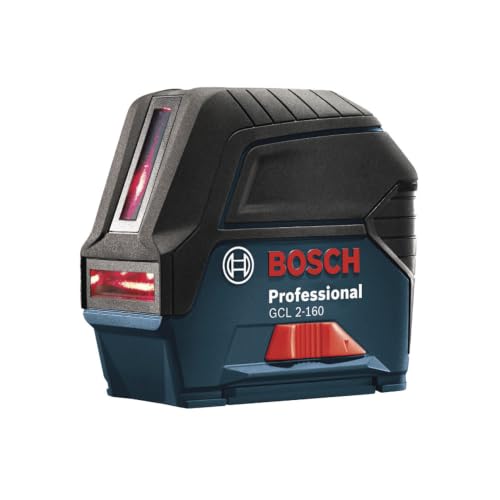
The relationship between a rotating line and an established plumb point can matter in a local installation. The GCL 2-160 provides dedicated dots, a red cross, and the RM1 mount for that combination. It suits a task moving between a transferred location and nearby wall alignment.
The GCL 2-160 combines horizontal and vertical red lines with dedicated up-and-down plumb points. Its RM1 mount rotates around the plumb reference, and the selected package includes a ceiling-grid clip. Receiver mode supports specified Bosch line detectors, including the LR8 identified by Bosch; the receiver is separate. This can be useful when the first task is locating a vertical transfer and the next is orienting a wall reference nearby. Secure the mount before rotation, and verify the original point if the whole bracket shifts. A compatible detector is a separate option for supported line operation, not evidence that every static point can be received.
Pros
- Dedicated plumb points.
- Horizontal and vertical lines.
- RM1 rotating mount.
- Ceiling-grid clip included.
- Specified receiver support.
Cons
- No continuous horizontal plane.
- Receiver is separate.
The GCL 2-160 suits a layout where an established plumb relationship needs to coexist with a changing local line direction. That makes the RM1 more than an accessory included to fill the box. The 7211CG is a stronger comparison when a continuous room height matters, while the dedicated point tools remain focused transfer options. For a buyer repeatedly moving between a ceiling location and nearby alignment marks, this Bosch’s combined references and rotating arrangement provide a concrete reason to choose it.
To buy this product, click here.
3. Huepar 7211CG (Best Common Height with Plumb Dots)

Common fixture heights and isolated overhead locations can belong to the same room. The 7211CG provides a horizontal plane, vertical line, and dedicated plumb dots for those different marks. That is useful when a local cross would need repeated turning for the height-reference task.
The 7211CG combines a continuous horizontal green reference with a vertical line. Dedicated up-and-down plumb dots add discrete floor-to-ceiling transfer to that line layout. Its rechargeable arrangement and magnetic bracket suit interior setup; this geometry is different from a three-plane laser with intersections only. The combination is useful when a local cross would need repeated turning for the horizontal task. It still does not provide five-point square geometry or a second complete vertical plane. Choose it because those particular references fit the installation, and keep the tool clear of the moving pipework and support materials.
Pros
- Dedicated up-and-down dots.
- Continuous horizontal reference.
- Vertical alignment line.
- Rechargeable supply.
- Magnetic bracket.
Cons
- Not a five-point square-layout instrument.
- No second complete vertical plane.
A room with several fixture heights and an occasional overhead point gives the 7211CG a useful combination of jobs. Its horizontal plane can stay relevant across surfaces while the isolated dots handle transfers that a wall line alone does not present as clearly. Five-point square layout is another requirement and points toward the GPL100-50G or STABILA. The Huepar is most convincing when common heights and dedicated plumb transfer are both used, so the combined geometry earns its place rather than merely sounding comprehensive.
To buy this product, click here.
4. DEWALT DW083CG (Best Focused Green Three-Point Tool)

A recurring point-transfer job gives a three-spot instrument a clear purpose. The DW083CG provides green discrete references with a magnetic pivoting bracket and AA power. It is the focused comparison when carrying an isolated location is more important than projecting a wall baseline.
The DW083CG is a three-spot green laser for discrete plumb and level transfers. Its integrated magnetic bracket and locking pendulum support setup and transport. The operating manual identifies four AA batteries and IP54 protection; its point geometry does not produce a continuous wall line. The magnetic pivoting bracket helps on suitable supports, but the downward mark must remain accessible. Check the actual body and track clearance before choosing a position over the layout point. If the work later needs a row of fixture heights, a point tool’s focused geometry should not be mistaken for continuous line coverage.
Pros
- Three green reference points.
- Self-leveling point transfer.
- Magnetic pivoting bracket.
- Locking pendulum.
- Replaceable AA supply.
Cons
- No projected cross lines.
- No side-point pair for five-point square layout.
The DW083CG is a focused tool for someone whose recurring problem is transferring a point, not carrying a baseline around the room. That narrow purpose is a benefit when it keeps the reference obvious and the setup manageable. The combined Klein and Bosch tools are more useful when wall lines are also part of the routine. For repeated discrete transfers with suitable point access and support, the DEWALT’s green three-spot arrangement is a clear alternative to buying several planes that do another job.
To buy this product, click here.
5. Bosch GPL100-50G (Best Five-Point Green Layout)

Square-reference directions add another role to a plumb-point instrument. The GPL100-50G provides five green points for those discrete relationships, with a compact AA-powered arrangement. The extra directions become useful when the interior layout needs more than a simple vertical transfer.
The GPL100-50G produces five discrete green points, including up-and-down plumb and right-angle layout references. Bosch specifies a different tolerance for the bottom point, so one accuracy figure should not be applied to every dot. The integrated magnetic mount, locking pendulum, and hard case support positioning and transport. The initial orientation matters: a right-angle point is useful only in relation to the intended baseline. Bosch also specifies the bottom point differently, so the controlling reference deserves its own check. Choose the five-point geometry when those horizontal relationships are part of the installation plan.
Pros
- Five discrete green reference points.
- Right-angle point layout.
- Integrated magnetic mount.
- AA power.
- Locking pendulum and hard case.
Cons
- Bottom-point tolerance differs from the other specified references.
- No projected wall lines.
The GPL100-50G is most relevant when the layout needs both plumb transfer and horizontal square-reference directions. Those side points add value only after the instrument is oriented to the intended baseline, and the bottom point deserves its own tolerance check. A simple vertical transfer may need only the DW083CG’s three-point geometry. For the broader point-layout task, the Bosch keeps the working references discrete, which can be preferable to interpreting multiple lines across an unfinished room.
To buy this product, click here.
6. STABILA LA-5P G (Best Framing-Base Point Package)
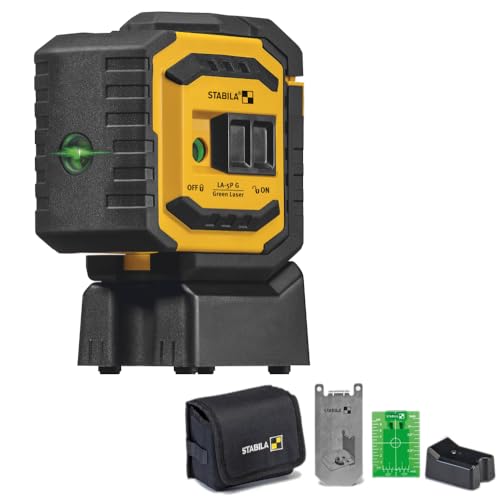
Before a room is closed in, the way a point tool sits beside framing can be decisive. The LA-5P G includes a removable base and other positioning options with its five green references. Those parts matter when they leave the actual starting mark visible and accessible.
The LA-5P G provides five green dots for plumb transfer and right-angle layout. Its removable framing base and V-groove magnet offer different positioning routes. The selected 03165 set identifies a target plate, wall bracket, and belt pouch; point-specific tolerances should be checked for the actual transfer. The different point tolerances should be read against the actual transfer distance. A ceiling mark and a horizontal square reference are not necessarily governed by one shared figure. Check how the supplied base and bracket put the instrument over the starting mark, rather than treating the accessory count as the benefit by itself.
Pros
- Five green points.
- Removable framing base.
- V-groove magnetic mounting.
- Wall bracket supplied.
- AA-powered operation.
Cons
- No projected wall lines.
- Up, down, level, and square references have separate tolerances.
The LA-5P G deserves consideration when its framing base and wall-positioning parts make the starting point easier to reach. That can be a deciding detail in an open interior before pipework and surfaces restrict access. The five-point geometry must also fit the task; a long shared fixture height is better served by a line or plane. For a buyer who needs discrete square and plumb references with the supplied positioning arrangement, the STABILA offers a purposeful package rather than simply another green-beam option.
To buy this product, click here.
7. DEWALT DW089LG (Best Connected Room References)

Several related installation surfaces can benefit from a reference arrangement that stays connected. The DW089LG supplies three complete planes for shared heights and vertical directions. It is useful when visible lines across the room serve the layout more directly than isolated spot emitters.
The DW089LG projects three 360° green planes and uses the specified 12V MAX battery platform. The documented kit includes a battery, charger, extended ceiling bracket, target card, and carrying case. Full-time pulse operation supports a compatible detector, supplied separately, while the housing carries an IP65 rating. Choose the intersection-based geometry deliberately. If an isolated point directly above the instrument is essential, check whether the available position and surfaces make the plane intersection clear enough. The selected rechargeable package also needs the specified 12V MAX power arrangement, rather than an assumed battery from another tool.
Pros
- Three full green reference planes.
- Uses the specified removable 12V MAX battery.
- Battery and charger included in the listed kit.
- Extended ceiling bracket and case supplied.
- Documented detector mode and IP65 housing.
Cons
- Detector and full-height tripod are separate.
- Battery compatibility is limited to the documented platform.
The DW089LG is the stronger choice when the plumbing layout is part of a connected room installation with several related surfaces. Its complete planes can keep heights and vertical directions available together. An isolated floor-to-ceiling location may still be more comfortably handled by a dedicated point tool, so check where the actual reference must appear. For the multi-surface line task, the DEWALT’s selected rechargeable package has a clear role, with pipe fall and installation dimensions established independently of the projected grid.
To buy this product, click here.
8. Bosch GLL3-330CG (Best Connected Controls and Positioning)

A reference that must meet a carefully established mark can make the mount as important as the optics. The GLL3-330CG combines the BM1 positioning device with three green planes and connected controls. That suits involved interior layout where the instrument remains on a stable datum.
Three green planes can be controlled through Bosch’s connected operating system. The listed package supports its Bosch 12V Max battery or four AA batteries with the required adapter. The specified LR8 receiver extends the operating range to 330 feet in diameter, not radius, and is separate from the base kit. The controls select the supported settings; they do not physically move the instrument onto the design. Start with the baseline and support, then use the active planes appropriate to the task. The separate LR8 detector arrangement applies to supported line operation and should not be treated as a universal point-detection accessory.
Pros
- Three-plane green layout.
- Connected operating controls.
- Documented 12V and AA-adapter power options.
- BM1 positioning device included.
- Supported LR8 receiver operation.
Cons
- LR8 receiver is separate.
- Connected functions add setup beyond basic wall alignment.
The GLL3-330CG is most persuasive when both connected geometry and controlled positioning are used. The BM1 can help bring the reference to the datum, and the settings can be managed without making every change beside the body. The instrument does not need that complexity for one isolated point. For an involved interior layout in which several marks must remain related, the Bosch provides a coherent reference arrangement, provided the physical baseline is established before the controls are used to manage it.
To buy this product, click here.
9. DEWALT DW089K (Best Fine Local Right-Angle Lines)

Local right-angle alignment rewards a different adjustment from isolated point transfer. The DW089K supplies three local lines and a micro-control for orientation. It is useful when the working baseline needs a small correction without requiring complete planes throughout the room.
Three red line references support 90-degree layout rather than three continuous planes. A micro-adjustment knob helps position the intersecting references; DEWALT specifies ±1/8 inch at 30 feet for level applications. The kit includes a ceiling mount, box, and four AA batteries; receiver operation uses the separately supplied compatible DW0892. Its geometry should stay clear in the decision: three local lines are different from three complete planes and from dedicated plumb dots. Picture the actual surfaces that must receive the reference before choosing. The micro-control is useful for aiming, while the installation dimensions and any required pipe fall remain separately established.
Pros
- Three lines support 90-degree layout.
- Micro-adjustment control.
- Magnetic pivot bracket.
- Four-AA supply.
- Documented DW0892 detector compatibility.
Cons
- Detector is supplied separately.
- Not a three-plane 360° system.
The DW089K fits local work where a small orientation correction is the awkward part of the job. Its third line and micro-control can be useful around a defined right-angle layout without pretending to provide either complete planes or isolated plumb dots. The Klein, GCL, and point tools deserve attention when those other references are essential. For a buyer who repeatedly needs controlled local lines, the DEWALT is a focused choice whose geometry should be the reason for the purchase.
To buy this product, click here.
Choosing the Best Laser Level for Plumbing
List the References the Installation Needs
Common heights, discrete centers, vertical alignment, and pipe fall are different tasks. Choose a point, line, or combined instrument according to the actual marks, rather than assuming more planes cover every plumbing need. A method for transferring rough-in marks without confusing level and plumb keeps fixture positions, supports, and overhead references attached to their intended meanings.
Keep Drainage Fall Separate
A level horizontal reference can help measure planned offsets, but it does not establish the required slope automatically. Use the installation’s specified fall and an appropriate measuring method rather than improvising from a tilted line.
Check Point Access and Tolerance
The downward point may be obstructed by the body or support. Confirm clearance and use the tolerance for that point at the stated distance. A cross-line figure should not be applied automatically to a plumb transfer.
Place the Tool Before the Area Is Crowded
Pipes, supports, and materials can block the reference or make the original position inaccessible. Establish and preserve control marks early, with a clear way to reconnect them after the instrument moves. Think about choosing a stable mounting arrangement around pipework before the installation makes the originally clear support position inaccessible.
Separate Alignment from Location and Fixing Checks
The laser transfers a chosen reference. It does not detect concealed services, determine fixture dimensions, or verify the support arrangement. Keep those installation checks tied to the relevant plan and equipment.
FAQ
Are Plumb Dots Useful for Plumbing Layout?
Yes, for discrete vertical transfers when the instrument can be positioned appropriately. Use the relevant point tolerance and preserve the starting reference.
Can a Plumb Line Establish Drainpipe Fall?
No. Plumb, level, and planned pipe slope are different references. The required fall needs its own measurement method and installation information.
Does a Three-Plane Laser Have Dedicated Dots?
Not automatically. Plane intersections can serve related tasks, but isolated point emitters are a different optical arrangement.
Can These Tools Find Pipes Behind a Wall?
These recommendations project layout references. Use appropriate separate locating and concealed-service checks before drilling or cutting.
Which Tool Combines a Continuous Height Reference and Dots?
The Huepar 7211CG here provides a horizontal plane, vertical line, and dedicated up-and-down dots.
Final Verdict
The Klein 93LCLS is our overall pick for mixed interior work that genuinely uses both dedicated plumb points and local wall lines. The Bosch GCL 2-160 offers a useful rotating relationship to the plumb reference, while the 7211CG combines dots with a continuous horizontal height. Those are different reasons to choose a combined instrument rather than treating every additional beam as another advantage.
A focused point tool can be enough for recurring discrete transfer; a plane system becomes more relevant when several surfaces share line references. Pipe fall, installation dimensions, and fixing details remain separate decisions. Picture the exact mark that must reach the ceiling or wall, then choose the geometry and support that make it accessible. That practical relationship is more useful than a generic ranking by plane count.
