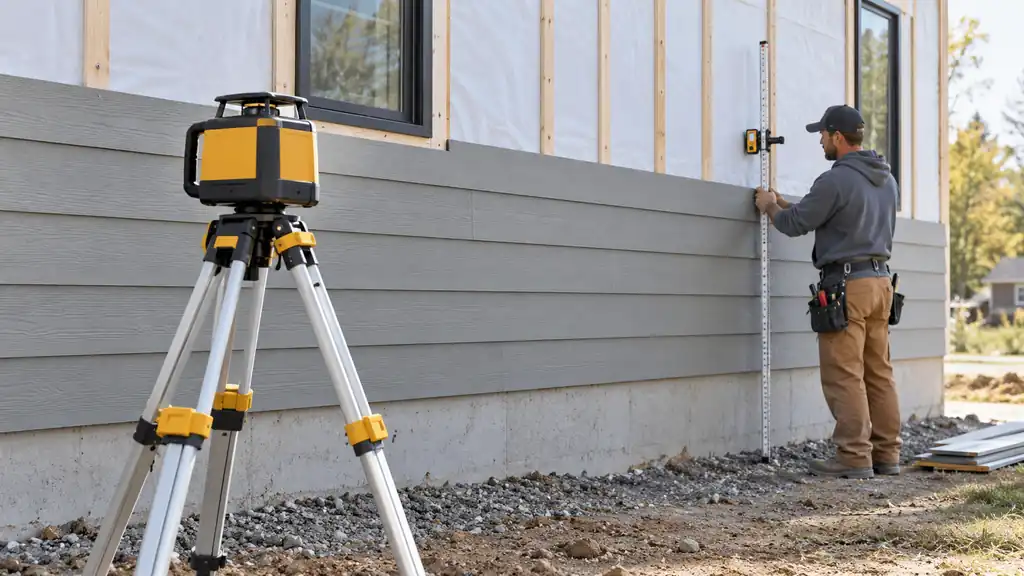
A siding run can look straight beside the first corner and reveal a different relationship across the wall. The useful reference must reach the intended control points, remain understandable around openings, and still be readable when daylight changes the working conditions. The best laser level for siding should help you carry the chosen course reference reliably around the work area in the available daylight.
Exterior work makes receiver compatibility important. A green line is not a promise of naked-eye visibility in sunshine, and a full horizontal plane can still be blocked by the building itself. The installation plan determines course relationships, starter positions, and clearances; the laser transfers chosen references.
These nine options cover connected line systems and a rotary field package. Choose around the intended control marks and supported reading method. A stable setup, appropriate receiver where required, and preserved reference points matter more than the most dramatic beam photograph.
Quick Answer
- Best Overall: DEWALT DW089LG. Three green 360° planes.
- Best Connected Controls and Fine Positioning: Bosch GLL3-330CG. Three green 360° planes.
- Best AA-Powered Three-Plane Alternative: Bosch GLL3-300. Three red 360° planes.
Comparison Table
| Product | Best fit | Reference layout | Power and positioning |
|---|---|---|---|
| DEWALT DW089LG | Best Overall | Three green 360° planes | DEWALT 12V MAX battery platform; Magnetic bracket and ceiling bracket |
| Bosch GLL3-330CG | Best Connected Controls and Fine Positioning | Three green 360° planes | Bosch 12V Max or AA adapter; BM1 positioning device |
| Bosch GLL3-300 | Best AA-Powered Three-Plane Alternative | Three red 360° planes | Four AA batteries; BM1 positioning device |
| Huepar B03CG Pro | Best Removable-Battery Plane Option | Three green 360° planes | Removable rechargeable battery; Magnetic pivoting base |
| Huepar 902CG | Best Two-Plane AA Setup | Green 360° horizontal and vertical planes | Four AA batteries; Magnetic base; tripod interface |
| DEWALT DW088CG | Best Local Green Cross | Green horizontal and vertical cross lines | Three AA batteries; Integrated magnetic bracket |
| Huepar S04CG-C Kit | Best Four-Plane Status Controls | Two horizontal and two vertical 360° planes | Rechargeable pack or AA holder; Magnetic bracket and lifting base |
| Huepar LS04CG | Best Two-Battery Four-Plane Kit | Two horizontal and two vertical green planes | Two supplied rechargeable batteries; USB-C; Magnetic bracket and lifting base |
| Bosch GRL900-20HVK Kit | Best Complete Receiver-Based Field System | Horizontal and vertical rotary operation | Selected alkaline-battery kit; LR10 receiver, BT160 tripod and grade rod |
1. DEWALT DW089LG (Best Overall)

Control marks around an opening can need connected height and vertical references together. The DW089LG supplies three green planes for that arrangement, with a documented separate detector route for supported bright-condition work. Its useful role is transferring the established installation references across surfaces the beam can reach.
The DW089LG projects three 360° green planes and uses the specified 12V MAX battery platform. The documented kit includes a battery, charger, extended ceiling bracket, target card, and carrying case. Full-time pulse operation supports a compatible detector, supplied separately, while the housing carries an IP65 rating. For bright exterior conditions, plan the documented compatible detector rather than relying on visible green projection alone. The selected package’s ceiling-oriented accessory is not automatically the right exterior support, so arrange a suitable mount at the intended height. The instrument should transfer the established installation datum, not determine course spacing by itself.
Pros
- Three full green reference planes.
- Uses the specified removable 12V MAX battery.
- Battery and charger included in the listed kit.
- Extended ceiling bracket and case supplied.
- Documented detector mode and IP65 housing.
Cons
- Detector and full-height tripod are separate.
- Battery compatibility is limited to the documented platform.
The DW089LG suits a siding-related layout that needs connected horizontal and vertical references, with a supported detector planned for conditions that defeat visual reading. It is a stronger fit for that mixed geometry than for elevation stations alone. The GRL900-20HVK supplies a more complete receiver-based field arrangement for the latter task. For a buyer who will use the planes at actual control marks and has a suitable exterior support, the DEWALT offers useful versatility beyond a short cross beside one opening.
To buy this product, click here.
2. Bosch GLL3-330CG (Best Connected Controls and Fine Positioning)

An exterior datum can stay established while related marks are checked farther along the work. The GLL3-330CG combines complete planes, connected settings, and BM1 positioning for that arrangement. A controlled height correction can be useful without broadly moving the support.
Three green planes can be controlled through Bosch’s connected operating system. The listed package supports its Bosch 12V Max battery or four AA batteries with the required adapter. The specified LR8 receiver extends the operating range to 330 feet in diameter, not radius, and is separate from the base kit. The LR8 is a separate, specifically supported detection route, and its extended coverage figures use a diameter convention. Building corners and projecting features can interrupt the path regardless of the nominal range. Establish transfer marks where the reference will remain accessible before changing the tool’s position around the structure.
Pros
- Three-plane green layout.
- Connected operating controls.
- Documented 12V and AA-adapter power options.
- BM1 positioning device included.
- Supported LR8 receiver operation.
Cons
- LR8 receiver is separate.
- Connected functions add setup beyond basic wall alignment.
The GLL3-330CG is most convincing when its mounting adjustment, connected controls, and complete planes all serve the same layout. The LR8 must be planned separately, and the building still decides where the reference can travel. A simpler local tool may be enough beside one opening. For related exterior control points with a verified detector path, the Bosch provides a coherent line-system approach, especially when a preserved datum allows each new setup to reconnect as work moves around the structure.
To buy this product, click here.
3. Bosch GLL3-300 (Best AA-Powered Three-Plane Alternative)

Replaceable-cell power offers a different routine within the complete-plane class. The GLL3-300 supplies red planes and a BM1, with supported LR8 detection arranged separately. It is useful when connected geometry fits the control marks and the actual reading method has been planned.
The GLL3-300 projects three red planes and uses four AA batteries. Its package includes the BM1 positioning device, target, pouch, and hard case. Bosch documents receiver-assisted operation with the appropriate LR8 and a 300-foot diameter range; this is different from the green connected GLL3-330CG. Its supported LR8 receiver arrangement is important for bright conditions. That detector is separate from the BM1 mount, and a visible line that works in shade may not remain readable when the sun reaches the wall. Plan the receiver and stable mounting route as parts of the working system.
Pros
- Three full reference planes.
- Standard AA battery supply.
- BM1 positioning device.
- Target and hard case included.
- Documented LR8 receiver support.
Cons
- Compatible receiver must be supplied separately.
- Red visible lines do not guarantee outdoor daylight readability.
The GLL3-300 provides a relevant AA-powered alternative for connected references, particularly when the operator prefers replaceable cells over rechargeable platform preparation. Its red projection and optional LR8 arrangement need to match the actual light and measuring method. The reason to choose it is complete-plane geometry with the BM1’s useful positioning role. For a buyer whose siding-related marks need those connected directions, that is a more meaningful distinction than assuming green color alone determines exterior usefulness.
To buy this product, click here.
4. Huepar B03CG Pro (Best Removable-Battery Plane Option)

A longer exterior marking session gives removable power a practical role alongside the beam geometry. The B03CG Pro supplies three selectable planes and a magnetic base. Its exterior use needs the appropriate support and compatible separate Huepar detector rather than an assumption about green visibility.
One horizontal and two vertical planes can be selected in different combinations. The listed package contains a removable 5,200mAh battery, USB-C charging equipment, magnetic base, target, and hard case. Receiver operation requires an appropriate Huepar receiver, which is separate from this kit. A suitable support and compatible separate Huepar receiver are essential decisions when bright conditions prevent direct visual reading. The magnetic base is useful only where secure suitable steel exists. Do not choose the instrument position simply because a nearby piece of metal is convenient if that position leaves the important control marks blocked.
Pros
- Three full planes cover adjoining surfaces.
- Selectable beam combinations avoid unnecessary lines.
- Removable rechargeable battery supports repeated indoor projects.
- Magnetic base provides positioning on suitable steel.
- Hard case and charging equipment are included.
Cons
- Full-height positioning tripod is not included.
- Outdoor receiver must be supplied separately.
The B03CG Pro has a clearer exterior role when the buyer plans the complete line-and-receiver arrangement instead of relying on the visible beam. Its removable battery can support a longer marking session, while the three planes serve related control references where the path is clear. A local opening task may need less geometry, and field elevation transfer may favor the Bosch rotary kit. For connected line work with suitable support, the Huepar offers a purposeful combination of layout directions and power preparation.
To buy this product, click here.
5. Huepar 902CG (Best Two-Plane AA Setup)

One horizontal and one vertical plane may cover the planned siding-related references. The 902CG provides that focused geometry with AA power. Its pulse-mode receiver arrangement is the relevant addition when exposed conditions make a directly visible reference difficult to read.
The 902CG projects one full horizontal and one full vertical plane. Its manual specifies four AA batteries and independent or combined plane operation. Pulse mode supports use with a suitable Huepar line receiver, supplied separately. The supported pulse-mode receiver arrangement matters in bright exterior light. Plan which surface receives the vertical plane, and keep the horizontal path clear of projections and stored materials. The beam establishes a datum from which course-related offsets can be transferred; it does not replace the actual siding manufacturer’s layout dimensions.
Pros
- Two continuous green reference planes.
- Standard AA battery supply.
- Independent plane selection.
- Magnetic positioning base.
- Documented receiver operating mode.
Cons
- No second vertical plane for a three-plane layout.
- Compatible receiver is separate.
The 902CG is attractive when the siding layout needs one horizontal and one vertical plane, with no recurring task for another vertical direction. That focused geometry and AA routine give it a distinct role among the larger rechargeable kits. The supported pulse-mode detector remains part of the exterior system, not an optional promise of seeing the line in sunshine. For a buyer whose control marks fit these two directions, the Huepar keeps the arrangement useful without adding reference planes that do no work.
To buy this product, click here.
6. DEWALT DW088CG (Best Local Green Cross)

Local marks beside an opening do not demand the same optical setup as elevations around the entire structure. The DW088CG supplies a green cross for that narrower task. Its AA power and integrated bracket are useful when the support and documented detector arrangement fit the working conditions.
The DW088CG provides a green cross-line configuration with a magnetic mounting bracket. DEWALT’s operating instructions list ±1/8 inch at 30 feet for the line reference. Detector-assisted use requires the compatible green-line detector; it is not included in the basic laser kit. Direct sunlight can change its useful visual role, so the documented detector arrangement should be considered before choosing it for exposed work. It does not provide continuous horizontal coverage. If the installation needs many related points around the structure, a plane or rotary system may fit the measurement method more naturally.
Pros
- Green wall-layout references.
- Documented line accuracy at a stated distance.
- AA battery power.
- Integrated magnetic bracket.
- Supports specified green-line detector operation.
Cons
- Compatible detector is separate.
- No continuous horizontal plane around the room.
The DW088CG belongs with a defined local task, such as relating marks beside an opening, rather than a promise to cover the whole exterior from one position. Its compact cross and AA preparation fit that narrower role. A long series of elevation stations makes the GRL900-20HVK more relevant, while connected visible references point toward a plane tool. For the local job, the DEWALT is a sensible choice when the support and documented detector arrangement suit the actual working conditions.
To buy this product, click here.
7. Huepar S04CG-C Kit (Best Four-Plane Status Controls)

Alternate horizontal windows can help place a reference around an awkward physical setup. The S04CG adds those options to its vertical planes, with a screen and remote plane selection. That control arrangement is useful when the instrument’s position is correct but its settings are inconvenient to reach.
Four green planes include a low horizontal reference in addition to the upper horizontal plane. The S04CG documentation describes LCD status, Bluetooth controls, rechargeable-pack power, and an AA holder. The lifting base changes the low reference position; pulse operation requires an appropriate Huepar receiver, supplied separately. The additional geometry is useful only where the beam path and mounting position support the work. Its remote does not rotate the base onto a mark. For bright conditions, use the correct separate Huepar detector and verify the reference from preserved points before treating the setup as ready for repeated transfer.
Pros
- Upper and lower horizontal references.
- Two vertical planes for connected layouts.
- Lifting base helps position the low line.
- Rechargeable and AA-holder power choices.
- LCD status and remote operating controls.
Cons
- Four-plane setup adds bulk and complexity.
- Compatible receiver and full-height tripod are separate.
The S04CG is worth considering when alternate horizontal reference positions and remote selection make an awkward setup more workable. Its screen helps identify the operating state, while the physical orientation still has to be established at the intended datum. Someone who needs fewer planes or simpler controls may prefer the B03CG Pro or 902CG. For a layout that genuinely uses the additional positions, the S04CG has a useful role, provided the separate detector and exterior mounting arrangement are chosen just as deliberately.
To buy this product, click here.
8. Huepar LS04CG (Best Two-Battery Four-Plane Kit)

Two supplied batteries and two horizontal plane positions solve different parts of a longer marking session. The LS04CG combines those features with selectable vertical references. Its useful role is a planned connected layout in which the alternate window actually improves the available beam path.
The LS04CG provides both upper and lower horizontal planes alongside two perpendicular vertical planes. Its selected package includes two rechargeable batteries, a magnetic bracket, and a lifting base. The batteries have separate USB-C charging ports; pulse operation supports specified Huepar receivers such as the LR-6RG, supplied separately. The low plane should not be selected merely because it is available. Choose the reference that clears the actual wall features and remains easy to detect. The compatible receiver is separate, and its pulse-mode pairing needs to be established before relying on exterior readings that cannot be seen clearly.
Pros
- Upper and lower horizontal planes.
- Two vertical planes.
- Two rechargeable batteries supplied.
- Separate battery charging ports.
- Lifting base and magnetic bracket included.
Cons
- Receiver is separate.
- More equipment to manage than a compact cross-line tool.
The LS04CG is best matched to a buyer who will use both its alternate horizontal positions and its two-battery package. Those are separate practical benefits, and together they can support a longer sequence of related control marks. The S04CG adds another control experience; the simpler plane tools offer less equipment to manage. For the LS04CG, the purchase should be driven by the actual beam position and power routine, with supported electronic detection arranged before exposed work depends on it.
To buy this product, click here.
9. Bosch GRL900-20HVK Kit (Best Complete Receiver-Based Field System)

Elevation stations in exposed conditions can favor a rotary receiver system over visible wall lines. The GRL900-20HVK supplies the receiver, tripod, and rod for that method. It can relate planned control heights through measurements rather than asking a local cross to serve the whole structure.
The selected kit includes an LR10 receiver, tripod, grade rod, remote, wall mount, and case. Horizontal and vertical operation supports elevation transfer and interior alignment. Electronic leveling and a disturbance monitor help identify a changed setup; the linked package lists D-cell power for the transmitter. The rotary system should be used for its documented reference and detection workflow. A level datum can relate planned starter or control marks through measured offsets, while the actual course progression follows the siding system’s instructions. Check the benchmark after movement and reconnect deliberately when the building blocks the receiver path.
Pros
- Horizontal and vertical operation.
- Electronic leveling.
- Disturbance monitor.
- Receiver, tripod, and rod included.
- Remote and wall mount supplied.
Cons
- Larger package than a compact wall laser.
- Do not assume numeric slope entry.
The Bosch rotary kit is the stronger choice when the siding-related task is primarily transferring elevations between stations. Its included receiver, tripod, and rod give that method a complete field context, instead of relying on a visible line across an exterior wall. A local opening reference may be better served by a compact cross. For repeated control heights around the structure, the GRL900-20HVK makes sense when its benchmark and transfer marks keep each measurement connected as corners interrupt the original path.
To buy this product, click here.
Choosing the Best Laser Level for Siding
Start with the Siding Layout
Starter position, course relationships, openings, and clearances depend on the actual system. Establish those dimensions first. The laser transfers the chosen datum rather than deciding the installation pattern. The routine for transferring exterior course heights from one benchmark connects the starting layout to the preserved reference rather than to an unverified existing course.
Plan for Bright-Light Reading
Green projection alone does not establish sunlight visibility. Choose a supported transmitter and detector pair where needed, with the correct mode and a clear path to the relevant control point.
Keep the Reference Accessible
Corners, projections, and installed material can block a plane. Preserve transfer marks before the beam path disappears. Reconnect a new setup to the established datum instead of assuming the height is retained. Where siding marks relate to rough framing, keeping wall and overhead layout references distinct prevents different reference surfaces from being treated as interchangeable.
Choose Stable Exterior Support
A magnetic bracket needs secure suitable steel, and a tripod needs sound footing away from work activity. Select the actual mounting method before judging the useful beam geometry.
Distinguish Elevation from Course Spacing
A shared height reference does not set every course dimension. Apply the correct offsets and manufacturer’s layout method, then recheck the marks after any support disturbance.
FAQ
Can a Green Laser Be Read in Full Sun?
Do not assume so. Use the documented compatible receiver arrangement when the visible reference is not reliable.
Will One Plane Reach Around the Entire Building?
Not necessarily. The structure and projections can block it. Preserve transfer marks and reconnect the reference where a new setup is needed.
Does the Laser Set Siding Course Spacing?
No. It provides references. Course progression and clearances follow the actual siding system and installation plan.
Is a Rotary System Useful Here?
It can be useful for receiver-based elevation transfer between control points, particularly in exposed conditions.
Can I Use Any Detector of the Same Color?
No. Match the exact transmitter family, signal type, and operating mode identified by the manufacturer.
Final Verdict
The DW089LG is our overall choice for connected siding-related line references, with the appropriate detector arranged for conditions that prevent reliable visual reading. The GLL3-330CG adds a coordinated mounting and control package. Where the job is primarily transferring elevations between outdoor stations, the GRL900-20HVK’s complete receiver-based system provides a more natural comparison.
Exterior light and the building’s sightlines should shape the final selection. A full plane cannot pass through a corner, and green projection does not remove the detector decision. Establish the actual installation dimensions and preserve control marks before the first setup becomes blocked. With that plan in place, choose the tool around the references that will remain usable as work moves from one part of the structure to another.
