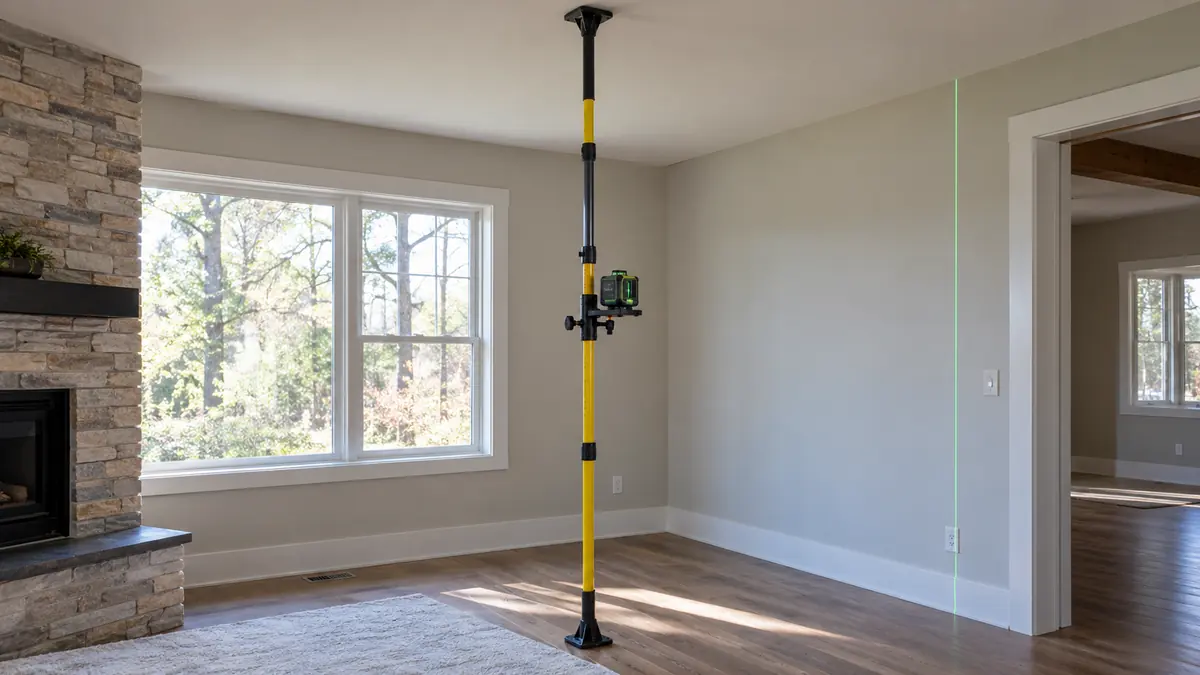
The reference is almost at the right height. Then the stand moves, the line drops, and the careful pencil mark needs another attempt. A laser pole is useful because it changes the positioning problem: raise the tool along a support instead of rebuilding the entire setup for every small height change. The best laser level pole must reach the working height and support the instrument securely without creating a moving or obstructed reference.
Most systems here compress between a suitable floor and ceiling, sometimes with an included tripod for additional support or freestanding use. One alternative is a tall freestanding pole tripod. Their mounting threads matter, but a matching adapter alone does not establish that a support suits every instrument’s weight and geometry.
These nine picks focus on laser support poles, including quick-clamp systems, fine-adjustment brackets, and tripod-supported alternatives. Graduated receiver rods serve a different measurement role. Start with the room height and mounting interface, then choose the support that lets the instrument reach the working reference securely.
Quick Answer
- Best Overall: Bosch BP350. Floor-to-ceiling telescoping pole.
- Best for Fine Bracket Adjustment: Firecore FLP370C. Sectional pole with support tripod.
- Best Multifunction Bracket: DOVOH DP3700. Sectional pole with adjustable tripod.
Compare the Nine Picks
| Product | Best fit | Support design | Mounting interface |
|---|---|---|---|
| Bosch BP350 | Best Overall | Floor-to-ceiling telescoping pole | Swiveling 1/4-20 mount and quick-set clamp |
| Firecore FLP370C | Best for Fine Bracket Adjustment | Sectional pole with support tripod | Fine-adjustment bracket; 1/4-20 and 5/8-11 adapter |
| DOVOH DP3700 | Best Multifunction Bracket | Sectional pole with adjustable tripod | Multifunction magnetic bracket and threaded adapter |
| DEWALT DW0882 | Best Compact Sectional DEWALT Option | Sectional floor-to-ceiling pole | 1/4-20 tool mount; spring-loaded base |
| Huepar LP36A | Best Huepar Support Kit | Sectional pole with support tripod | Adjustable bracket; 1/4-20 and 5/8-11 adapter |
| Firecore FLP400A | Best Twist-Lock Telescoping Option | Twist-lock telescoping pole | Rotating FM30 bracket and 5/8-11 adapter |
| Johnson Level 40-6302 | Best Indoor Foot-Pedal Setup | Eleven-foot indoor pole and tripod | Quick-release clamp; 1/4-20 adapter |
| Takamine Twelve-Foot Pole Kit | Best Height-and-Depth Bracket Alternative | Sectional pole with adjustable tripod | Height/depth bracket; two thread interfaces |
| VEVOR Extendable Pole Tripod | Best Without Ceiling Contact | Tall freestanding telescoping pole tripod | 1/4-20 and 5/8-11 mounting connections |
1. Bosch BP350 (Best Overall)

The BP350 is useful when a local line or point laser needs to move smoothly between indoor reference heights. Its quick-set clamp and swiveling mount keep the adjustment close to the tool. The ball-jointed ceiling plate helps establish contact without making the pole’s angle the laser’s calibration.
The BP350 adjusts from about 4.6 to 11½ feet between suitable floor and ceiling surfaces. Its quick-set clamp and swiveling 1/4-20 tool mount allow height and orientation changes. An anti-slip foot and ball-jointed head support compression positioning; the optional WM1 adds microfine height adjustment.
Pros
- Quick-set height clamp.
- Swiveling 1/4-20 tool mount.
- Ball-jointed ceiling plate.
- Anti-slip foot.
- Telescoping adjustment.
Cons
- Needs suitable opposing surfaces for compression support.
- WM1 microfine adjustment accessory is separate.
Check the room against its extension range. Choose a separate micro-adjustment accessory only if that finer height control is needed.
To buy this product, click here.
2. Firecore FLP370C (Best for Fine Bracket Adjustment)

The FLP370C combines a sectional pole with a tripod and a bracket that adjusts in height and depth. That is useful beside a precise cabinet or ceiling mark where moving the whole support would be clumsy. The marked sections help repeat the physical setup.
The FLP370C reaches approximately twelve feet using four sections and a telescoping tail. Its bracket provides height and depth adjustment, with a primary 1/4-20 connection and 5/8-11 adapter. The selected package includes a support tripod, spring-loaded base, marked pole sections, and carrying case.
Pros
- Support tripod included.
- Fine height adjustment.
- Depth adjustment.
- Two mounting interfaces.
- Inch and centimeter pole markings.
Cons
- Several sections to assemble and pack.
- Tall freestanding use requires careful stability checks.
The markings locate the support, not the optical beam’s calibrated elevation. Recheck the actual reference after every bracket adjustment.
To buy this product, click here.
3. DOVOH DP3700 (Best Multifunction Bracket)

The DP3700’s bracket can work on the pole or attach independently to suitable surfaces. That gives it a useful second role when the next room has convenient metal or another supported attachment point. Its height and swivel controls also help place the instrument without rebuilding the pole.
The DP3700 uses four extension rods and a telescopic rod for approximately twelve feet of reach. Its bracket offers height and swivel adjustment and can also mount independently to suitable metal, nails, or thin boards. The kit includes a support tripod, spring foot pedal, ceiling plate, and 5/8-11 adapter.
Pros
- Multifunction magnetic bracket.
- Height and swivel positioning.
- Support tripod included.
- Spring foot pedal.
- Thread adapter supplied.
Cons
- Bracket attachment must suit the surface.
- Tall freestanding configuration needs extra stability attention.
Check the bracket’s grip and beam clearance. Each attachment method needs a suitable surface and a secure fit before the line is used.
To buy this product, click here.
4. DEWALT DW0882 (Best Compact Sectional DEWALT Option)

The DW0882 offers a direct sectional arrangement for compatible 1/4-20 instruments. It makes sense in ordinary rooms where ten feet of reach is sufficient and a spring-loaded base can establish compression. Screw-together aluminum sections keep the design straightforward.
The DW0882 uses screw-together aluminum sections and extends up to ten feet. A spring-loaded base helps establish a compression fit between suitable surfaces. The primary interface is 1/4-20; its sectioned design packs into a supplied carrying bag.
Pros
- Screw-together sections.
- Ten-foot maximum extension.
- Spring-loaded base.
- 1/4-20 interface.
- Carrying bag included.
Cons
- Shorter maximum reach than several alternatives.
- No direct 5/8-11 connection.
Measure the room before choosing. Its maximum reach and primary thread are more limiting than some larger adapter-equipped kits.
To buy this product, click here.
5. Huepar LP36A (Best Huepar Support Kit)

The LP36A supplies the sectional pole and support tripod as one arrangement. It suits a Huepar user who needs more height flexibility than a compact stand provides. The adjustable bracket lets the reference move while the main support remains in place.
The LP36A is a roughly twelve-foot sectional laser support with a telescoping end. Its supplied support tripod provides a positioning option where overhead compression is unavailable. An adjustable mounting bracket, threaded adapter, and spring-loaded foot complete the selected setup.
Pros
- Support tripod supplied.
- Adjustable mounting bracket.
- Primary 1/4-20 interface.
- 5/8-11 adapter supplied.
- Spring-loaded compression foot.
Cons
- Full-height freestanding stability needs checking.
- Not a substitute for a rated heavy instrument tripod.
Confirm the supplied bracket and adapter for the exact listing. Freestanding use still needs a stable footprint and conservative extension.
To buy this product, click here.
6. Firecore FLP400A (Best Twist-Lock Telescoping Option)

The FLP400A uses twist-lock sections instead of the same sectional-and-tripod format as the FLP370C. Its longer reach can help in a taller room, while the FM30 bracket offers alternative attachment methods. That structural difference is why both Firecore models appear here.
The FLP400A uses twist-lock telescoping sections and reaches approximately thirteen feet. Its rotating FM30 mounting bracket can also attach to suitable pipes or be fixed with screws. A ball-jointed head, anti-slip contact surface, and sectioned carrying bag support floor-to-ceiling setup and transport.
Pros
- Twist-lock adjustment.
- Approximately thirteen-foot reach.
- Rotating mounting bracket.
- Alternative bracket attachment methods.
- Sectioned carrying bag.
Cons
- No support tripod identified in this selected package.
- Requires suitable opposing surfaces for compression setup.
This selected package does not identify a support tripod. Plan for a suitable floor-to-ceiling compression setup rather than assuming one is included.
To buy this product, click here.
7. Johnson Level 40-6302 (Best Indoor Foot-Pedal Setup)

The Johnson 40-6302 combines a foot-pedal compression arrangement with a supporting tripod. That can help establish the pole while keeping the instrument mounting area accessible. Its quick-release clamp is useful when changing position between related interior reference heights.
The 40-6302 provides an indoor floor-to-ceiling support extending up to eleven feet. A foot pedal and spring-loaded end help establish compression, while the tripod provides additional support. The selected package includes pole sections, ceiling mount, quick-release clamp, threaded adapter, and carrying case.
Pros
- Eleven-foot indoor support.
- Foot-pedal compression setup.
- Support tripod included.
- Quick-release clamp.
- Carrying case supplied.
Cons
- Designed for indoor environments.
- Shorter reach than some twelve- and thirteen-foot systems.
The system is intended for indoor environments. Check the eleven-foot maximum against the room and protect the contact surfaces.
To buy this product, click here.
8. Takamine Twelve-Foot Pole Kit (Best Height-and-Depth Bracket Alternative)

The Takamine package offers bracket height and depth adjustment alongside a support tripod. Those controls can help clear a projection window or move the instrument nearer the intended surface. A soft case keeps its separate sections and mounting parts together between rooms.
This Takamine kit provides four pole sections and a telescoping spring-base section. The mounting bracket adjusts in height and depth and accepts the supplied 5/8-11 adapter. The package includes an adjustable tripod, anti-slip ceiling plate, marked sections, and a soft carrying case.
Pros
- Adjustable support tripod.
- Height-adjustment bracket.
- Depth adjustment.
- Thread adapter supplied.
- Soft carrying case.
Cons
- Multiple components to assemble.
- Tripod bubble does not verify laser calibration.
Do not confuse the tripod bubble with a calibrated laser check. Establish the support, then verify the instrument’s reference independently.
To buy this product, click here.
9. VEVOR Extendable Pole Tripod (Best Without Ceiling Contact)

This VEVOR is the alternative when the support cannot press against an overhead surface. Its tall center-pole tripod provides freestanding height adjustment and a rotating mount. That avoids ceiling contact but requires more clear floor space around the legs.
This VEVOR option is a tall freestanding pole tripod rather than a floor-to-ceiling compression system. Its listed height range is approximately 41 to 134 inches, with a rotating instrument mount. An aluminum-alloy frame, bubble reference, folding format, and bag support portable positioning.
Pros
- Does not require ceiling contact.
- Tall telescoping range.
- Two common mounting interfaces.
- Rotating tool mount.
- Folding format and bag.
Cons
- Larger floor footprint than a compression pole.
- No spring-loaded ceiling compression.
Choose it for the freestanding format. Keep people and materials away from the footprint, especially when the center section is extended high.
To buy this product, click here.
Choosing the Best Laser Level Pole
Measure Both Room Height and Working Height
The pole must fit between the surfaces, and the bracket must reach the desired beam height. Those are different measurements. Check minimum extension, maximum reach, and the bracket’s usable travel before choosing a system for a very low reference or a tall ceiling. For framing or rough-in work, transferring marks to an overhead layout is the reason to establish a usable high position rather than simply extend the pole.
Choose Compression or Freestanding Support
Compression needs suitable opposing surfaces that can safely accept the contact pressure. A tripod avoids or supplements that connection but adds a footprint and a different tipping risk. Use the configuration documented for the model and inspect stability before raising the instrument.
Check Thread, Clearance, and Instrument Suitability
A 1/4-20 screw or 5/8-11 adapter establishes the connection size. It does not establish the load capacity or prevent a large instrument from fouling the bracket. Check the tool’s body, center of mass, beam windows, and the support’s documented limits together. Use the checklist for checking pole height and carriage positioning before relying on the mounting thread alone.
Look for Useful Fine Adjustment
A sliding clamp makes broad height changes. A fine height knob makes a smaller correction, while depth and swivel controls solve different positioning problems. Consider the last adjustment you usually struggle with and choose the bracket that actually provides that movement.
Protect Finished Contact Surfaces
Rubber feet and ceiling plates still need clean, sound contact surfaces. Debris, weak paint, and excessive compression can create damage or an insecure fit. Follow the setup instructions, avoid fragile ceilings, and recheck the pole when work nearby introduces vibration.
Keep a Separate Optical Reference
Pole markings and support bubbles help position the hardware. They do not verify the projected line’s calibration or preserve an earlier height after the instrument moves. Check against a durable mark after adjustments and allow the automatic leveling system to settle before marking again.
FAQ
Is a Laser Pole the Same as a Grade Rod?
No. A support pole carries the laser. A grade rod carries a receiver or a measurement scale at the point being checked. They have different roles in an elevation-transfer system.
Can I Use a Compression Pole Without a Ceiling?
Only with an appropriate supported freestanding arrangement. Some kits include a tripod, but the permitted extension and stability still need to follow the model’s instructions.
Will Any 5/8-11 Adapter Support a Rotary Laser?
A matching thread does not establish suitability. Check weight, bracket clearance, support capacity, and the instrument’s mounting instructions before attaching a heavy rotary unit.
Does the Pole Have to Be Perfectly Vertical?
Set it as instructed for secure support and useful adjustment. The instrument’s self-leveling and field-check requirements are separate from the support’s physical orientation.
Can I Clamp the Pole Against a Suspended Ceiling Tile?
Do not assume that a fragile or unsupported panel can accept compression. Use sound contact points and the support arrangement permitted by the pole and ceiling structure.
Why Does the Line Move After I Adjust the Bracket?
The support or instrument position may have changed, and the leveling system may need to settle. Recheck the datum rather than assuming the previous reference survived the adjustment.
Final Verdict
The Bosch BP350 is our overall choice for straightforward indoor pole positioning. Choose the Firecore FLP370C for its tripod and fine bracket controls, or the DOVOH DP3700 when its alternative bracket attachments are useful.
The VEVOR tall pole tripod serves the different situation where ceiling contact is unavailable. Match the room, instrument, and permitted support configuration, then verify the beam after each physical adjustment.
