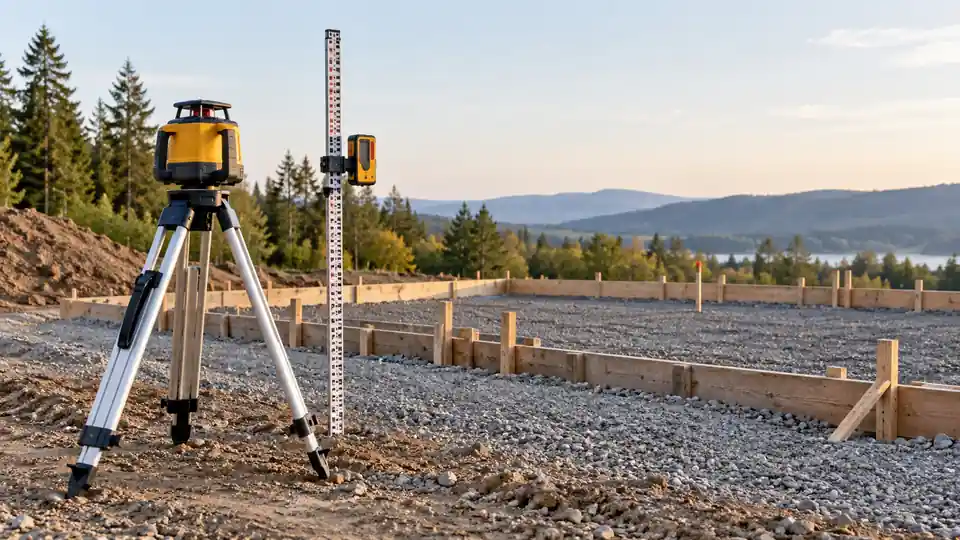
A rotary laser can cover a large site, but the receiver still has to give you a dependable elevation reference where you stand. For Topcon RL-H5A vs RL-H5B, the important differences are the published working diameter and horizontal accuracy. The H5A is the stronger fit for longer distances or tighter instrument tolerance; the H5B remains relevant when the working area and required tolerance comfortably fit its specification.
Start with the farthest useful reading, then check the complete kit. The instrument with the greater reach is not automatically the more complete package. A receiver, clamp, stable tripod, and suitable grade rod can matter more to the first day’s work than another headline range number.
RL-H5A: more reach and a tighter horizontal rating

The RL-H5A provides the more capable published range-and-accuracy combination of these two instruments. It makes sense when readings extend farther from the transmitter or when the instrument tolerance needs to leave more room for the rest of the layout process. The linked package identifies an LS-80 receiver arrangement, so treat it as that specific kit rather than assuming every H5A offer includes the same field accessories.
Its useful advantage is headroom within a planned elevation workflow. You still need a stable setup, a suitable receiver position, and a preserved benchmark. Extra reach cannot make an obstructed line of sight usable or correct a rod held out of plumb.
To buy this product, click here.
RL-H5B: a horizontal system for a working area that fits

The RL-H5B can be a sensible match for shorter site distances where its published tolerance meets the job. The selected offer is a receiver, tripod, and rod bundle, which makes package contents an important part of the decision. Check the actual rod style, scale, and tripod suitability rather than judging the system only by the laser body.
The package should support the way you read elevations. A rod with the wrong scale or an unsuitable clamp can add avoidable friction even if the transmitter is entirely adequate. Buying the right system means matching those details to the work, not merely collecting the largest number of accessories.
To buy this product, click here.
Topcon RL-H5A vs RL-H5B: Range, Accuracy, and Kit Contents
| Factor | RL-H5A | RL-H5B | What it changes |
|---|---|---|---|
| Published working diameter | 800 m, about 2,625 ft | 400 m, about 1,312 ft | Overall nominal coverage |
| Nominal radius from a central setup | 400 m | 200 m | One-way geometry, not guaranteed detection |
| Horizontal angular accuracy | ±10 arc seconds | ±20 arc seconds | H5A has the tighter published rating |
| Self-leveling compensation | Horizontal ±5° | Horizontal ±5° | Compensation is not a grade-entry function |
| Rotation speed | 600 rpm | 600 rpm | Common ground in the factory comparison |
| Protection rating | IP66 | IP66 | Protect the instrument and check it after disturbance |
The Topcon US lasers-and-levels catalog lists both models together, distinguishing their horizontal accuracy and working diameter. Use that common basis for the instrument comparison. A retailer’s bundle headline should not turn a diameter figure into a one-way distance.
Diameter is not the distance from the tripod to the receiver
The published working area is 800 meters in diameter for RL-H5A and 400 meters for RL-H5B. In simple geometric terms, the corresponding radius is half the diameter. That places the nominal edge of the working area about 400 meters from a centrally positioned H5A, or 200 meters from a centrally positioned H5B, subject to the operating conditions.
This matters when a site drawing shows a long edge. If you place the laser near one end rather than near the center, the far receiver position may be much farther from the transmitter than the site width initially suggests. Plan the actual sightline from the intended setup point, including access, obstructions, and where the rod can safely be used.
Do not design a critical workflow right against a maximum range figure. Heat shimmer, interference, obstructions, and receiver conditions can affect whether a reading is dependable. A shorter unobstructed sightline with a preserved benchmark is often more useful than stretching one setup simply to avoid repositioning.
For a small pad or repeated work within a compact area, the H5B’s working diameter may already provide ample coverage. For longer elevation transfer across open ground, the H5A offers more published reach. The relevant question is where your farthest required reading lies, not which number looks more impressive in a title.
Accuracy is meaningful only within the whole measurement process
Topcon lists horizontal angular accuracy of ±10 arc seconds for H5A and ±20 arc seconds for H5B. These are not time measurements. An arc second is an angular unit, and the resulting height deviation grows as the reading distance increases. At a common distance, the H5A’s quoted angular tolerance is tighter.
To put the units in context, those angular ratings correspond approximately to ±0.058 inch and ±0.116 inch at 100 feet. Those are calculated equivalents of the published instrument ratings, not field measurements or guaranteed total-system results. They help explain why distance and tolerance belong in the same buying decision.
The receiver’s detection setting, the rod’s scale, rod plumbness, setup stability, and the way you transfer the benchmark also contribute to the result. A transmitter with the tighter rating does not remove those factors. Set the complete error allowance around the job’s requirements rather than assigning every possible deviation to the laser alone.
Consider a receiver clamped to a leaning rod. The indicated position can change even though the laser plane has not moved. Or consider a tripod foot settling into loose ground after the first reading. Neither situation is cured by selecting the H5A. The useful upgrade is a better instrument specification combined with a sound field method.
Compare the selected packages separately from the laser bodies
| Component | Linked RL-H5A offer | Linked RL-H5B offer |
|---|---|---|
| Transmitter | RL-H5A | RL-H5B |
| Named receiver arrangement | LS-80 receiver | LS-80X receiver |
| Receiver support | Holder listed | Rod bracket listed |
| Tripod and rod | Do not assume they are included | Bundle names both; verify current specifications |
| Carrying components | Case listed | Check bundle component list |
| Before ordering | Confirm exact power package | Confirm power package, rod scale, and tripod connection |
The linked H5A and H5B offers are not identical packages, so the body comparison and accessory comparison should remain separate. The H5B bundle names an LS-80X receiver, a tripod, and a rod. The H5A offer names an LS-80 receiver arrangement and carrying components. Verify the current component list on the selected offer before building a kit around it.
Pay particular attention to the rod scale. Feet-and-inches markings, decimal feet, and metric scales suit different routines. The wrong scale can be awkward even when the rod is mechanically compatible. The receiver clamp must also attach securely at the height you need without obscuring the reading.
For the tripod, useful stability and attachment compatibility come before maximum extension. The transmitter needs to remain still while you work, so arrange the feet on firm support and keep the setup away from disturbance. If a machine or material delivery can strike it, a different location may be more valuable than an additional accessory.
Power, self-leveling, and slope are separate decisions
Confirm whether the selected kit uses the alkaline arrangement or includes the appropriate rechargeable components. The laser family has different power-package configurations, and a charging accessory shown in another bundle is not evidence that it belongs in yours. Prepare the correct cells or pack before the first site visit.
The ±5-degree self-leveling range describes how far the instrument can compensate while establishing its horizontal reference. It is not a promise that you can enter a ±5-degree grade, and it is not a five-percent slope specification. Degrees and percentages are different descriptions of slope, so do not interchange them in a purchasing decision.
The H5A documentation describes manual slope capability, but that is not the same as automatic numerical grade entry. If a particular drainage or grading task depends on slope control, verify the exact model’s procedure and required accessories before selecting the instrument. Neither of these horizontal-laser names should be treated as proof of a dual-grade system.
For the basic benchmark and receiver routine, our guide to using a rotary laser level explains how to preserve a reference through setup changes. That method remains important whichever transmitter you bring to the site.
Choose by distance, tolerance, and the equipment you already own
| Requirement | Stronger starting point | Condition |
|---|---|---|
| Longer open-site reference distances | RL-H5A | Plan the actual radius and reliable sightline |
| Tighter published transmitter tolerance | RL-H5A | Keep receiver and rod errors in the total allowance |
| Compact area with compatible tolerance | RL-H5B can fit | Check the complete job requirements |
| Need a receiver, tripod, and rod together | Compare the exact bundle | Accessory completeness is separate from body capability |
| Need automatic numerical grade or dual slope | Evaluate a dedicated grade system | Do not infer that function from self-leveling range |
| Already own suitable field accessories | Compare transmitter and receiver compatibility | Avoid buying around duplicate or mismatched components |
Both models can be considered for horizontal elevation reference work, but neither should be selected merely because a project is labeled construction. Match the actual task and operating method. The wider rotary laser-level guide is useful if you also need vertical work or a dedicated grade function.
Questions to settle before choosing the kit
Does H5A cover twice the one-way distance?
The published diameters are 800 and 400 meters, so the nominal radii also differ by that ratio. Actual usable detection still depends on the setup, receiver, and operating conditions.
Is H5B a more accurate successor because its letter comes later?
No. The factory comparison lists the tighter horizontal accuracy for H5A. Model-letter order is not a sound way to rank either range or precision.
Does a receiver kit include a tripod and grade rod?
Not necessarily. Read the component list for the exact offer. A receiver, holder, and case do not automatically include a site tripod or the rod scale your workflow requires.
Which system deserves a place on your next site?
The RL-H5A makes the stronger case when distance and instrument tolerance lead the decision. Its greater working diameter and tighter horizontal rating provide useful headroom for demanding elevation transfer. Match it with a receiver, rod, and stable setup that can make use of that capability, and protect the benchmark through every move. Its advantage is a more capable reference system, not permission to skip the field checks.
To buy this product, click here.
The RL-H5B remains a practical choice when your site and required tolerance fit its specification. A suitable accessory bundle can make it easier to assemble a working setup, especially if you do not already own the receiver, tripod, and rod. Confirm the contents and scale, plan the farthest reading, and buy it for the job it actually covers rather than assuming the later letter means a universal upgrade.
To buy this product, click here.
