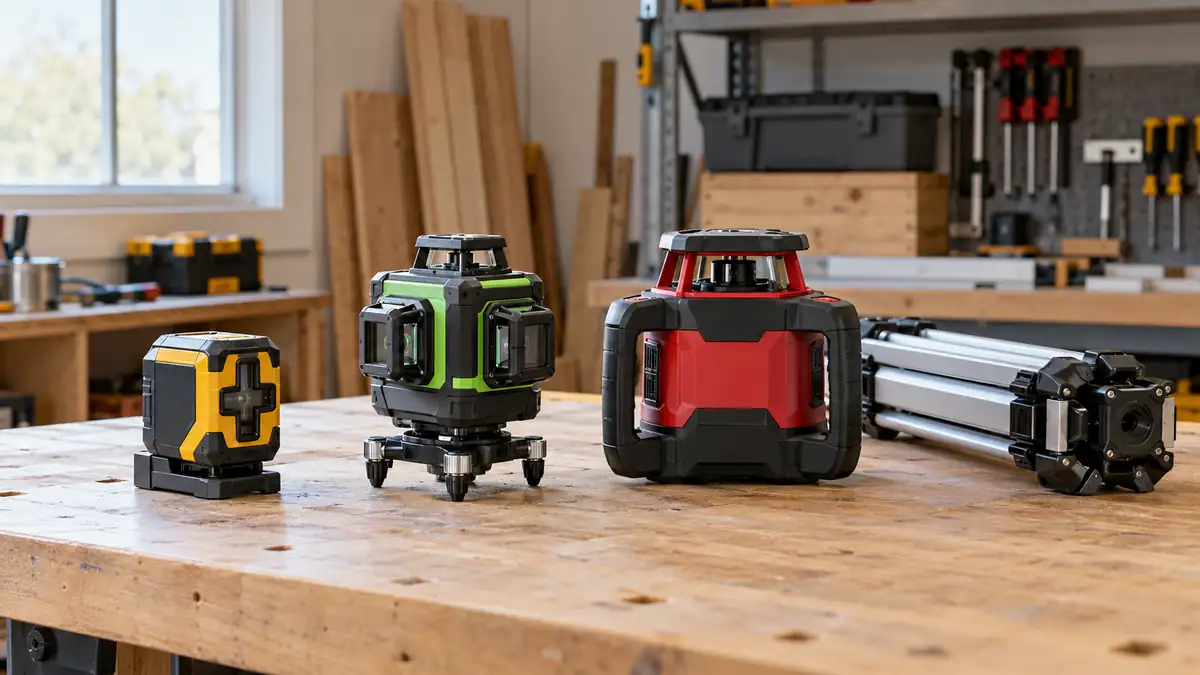
The best laser levels are the ones that supply the reference your project needs and can be positioned securely where the work happens. For a few wall fixtures, that may be a compact cross-line tool. Connected room layouts can benefit from continuous planes, while outdoor elevation checks often call for a rotary system with a compatible receiver.
Start with the task rather than the largest beam count. You need to know which surfaces or points must relate, how far apart they are, and how the reference will be read. Battery supply, mounting equipment, and the contents of the selected kit then become practical parts of the decision.
This guide helps you choose the right comparison to read next. The individual shortlists explain the candidate configurations and their trade-offs in more detail, without requiring every project to begin with the same kind of laser.
Find the Best Laser Levels by Reference Type
| Your task | Reference to investigate | A decisive setup question |
|---|---|---|
| Shelves, pictures, curtain hardware, and other local wall marks | A suitable line or cross-line arrangement | Can you hold the reference clear of the actual fixing marks? |
| Matching heights or related layouts on several indoor surfaces | Continuous horizontal and relevant vertical planes | Will the required surfaces be reached from the chosen position? |
| Comparing elevations across outdoor stations | A suitable rotary system and compatible receiving equipment | How will the readings connect to a preserved benchmark? |
| Transferring a specific point between documented directions | A dot or combination instrument with the required capability | Does the exact point layout perform the transfer you need? |
For Everyday Home Projects
A shelf installation is usually more about a clear, stable reference and the actual bracket offsets than the maximum number of planes. The same applies to curtain hardware and a single wall of pictures. A simple tool can be useful when it produces the needed reference and the mounting method fits the room.
Our laser levels for home projects compare compact wall arrangements alongside broader indoor configurations. Pay attention to whether alignment is manual or automatic, what support is supplied, and whether the reference remains accessible while you mark and install.
If the next job already includes connected cabinet or trim work, consider that future need without treating it as a reason to buy every available feature. A smaller tool that fits the current work and a larger multi-surface instrument can both be sensible choices for different households.
For Connected Indoor Layouts
A continuous horizontal plane can carry a height around several walls from one position. Relevant vertical planes add other relationships when the layout needs them. That coverage can be useful in a renovation where the reference must continue beyond a single patch of wall.
Compare 360-degree options for connected indoor layouts by the actual plane arrangement, power supply, and positioning equipment. A rotating bracket and a projected continuous plane are different things, and a marketing line count is not a substitute for understanding the geometry.
Coverage also has limits. Cabinets, door openings, stacked materials, and your own working position can interrupt the reference. More planes do not remove the need to preserve a datum or reconnect the setup after a move.
For Outdoor Elevation Work
Across a site, the important reference may be read with a receiver instead of located visually on a wall. The transmitter, compatible receiver, rod, and support then form a measuring system. A long advertised reach alone does not explain what the chosen package lets you do.
The rotary laser systems for field references comparison covers those arrangements. Check the benchmark routine, supplied receiving equipment, and any documented vertical or slope functions needed by the project.
A horizontal reference can be used to compare different designed elevations. A slope-capable setup requires its own documented method and checks. Neither arrangement determines what drainage, structural, or installation requirements the site should meet.
For Point Transfer and Plumb Layout
Sometimes the missing capability is a specific point above or below a starting position rather than another line across a surface. A dedicated point or combination tool can serve that role when its documented geometry and orientation match the intended transfer.
These dot laser options for point transfer distinguish the available arrangements. Check which directions are provided and which accuracy statement applies. A point projected forward is not automatically a reference directly overhead.
Make sure the support leaves the required points accessible. A mounting arrangement that works for a wall cross may hide a downward reference or prevent the instrument from being placed over the starting mark.
Compare the Complete Working Arrangement
Once the reference type fits, examine the part of the setup most likely to interrupt the job. That might be working height, access to adjustment, a compatible receiver, or a battery arrangement that fits the way you use the tool.
For a more detailed decision, follow how to compare accuracy, power, and supplied equipment. Keep model-specific compatibility separate from brand familiarity: a shared logo, a voltage label, or a familiar charging connector is not a complete compatibility statement.
- Read accuracy with its stated distance and function. Range, beam visibility, and measurement tolerance describe different things.
- Plan the support. Check interface, usable height, attachment surface, and whether the active reference will remain clear.
- Inspect the package. Instrument-only, battery, charger, bracket, receiver, and rod arrangements can differ between selectable versions.
- Understand the operating mode. A deliberate angle, a self-leveling reference, and documented grade control are not interchangeable labels.
- Keep a recoverable datum. Automatic leveling does not restore the original height after the instrument moves.
Three Questions That Resolve Common Buying Confusion
Does a Green Beam Make a Laser More Accurate?
No. Beam color concerns the light you locate, while accuracy is specified for the instrument and applicable reference function. Evaluate the exact tolerance, distance, operating conditions, and checking procedure rather than using color as a precision rating.
Should Every Homeowner Choose a Full-Plane Model?
Not every task needs that coverage. A local wall reference can be sufficient for a contained job. A full plane becomes more useful when several surfaces need to share the reference, provided the mounting and line of sight fit the work.
Will the Laser Guarantee the Finished Installation?
It supplies a reference. Hardware offsets, material condition, support movement, fixing requirements, and the installation process still determine the finished result. Choose a useful reference system, then apply it to the actual dimensions and instructions of the project.
